From the Stabilo pencil to AI: the evolution of design through three generations
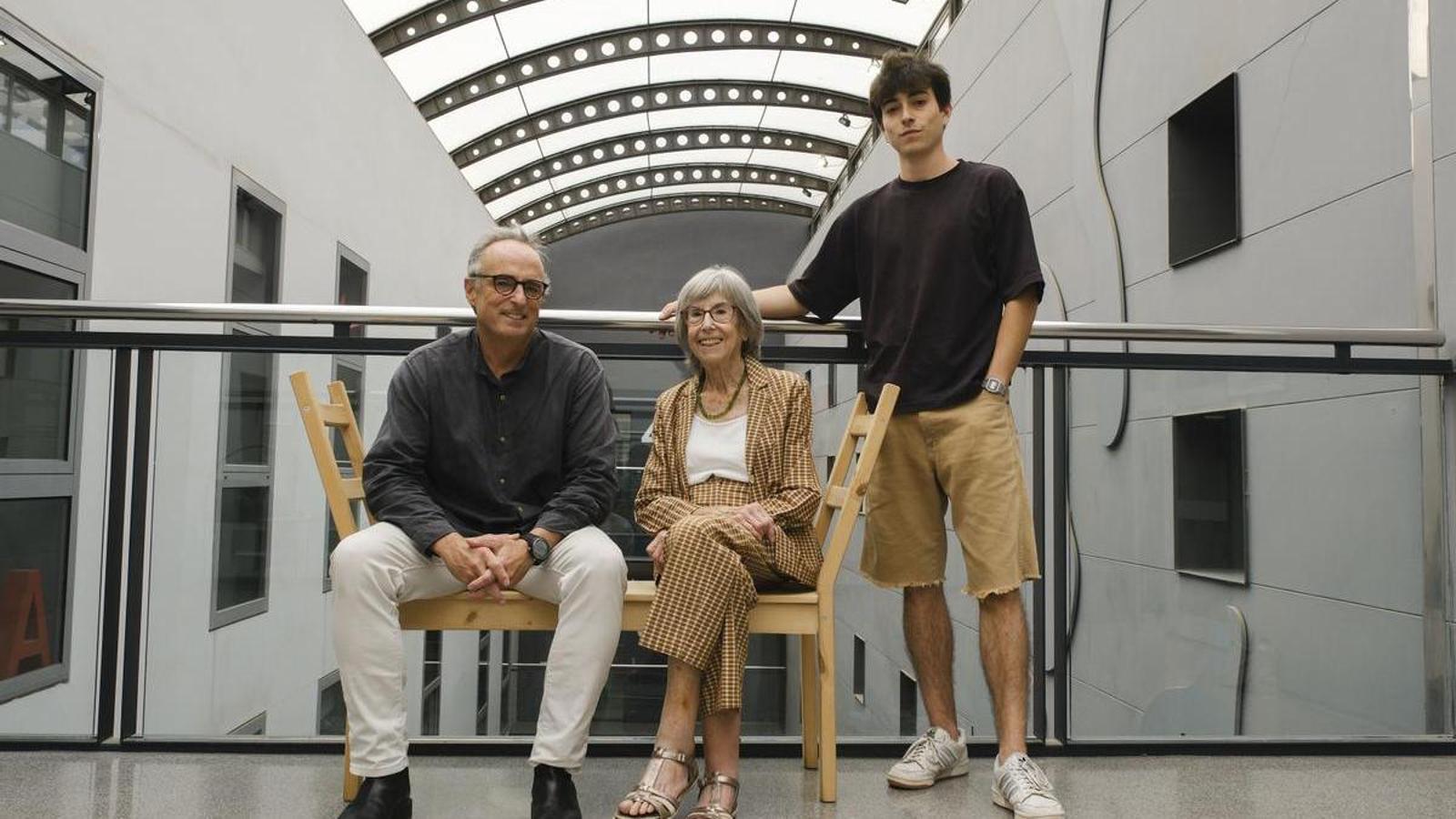
María José Alier, Joan Botey Alier and Joan Botey Durich studied at Elisava in very different contexts
-
CAT -
CAST
BarcelonaWhen María José Alier first crossed the doors of Elisava, in 1961, design was still an emerging discipline in Catalonia. The school had just been founded, the classrooms were exclusively for women, and there was only one specialization: interior design. Sixty-five years later, Elisava celebrates its anniversary as an international university center with dozens of specializations and students from all over the world. The trajectory of the Alier-Botey family allows us to explain, almost as if it were a timeline, how design has evolved over these decades.
María José Alier was part of the school's first graduating class and worked with Federico Correa and Alfonso Milà, later specializing in the restoration of Catalan farmhouses. Her son, Joan Botey Alier, studied product design in the eighties and later founded Botey Produccions, a company specializing in ephemeral spaces responsible, among other things, for the traveling exhibition on the legacy of Salvador Dalí that has visited Madrid, Brazil, Mexico, and Barcelona. The grandson, Joan Botey Durich, a graduate in 2023, represents a new generation of professionals trained in a context marked by digitalization, sustainability, and the emergence of artificial intelligence. Three generations, three historical contexts, and the same vocation: to understand design as a tool to improve people's lives.

The evolution of Elisava is also the history of the transformation of design in Catalonia. When María José Alier began her studies there, the school was a modest project. "There were seven of us girls studying interior design and fourteen studying graphic design," she recalls. The space was small, but the enthusiasm of the teaching staff made up for any shortcomings. Those first teachers, a list that is striking for including figures such as Maria Girona, Xavier Miserachs, Miguel Milà, Xavier Rubert de Ventós, Lluís Cantallops, Albert Ràfols-Casamada, Alexandre Cirici, Federico Correa, and Josep Maria Subirachs, profoundly marked the way Alier understood the profession.
Over the years, the school has grown exponentially, as has the sector. Joan Botey Alier experienced an intermediate stage, with three distinct specializations — graphic, interior, and product — and a school still of modest size. Today, however, the educational offerings have multiplied. "From the same degree, very different jobs and fields emerge, and that is very positive," explains his son, who highlights the emergence of new professional profiles linked to materials, processes, or sustainability.
The change has also occurred in references. While for María José Alier names like Federico Correa, Alfonso Milà, or José Antonio Coderch were unquestionable figures, new generations combine the great masters of Catalan design with contemporary studies and multidisciplinary creators. However, some principles have remained unaltered. "The user is at the center of everything we think," summarizes Joan Botey Alier, synthesizing a philosophy that has consolidated over recent decades.
If there is one element that symbolizes the transformation of design better than any other, it is the tools. María José Alier still keeps her Stabilo pencilswith which she used to draw perspectives by hand when she studied at Elisava. "They gave us a pencil, a ruler, a set square, and we did all the perspectives on paper," she explains. Each mistake meant starting over, and any modification involved hours of work. When Joan Botey Alier graduated, in the early nineties, computers had not yet fully entered classrooms. "I left school without having used any digital drawing program," he recalls.

Nowadays, reality is radically different: there are tools like Photoshop, InDesign, Illustrator or KeyShot, which help the designer create more realistic images of the product. Three-dimensional modeling software, hyperrealistic renders and digital simulations are part of professionals' daily lives. And recently, artificial intelligence has been added to this technological revolution. For Joan Botey Durich, AI has arrived "like a very heavy change", but it will not replace designers. "It can do very nice things, but there won't be a person behind it thinking if it's comfortable or practical", he states. Both he and his father agree that AI has become another tool for generating images, presenting projects or improving visualizations, but they insist that the designer's essential task remains analyzing needs, understanding users and transforming ideas into real objects or spaces. "Not everything is an image or a render; it must be producible, one must think about materials and sustainability", defends the young designer.
Regenerative design
Precisely, sustainability appears as one of the great challenges of the future. If for decades design focused mainly on making people's lives easier, now the profession is called upon to respond to global challenges. At Botey Produccions, this concern is already part of the creative process. Joan Botey Alier explains that they work with economical and sustainable materials to build ephemeral spaces that can be dismantled and reused without becoming waste. His son goes even further and believes that design should not only be sustainable, but also "regenerative" and especially sensitive to people and the environment.
Despite profound technological and social changes, the three generations share an optimistic view of the future of the profession. "We can always improve spaces and products so that people feel more comfortable in them," says Joan Botey Alier. The pandemic, he recalls, demonstrated the adaptability of designers, capable of reinventing themselves and creating virtual congresses when in-person fairs suddenly disappeared.
Sixty-five years after its founding, Elisava continues to be a privileged witness to the evolution of design. From T-squares and hand drawings to renders generated with artificial intelligence; from a classroom of seven students to an international community; from a single specialty to a universe of disciplines. The history of the Botey-Alier family shows that, beyond tools and trends, the essence of design remains the same: observing the world, understanding people's needs, and imagining ways to live better.
