"Just maintaining Catalan is not enough: we have to make others change their language"
The Catalan Book Week dedicates a thematic afternoon to the language with Pau Vidal and Òscar Andreu

-
CAT -
CAST
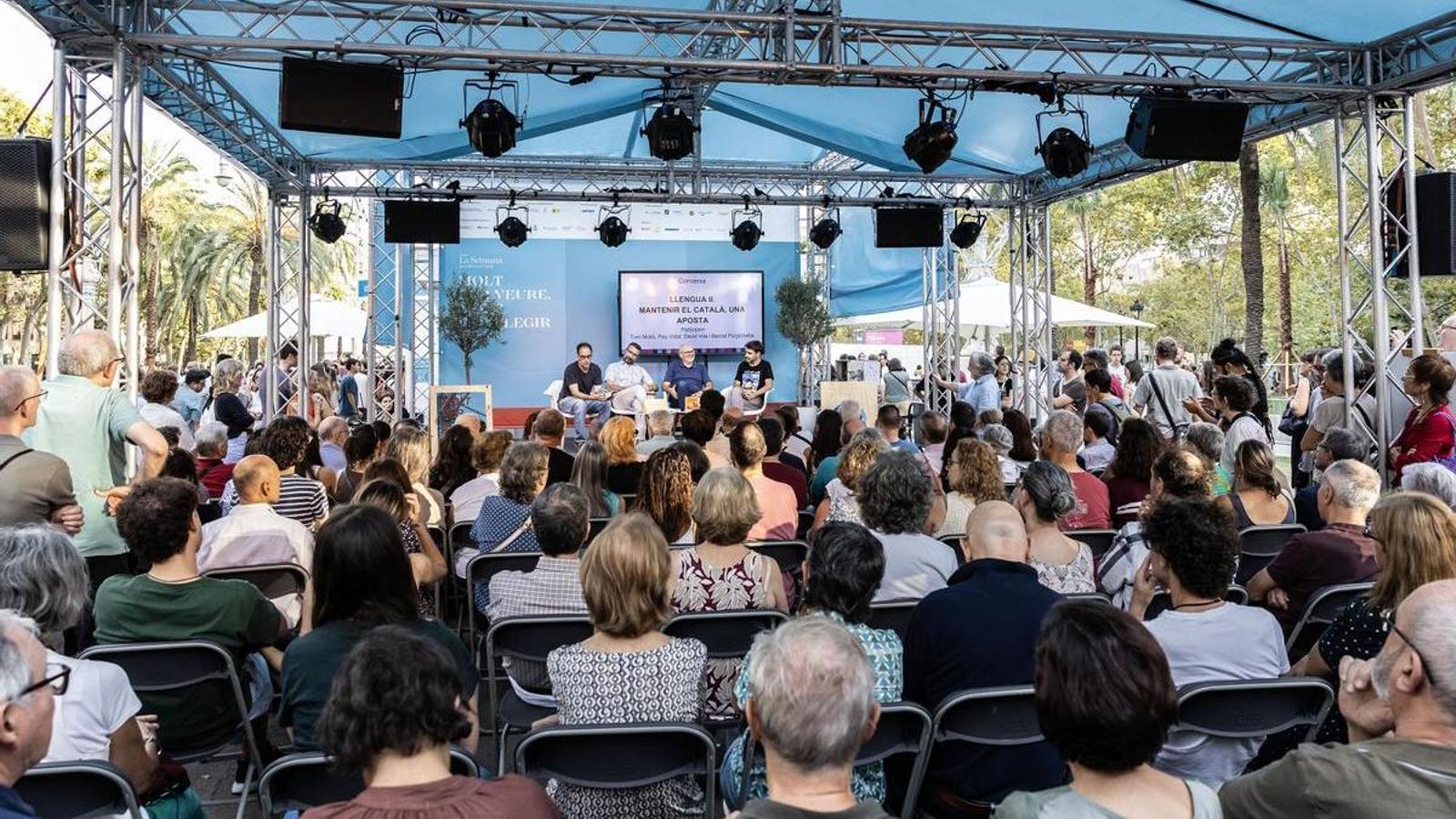
BarcelonaGranted that the Eixample is full of streets dedicated to the exploits of the soldiers of the Crown of Aragon –from Calabria to Sardinia and from Corsica to Aragon–, but if today a taxi driver is looking for Almogavars, they shouldn't head towards Razzmatazz but towards the Arc de Triomf, at the Catalan Book Week. This is what the Valencian sociolinguist Toni Mollà says, who presents The languages of tomorrow (Bromera) on a crowded afternoon of La Mercè dedicated to Catalan. "Surely those of us here are staunch Almogavars, but there are global linguistic uses that we should take into account when designing official and non-official linguistic policies," he warns. He argues that Catalan will only be a language of tomorrow if it moves out of the school and folkloric environment and adapts to what is structural: capitalism, globalization, and algorithms. This is in addition to maintaining the individual linguistic loyalty of speakers.
And this is where the teacher and popularizer David Vila comes in with The language and you (Voliana), a manual of linguistic solfeggio that aims to raise awareness and help speakers to "maintain the language without feeling uncomfortable," something that, he says, still seems like an "implausible" milestone to many.
A step further
The one who seems uncomfortable on stage is the writer and linguist Pau Vidal, who has more drastic and transformative proposals for Go out to win (VilaWeb Books). "For years and years books have been coming out explaining the same thing and I would like us to take a step further. Speaking one's own language is what is normal, or should be. But maintaining Catalan is not enough: we must make others make the change, let it be them who feel uncomfortable because they have been here for 4 or 40 years and do not speak Catalan. If we only maintain ourselves it means we are retreating: that is why when we look at the figures we get depressed," he states. An ambulance goes by on the Lluís Companys promenade.
In his book, Pau Vidal ironically sketches eleven profiles of half-hearted Catalan speakers and then launches at them Guardiola's motivational speech before the Rome Champions League final: "Once and for all, we must go out onto the pitch with a winner's mentality. Most of us have lost the notion that this match can be won, and that is why we wait to be pelted with stones, spat at, and insulted before we give up. We do not take the initiative. Now that we are in a linguistic and political survival war, and we are losing by a lot, we either go out to attack or we shut up shop." For him, shooting at goal means creating new Catalan speakers. How? A trick he uses is the mirror technique; that is, moving from the I maintain to the "I don't understand you".

The last author of the thematic afternoon is Òscar Andreu, who since Sant Jordi has become the Amma of the language. Since his Manual for the defense of Catalan (Univers) is a version of a monologue, the jokes are well-greased and the speech flows smoothly and forcefully, with the help of Elisenda Pineda. "If we treat Catalan like a gram of cocaine at the nightclub at four in the morning, if we hide it from everyone, why should those who don't speak it buy into it?", he asks. And furthermore: "We won't seduce others by renouncing who we are. Being strong and solid is the way to seduce". It is likely that if he founded a political party, or a religion, he would have followers, judging by the applause: "A country that renounces its language renounces the essence of the country, the fundamental part of its identity. They are shooting at this identity because they are shooting against sovereignty", he proclaims. And it is quite a feat, having the seat of the High Court of Justice of Catalonia nearby, "of Catalonia just to pretend", he says.
Òscar Andreu is not satisfied with having the audience in his pocket and finishes with a little detail for the organizers: "Isn't it strange to hold a Catalan Book Week... in Catalonia?", he drops, sarcastically. If we go by the sales lists, for him it is turning out to be a Week that will last all year.
