Zelensky attacks Russian oil by attacking Moscow's largest refinery
Ukraine launches the most massive bombing of the war on the capital, the second on the plant in three days

-
CAT -
CAST
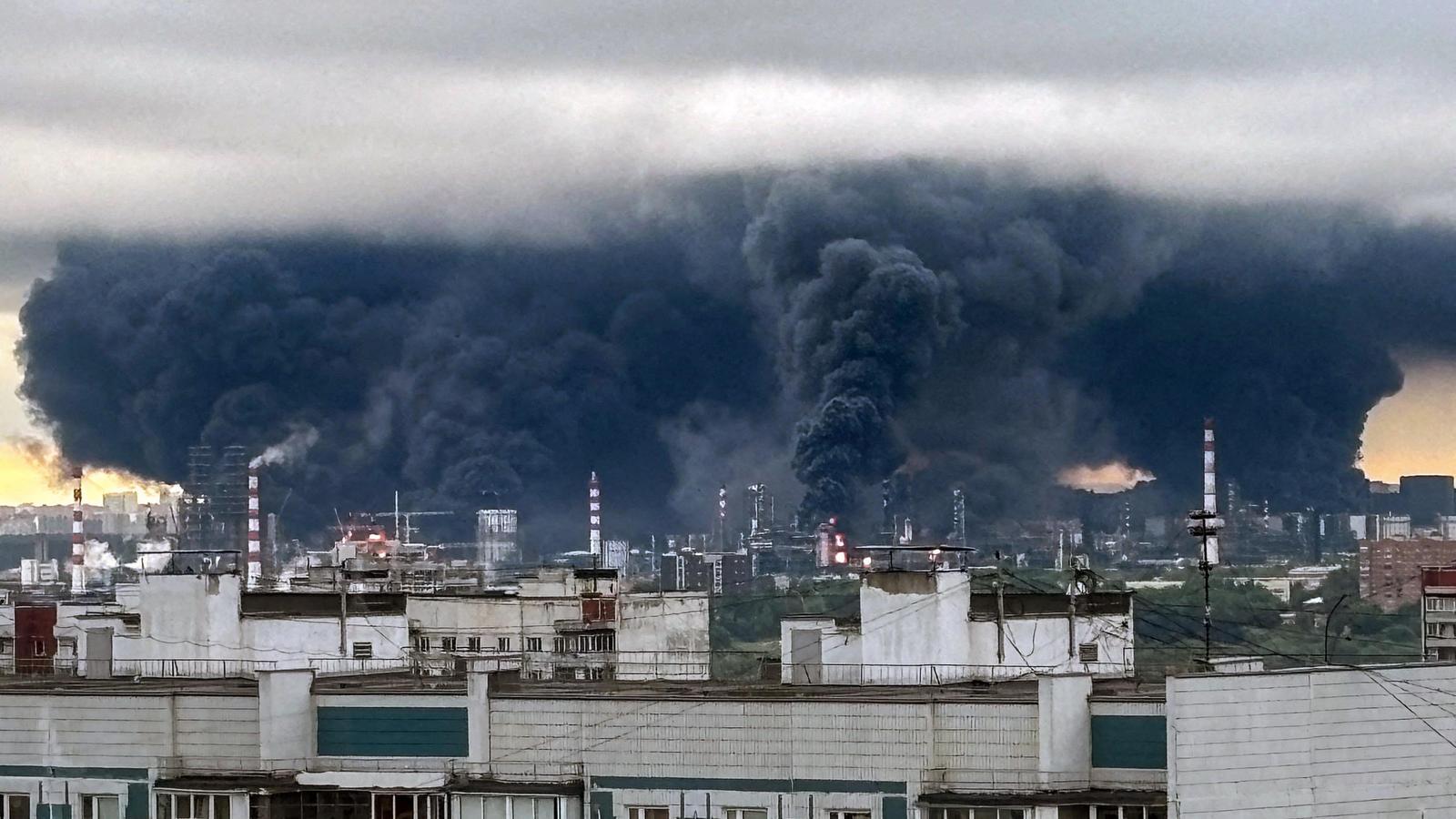
MoscowThe impact of a drone against the Kapotnya refinery, about 15 kilometers south of central Moscow, caused an explosion this Thursday that blew the roof off the plant. The striking moment, captured on video by dozens of residents, testifies to Ukraine's most massive attack on the Russian capital since the war began. In total, 555 aircraft flew towards Russian territory, of which 194 headed for the city. The bombing caused 17 injuries and once again highlighted the vulnerabilities of Russian air defenses and further aggravated the fuel crisis the country is going through.
It has been the third consecutive night of attacks against Moscow. On Tuesday, Kyiv's drones had already hit the same oil facility, but the damage this Thursday has been much greater. While usually between one and three aircraft manage to crash into their targets, at the Kapotnya plant at least seven have exploded. This is the region's most important refinery, covering more than a third of the capital's fuel needs. The authorities had reinforced the defense systems around the industrial complex, but it was not enough to thwart the bombing, which also forced Red Square to be sealed off and operations at all Moscow airports to be halted.
"If Ukraine burns, your Moscow will also burn," said Volodymyr Zelenskyy. The ferocity towards this refinery is not accidental. According to the economic newspaper The Bell, 53 Russian regions are suffering from fuel shortages. In fact, on the night of Wednesday to Thursday, drones also set fire to an oil depot in Rostov, southern Russia, where they killed one person and injured two more. It is estimated that, in total, the country has lost between 20% and 30% of its refining capacity due to Ukrainian attacks.
Although authorities deny a supply crisis, to confront it the Kremlin will begin to import gasoline from Asia, according to Reuters. It is not at all common for gasoline to arrive in Russia by sea, and experts warn that it will not solve the problem and can only work as a temporary patch because it involves many logistical difficulties and high costs. Among other measures taken by the Russian government are prohibiting producers from exporting gasoline until the end of July or allowing the use of fuel with excess sulfur. This type of fuel does not meet the minimum mandatory quality standards, can damage vehicle engines, and is more polluting.
Russia runs out of extra income
It is also no coincidence that the escalation in bombings against the Russian oil sector is occurring at a time when everything points to Putin ceasing to benefit from high crude oil prices due to the war in the Middle East. If at the height of the confrontation between the United States, Israel, and Iran, Russian benchmark oil sold for $124 a barrel, it has now fallen to $64, not far from the $56 it was at before the conflict. The Kremlin has enjoyed three months of extra revenue. Unexpected profits that have been insufficient to alleviate the enormous deficit of the Russian administration, but which have given air to state finances and have allowed measures that had caused alarm among businessmen, such as a VAT increase, to be avoided.
Moscow has also taken advantage of the temporary lifting of American sanctions to sell its stranded oil at sea. This exemption expired on Wednesday and, after the G-7 summit, at which Donald Trump pointed out that restrictions on Russian crude could be reimposed "soon" with the reopening of the Strait of Hormuz, it seems unlikely that the White House will decide to extend it.
