What do the Houthi of Yemen want and what does their entry into the war imply?
The Shiite movement calculates its moves and attacks Israel but not the Bab el-Mandeb strait, the gateway to the Red Sea

-
CAT -
CAST
BarcelonaYemen's Houthis have taken a month to come out in defense of their ally, Iran, in a key week of the United States and Israel war. The Shiite militia has entered the war cautiously: it has attacked Israel, but not US bases, nor Saudi refineries, nor the Bab el-Mandeb Strait, between Yemen and the Horn of Africa, which gives access to the Red Sea. A closure of this passage, while Iran blocks the passage of commercial ships through the Strait of Hormuz in the Arabian Sea, would further strangle the global economy. The Houthis have warned that, if necessary, they are willing to play this card, and just the threat has already caused many ships to turn back.

- If you want to see the map in more detail, open the high-resolution version in another tab.
“The Houthis are calculating their moves”, Leyla Hamad, a researcher at the Center for Arab Studies and a specialist in Yemen, a country where she lived for five years, explains to l’ARA. “The United States is deciding whether to launch a ground intervention, and now is the time when the Houthis can show their strength. They also justify themselves to their bases after a month of silence, and at the same time, they send a message to Saudi Arabia, which knows very well what they are capable of,” she adds. The Houthis can play the strategic advantage that geography gives them, but they risk receiving a rain of American bombs.
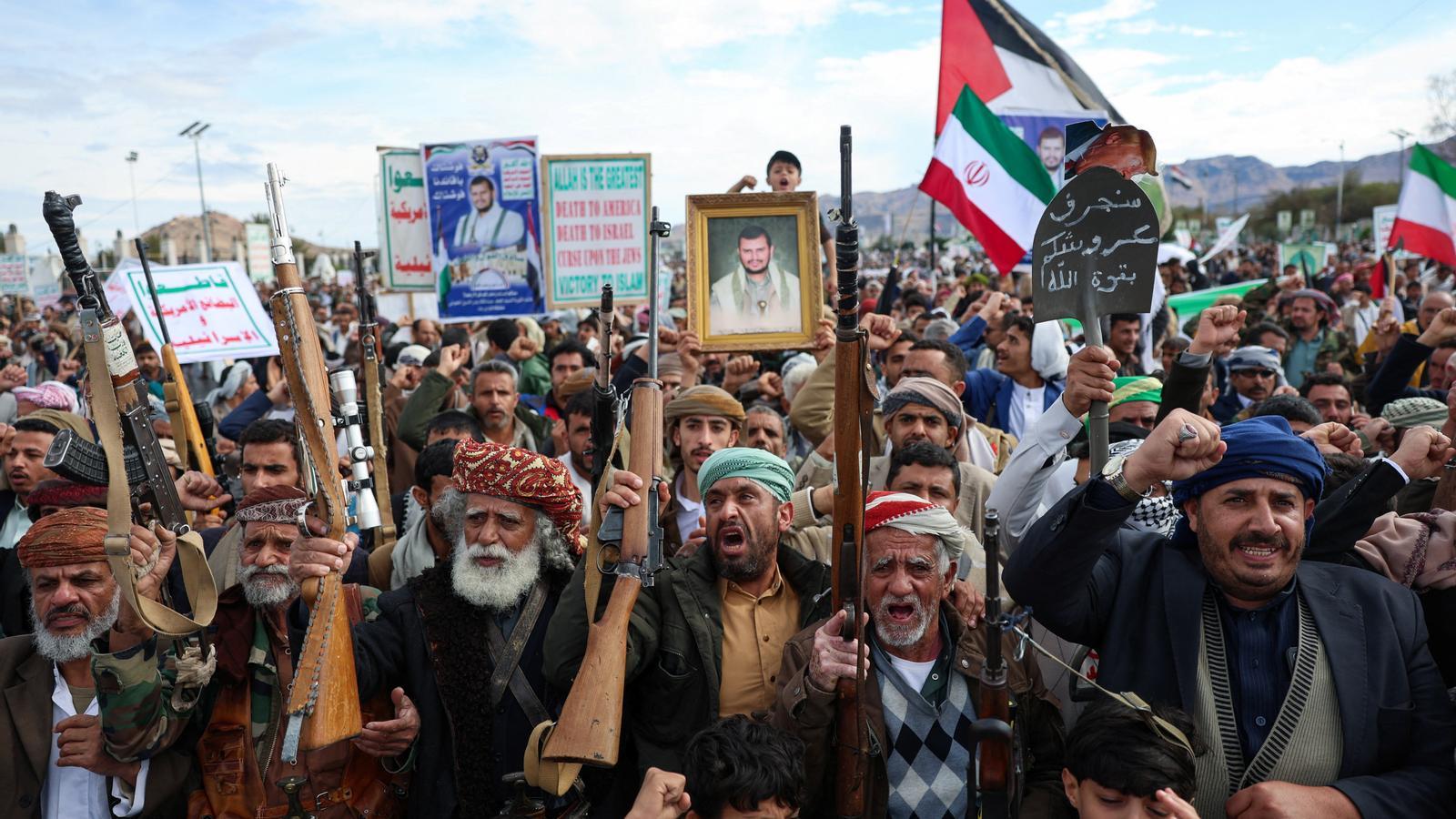
This Shiite movement, which shares the slogan “Death to America and Death to Israel” with Iran, controls large areas of Yemen since 2014, including its capital, Sanaa, and most of the country’s population. Yemen has been immersed in a civil war since 2014, after the failed revolutions of the turn of the decade. The movement entered into war against Israel in October 2023, in solidarity with the Palestinians of the Gaza Strip, and attacked ships in Bab el-Mandeb as a pressure tactic. The result was that the major shipping companies, instead of following the usual route through the Red Sea towards the Suez Canal, which connects to the Mediterranean, had to take a huge detour, going all the way around the African continent to reach Europe, with the consequent increase in costs.
Closing the Bab el-Mandeb strait, with drones, missiles, and speedboats, cost the Houthis and Yemenis an eight-week campaign of American bombings that had devastating effects on the country and also on their missile launch capability. In May 2025, with the mediation of the neighboring Sultanate of Oman, the Houthis signed a ceasefire with Donald Trump and stopped attacks against American vessels. Four months later, Israel killed the Prime Minister, the Chief of Staff, and several Yemeni ministers in a single attack, but not the leader of the movement, Abdul-Malik al-Houthi. Last October, they extended the ceasefire to Israel, after Hamas accepted the truce sponsored by Donald Trump in Gaza. Nevertheless, major shipping companies like Maersk had barely begun to transit through the Red Sea.
Hamad believes that the Houthi movement is calculated: “They have only attacked Israel and not the Red Sea because this way they send the signal that they are in a position to create problems in the strait, and at the same time they have chosen a target that is internally uncontroversial, because everyone sees that Israel is doing in Lebanon the same thing it had done in Gaza”. Exposing oneself to lose everything just to defend Iran “would not have the same support even among the bases, much more in favor of defending Gaza and southern Lebanon than Iran,” the analyst points out.
Military autonomy
Yemen's Houthis received weapons and training from Iran, but it would be a mistake to see them solely as Teheran's puppets. According to the UN group of experts, they can find alternative arms supply routes and also have the capacity to assemble components to manufacture missiles and drones within their territory. Their pragmatism is demonstrated by the fact that, although they are the strongest militia in the so-called "axis of resistance" sponsored by Teheran, they took a month to intervene, and they did so with a limited objective and a warning. "If they definitively align with Iran, they lose the possibility of achieving peace with Saudi Arabia, and this involves the decision to close Bab el-Mendeb. And they know they face an existential threat, in a country where the population is exhausted after twelve years of war," warns Hamad, who recalls that "the Houthis have a great tolerance for suffering and, when cornered, instead of retreating, they tend to escalate."
The Houthis are also acting cautiously because they have a lot to lose. Saudi Arabia has long been trying to end the internal conflict in Yemen that threatens its interests. In 2023, before Israel launched its genocidal operation on Gaza, Riyadh facilitated an agreement between the various warring factions in the country, but the Houthis' move in support of the Palestinians and the escalation in the Red Sea left the process stalled. As Hans Grundberg, the UN special envoy for Yemen, warns, “this escalation threatens to drag Yemen into a regional war that will make resolving its internal conflict more difficult, deepen economic repercussions, and prolong the suffering of civilians”.
