War on 'standby' in the Gulf: "You see that ship? It's a secret American mission"
Awaiting the outcome of negotiations, Arab monarchies rethink their model hit by Iranian missiles

-
CAT -
CAST
Special envoy to Fujairah (United Arab Emirates)Missiles test advertising logic, and the slogan of the grand Al Bahar hotel did not account for the Third Gulf War: "Enjoy a perfect combination of luxury and serenity".
Missiles, Donald Trump, and the whims of geostrategy have left the five-star resort in a delicate position: on the very front line of Fujairah beach, one of the cities in the United Arab Emirates most affected by the Ayatollah's fire. The owners have had to opt for another slogan, less poetic, more direct. “Great offer. 25% off all rooms”.
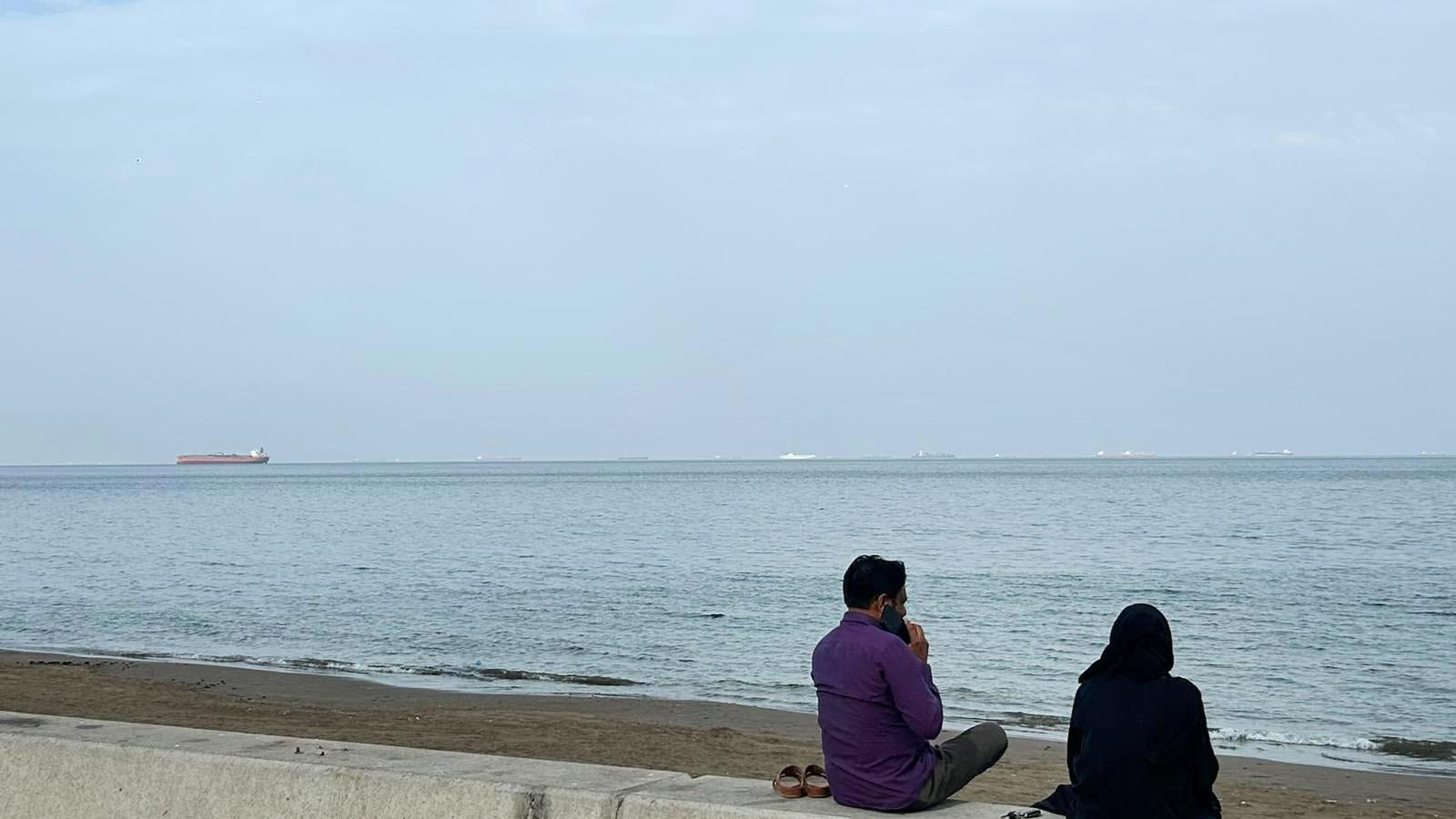
From the hotel pool, there are now immediate views of the war. A man with inside information helps me interpret the landscape.
On the horizon, dozens of boats can be seen anchored in the waters of the Gulf of Oman. On the other side is Iran. Also on the other side, a little further east, is Pakistan, where Washington and Tehran are trying to reach an agreement. A military helicopter flies over the area. Crows – the UAE's symbol is the falcon, but desert crows are abundant – caw to answer the mechanical roar.
—Is the helicopter Iranian?
—No, it's ours, from the Emirates. It scans the sea and sky to monitor enemy movements.
—But there's a truce now, isn't there?
—Yes, but we have to be prepared… they attacked us anyway hours after the agreement was confirmed.
—And all these boats?
—Many are oil tankers. Some come to our port. Others are waiting for the reopening of Hormuz. Look, do you see that boat? It's a secret American mission. They are US soldiers.
The vessel appears civilian, but it's a military radar ship. It detects threats and sends information to neutralize them. The man requests anonymity. The man has worked these days with the US Marines, part of the special deployment the Pentagon has sent to the Middle East.
The war is on standby, but the war continues deployed, prepared.
Trump has decided to keep troops despite the temporary ceasefire. Warships like these are scattered across the region. "We are reloading our ships with the best ammunition in case negotiations fail and the war continues," Trump said on Friday. But if the talks work and the war ends, perhaps they will travel to other seas. "They are now preparing and resting, awaiting their next conquest." This last sentence is also from Trump. It is once again a time of jitters for Washington's soldiers.
The temporary truce agreed upon by the United States and Iran on Tuesday night was born trembling, but it survives. Despite cross-threats, fingers on the trigger, the semi-paralysis of Hormuz, and Netanyahu's siege of Lebanon, Americans and Iranians have faced each other in Islamabad. The meeting began on Saturday with optimism and ended on Sunday with pessimism: the men from the White House withdrew from negotiations due to a lack of agreement.
A father of a family sitting on the Fujairah promenade takes a more practical view: "Take advantage of it. Today there is peace again, tomorrow we don't know." His children are playing ball. The goal is an oyster-shaped bench. We also don't know what people on the other side of the sea are saying. A thousand hours have passed since the ayatollahs' regime disconnected Iranians from the world with a fierce internet shutdown. It is estimated that American and Israeli bombs have killed at least 3,000 people in Iran."What do you think of the Iranians?
"I have lived here for years, but I am from Syria. What am I supposed to think? No matter how much you think, the world is sometimes too complicated to understand.
"What don't you understand?
"This war. Why have they attacked us? Why did Trump attack Iran?
"Will the ceasefire hold?
"What I think has no importance or effect.
There are ten days left to find a definitive solution to the war. What happens until the deadline is an unknown path even for the Pentagon. The question is the same as in all wars: When will the war end?
Fight until you retreat
The city of Fujairah is strategic and the war has made it appreciate.
For Abu Dhabi, it is the only emirate located on the coast of the Gulf of Oman and not the Persian. Geopolitical translation: it allows it direct access to the Indian Ocean without having to pass through the Strait of Hormuz. From its port, one of the most important in the Gulf, the government of the Emirates can export oil and gas avoiding the sensitive Hormuz, now under Tehran's control. In recent weeks, the ayatollahs have strategically struck these facilities with rage. The economic and energy impact of the war has been the philosopher's stone for the Iranian regime to pressure Washington.
On the road to the port, the car's GPS gets disoriented. Lapses in navigation applications are common in war zones. Armies use jamming systems to confuse enemy drones and missiles. On both sides of the highway, gas and oil depots dominate the landscape.
The blue cursor on the map virtually places me at the door of a beastly business: Fujariah Bull Fighting. Click. It is a tourist farm where they exhibit bullfights. The fight is traditional: the two animals face each other and clash heads and horns, one trying to make the other retreat. As in wars, the one who makes the opponent retreat the most wins.Seventy-two hours earlier, Iranian drones had hit depots in this area. The attack came with the truce already begun. The scene at the port entrance is now one of normality: trucks entering and leaving, workers entering and leaving, stray dogs dodging buses carrying more workers. All the workers are immigrants: coming mostly from India, Pakistan, Bangladesh, the Philippines, Ethiopia. They earn about 500 euros a month. They are the first layer of the Emirates' economy, where only 10% of the population is local.

“There have been attacks every day. The last day they attacked three times behind these mountains”, the Nepali worker at a gas station tells me.
—And you worked as usual?
— We had to come.
—And you weren't scared?
— Of course. But we had to come. Otherwise, they could have fired us.
— Do you have videos of the bombings?
— No. And if there are more attacks, don't do it. They could arrest me, sir.
The Emirati monarchy doesn't want videos, but it does want flags. These days it has asked the population to display the country's colors. The surprising effectiveness of the anti-aircraft defense system – with an interception rate that has surpassed the famous Israeli Iron Dome – is a cause for global pride.
The Emirati monarchy has also sent a global message: “With the confidence of one who has overcome a treacherous aggression, we will precisely read about our regional and international relations and determine whom we can trust.” The Emirates have been the country most attacked by Tehran. Gulf governments are also not happy with Washington: they pressured until the end to prevent Trump from launching the war. They feared that, as has happened, the bombs would shake their economies and their ability to attract foreign investors and tourists.
The question is the same as in all crises: How long will the recovery take?
Tehran Restaurant
Irreversible changes of mentality are occurring in the Gulf. The Middle East, like the world, is being reshaped. Trump is the accelerator.“Iranian missiles have hit the three fundamental pillars on which the region’s political and economic model was based: energy, logistics, and global connectivity,” states Iranian analyst Mehran Haghirian, an expert on the Persian Gulf and director of the Bourse & Bazaar Foundation. The expert makes a three-act diagnosis.

The first: “The security model has become obsolete. For years, the region relied on a combination of deterrence, protection from the US, and managed tension with Iran. All of that has gone up in smoke.” The second: “There will be a crisis of reliability with the US. But the dependence is too great, and Washington is an irreplaceable ally. We will have to explore other alliances and invest in our own resilience measures.” The third: “The model of coexistence by necessity with Iran has exploded. But the detonation must be controlled: they will always be neighbors across the sea and can emerge strengthened from the war.”
On Friday night -the first without missile threats for a month- one could dine in restaurants across the sea in Dubai.
Exquisite Persian cuisine abounds in the capital of luxury. High-net-worth Iranians also abound, living more peacefully far from the ayatollahs. In the five difficult weeks of war, the Emirates have restricted the entry of Iranians into the country, frozen assets of companies linked to Tehran, and withdrawn licenses from Persian schools. Abu Dhabi expects these to be temporary measures, like the war.
The Berenjak restaurant was quite empty, but it didn't seem like any geopolitical reaction: tourists are still afraid to return to the city, and the city breathes sadly. The waiter, who was Indian and not Iranian, brought the menu. The slogan he had printed had also not foreseen the third Gulf War:
“We transport you to the streets of Tehran”.

