The ceasefire survives but trembles because of Hormuz and Netanyahu
Maritime traffic continues almost paralyzed and Washington and Tehran, who will face each other on Saturday, exchange threats

-
CAT -
CAST
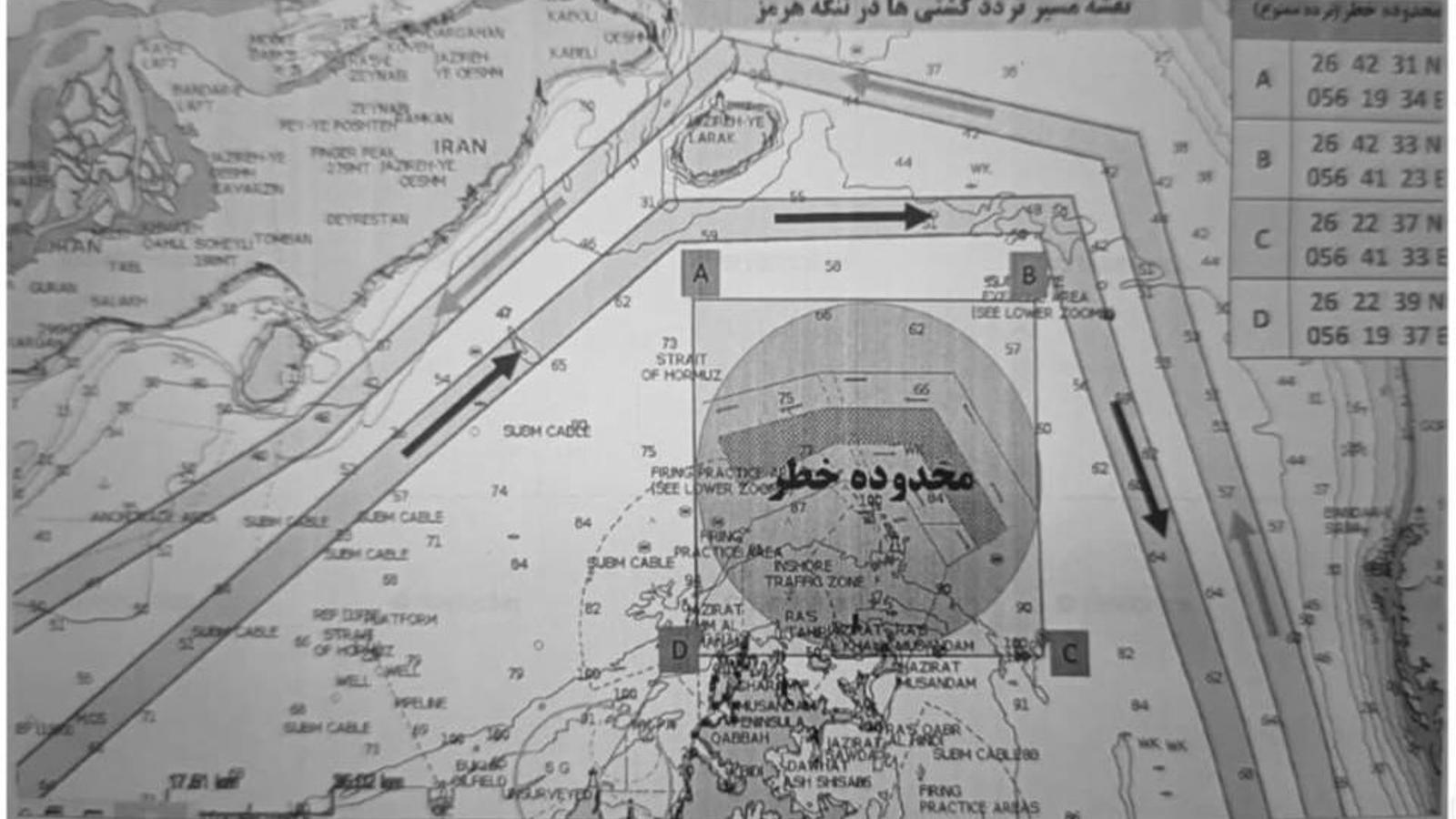
Special correspondent to Dubai (United Arab Emirates)The navy of the ayatollah regime was disseminating on Thursday a map from another era: on paper, and in black and white. According to the Iranian agency ISNA, the document shows the approximate location of naval mines that the Revolutionary Guard has installed in the precious waters of the Strait of Hormuz during five weeks of war. The paper recommends alternative routes to oil tankers and other commercial vessels to safely cross the passage, avoiding the bombs.
The alternative is worse: any ship that crosses Hormuz without permission "will be destroyed",The alternative is worse: any ship that crosses Hormuz without permission "will be destroyed", warned the ayatollahs, who feel like winners of the war. The threat has not pleased Washington.
The figures are revealing. Only one oil tanker and five bulk cargo ships have crossed Hormuz in the last 24 hours. Before February 28, the night the war began, about 140 ships crossed the strait daily, vital for the entire global economy to function.who he convinced to set fire to the Middle East in a meeting at the White HouseThe fragile ceasefire agreement survives, but it is trembling. It is trembling a lot. Although Washington and Tehran seem to be presenting themselves on Saturday in Islamabad to face each other and negotiate about the future of the war, on Thursday the threats of bombing each other again have continued.
"We have our finger on the trigger," said Iran's president, Masoud Pezeshkian, on X, referring to Tel Aviv's siege against Beirut and other Lebanese towns. "The new attack by the Zionist regime on Lebanon is a flagrant violation of the initial truce agreement. It is a dangerous sign of deception and lack of adherence to potential agreements. The continuation of these actions will render the negotiation insignificant," the leader assured.
"We will start a bigger, better, and stronger battle than ever before," Trump threatened in the early morning. The president has decided to maintain the deployment of soldiers in the Middle East until the "real agreement" of a ceasefire with Tehran "is fully respected." He will attack with more virulence if Tehran does not respect the reopening of Hormuz. In the same message on Truth Social – the official platform for war threats – the Republican added a disturbing note: In Cuba and Greenland, the note should be read with some vertigo.
In Cuba and Greenland the note should be read with a certain dizziness.
whom he convinced to set the Middle East ablaze in a meeting at the White House.
But Washington can also pressure Tel Aviv - the strength of the latter depends on the former - and an announcement surprised in the mid-afternoon: Israel will begin talks with Lebanon to achieve the disarmament of Hezbollah, but also to "establish peaceful relations." The first meeting between the neighboring countries will be at the State Department of the United States, which would have sponsored the negotiation.
The petromonarchies, astonished
The other focus of instability during the early hours of the truce were Tehran's attacks on the Gulf countries. Despite the pact with Trump, the ayatollahs repeated on Wednesday what they have been doing every day since February 28: sending missiles and drones against the cities on the other side of the sea. On Thursday, the panorama changed slightly. The United Arab Emirates, the most attacked country in the region by Iranian bombs, emphasized on social media that, for the first time in five weeks, its impeccable air defenses had not had to be activated to intercept any enemy missiles or drones. But in Saudi Arabia and Bahrain, attacks on critical infrastructure were registered. It will be important to follow the evolution of this front in the coming hours.
None of the petromonarchies wanted this war, and they made it known to the White House, until the last moment. And with the war supposedly on standby, the confusion about the horizon ahead has not disappeared. Among the Arab kingdoms of the Persian Gulf, two questions abound. The first: why is the strait not completely open if that was the condition of the truce? The second, more worrying: does Trump's pact mean that Iran will act as if the passage, through which 25% of the world's oil and 20% of liquefied gas pass, were its own?
The petromonarchies fear that Trump is now only prioritizing escaping a war that has never gone as calculated from Washington. In this scenario, the interests of the North American allies in the region, punished from the first day by Tehran, do not seem to have entered into the calculations of the Republican. An Iranian control of Hormuz leaves the Gulf capitals under the constant threat of disturbances and economic blackmail by the ayatollahs. An Iranian control of Hormuz leaves the Gulf capitals under the constant threat of disturbances and economic blackmail by the ayatollahs.
There is a third question that also worries the region and that should sound familiar to us Europeans: has the United States stopped being a reliable partner? Its security depends, in large part, on Washington's friends. Trump has disrupted the codes of friendship and traditional alliances. Some kingdoms have begun to look for alternatives.
The Middle East, like the world, is being reshaped.
