Both the United States and Iran proclaim themselves winners of the war with a fragile ceasefire
Israel endangers the truce with bombings in Lebanon and Trump now denies that the Arab country was included in the agreement reached with the ayatollahs

-
CAT -
CAST
WashingtonFinally, the destruction of Iran promised by Donald Trump has not been carried out by the US president nor suffered by the Persian country. Washington and Tehran raise a fragile truce in the air as a war trophy, with Israeli bombs over Lebanon as a backdrop. The ayatollahs proclaim the beginning of "the era of Iran", after having survived one more day the offensive of the "great Satan". Trump proclaims the advent of "the golden age of the Middle East" and already speaks of peace, despite Tel Aviv endangering the incipient ceasefire. Benjamin Netanyahu has continued attacking southern Lebanon against the demands of the Iranians in the pact mediated by Pakistan. Iran, which has never been in a hurry to end the conflict, this Wednesday has already tested the agreement and said it was keeping the Strait of Hormuz closed.
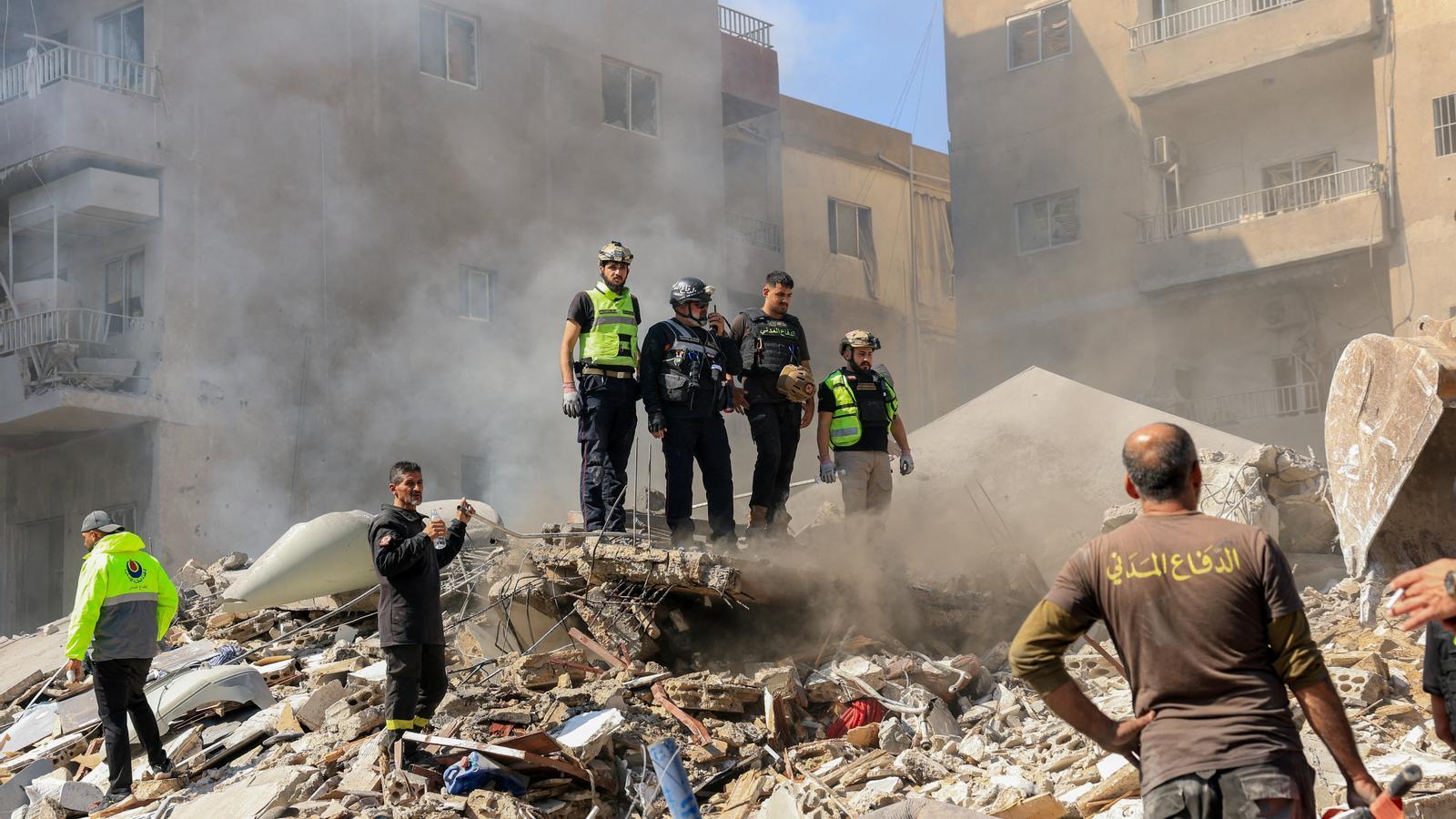
Washington's credibility, erodedNetanyahu, who dragged Trump into Iran's mud, once again makes the divergences of interests with his partner evident. All the statements and postulates coming from the White House are in line with preparing an exit from the conflict, but the hundred Israeli bombs that have fallen in 10 minutes on Lebanon point in another direction. The US president once again takes refuge in ambiguity and now says that Lebanon was not one of the points of the plan, contradicting the version of Pakistan, the mediating country. "Because of Hezbollah, they have not been included in the agreement," Trump told public radio and television PBS this Wednesday. "This will also be resolved," he insisted.
Iran's Foreign Minister Seyed Abbas Araghchi responded via X to the tycoon and shared the publication of Pakistani Prime Minister Shehbaz Sharif, in which he clearly cited Lebanon as part of the proposal. "The terms of the ceasefire between Iran and the U.S. are clear and explicit. The United States must choose: ceasefire or continuation of the war through Israel. You cannot have both," he wrote. Araghchi assures that Trump has "the ball in his court" and the world "is watching" whether he will keep his word. Despite the new clashes between Tehran and Washington, the first meeting of both delegations remains scheduled. White House spokeswoman Karoline Leavitt has confirmed that talks will begin in Islamabad on Saturday morning. The American delegation will be led by Vice President J.D. Vance and will include the participation of special envoy Steve Witkoff and advisor Jared Kushner.
Lebanon is not the only place where Trumpian peace seems not to have arrived. Despite the agreement, the Persian Gulf countries – including Kuwait, the United Arab Emirates, Qatar, and Israel – have continued to register missile and drone attacks. It is not clear whether this is a violation of the pause by Iran or if the information had not yet arrived through the chain of command to the rest of the Iranian forces, which have been acting in a decentralized manner for weeks in response to the strategy of the United States and Israel to eliminate central command. Beyond the army, the ayatollahs' regime also has the Revolutionary Guard, which acts as a separate body.
Iranian media have also reported that an oil refinery in Lavan, an Iranian island in the Persian Gulf, had been attacked by unspecified “enemies.” Sharif stated in a social media post that ceasefire violations had been registered in “some points in the conflict zone,” a fact that further undermines the credibility of the diplomatic process. Sharif has urged all parties to “exercise restraint.”
Washington's credibility, eroded
Trump, who has agreed to sit down and negotiate based on the 10-point plan presented by Iran, insists on selling the negotiation as a US victory. In another sensational turn amid the war, the US president stated in a publication this Wednesday that the United States "will work closely with Iran," when just a few weeks ago he was demanding "unconditional surrender." In this same post on Truth Social, the president assures that "there will be no uranium enrichment" and that the US "working with Iran, will excavate and remove all the nuclear "dust" "deeply buried" in the nuclear facilities that Washington bombed last year with the B-2s.
Defense Secretary Pete Hegseth has continued with the official discourse and has presented the war against Iran as a "historic success" for Washington, in a press conference this Wednesday. Both Trump and Hegseth insist on the idea of a regime change that the United States and Israel would have forced with their bombings.
Trump's sudden change of opinion yesterday came after he had threatened Iran with war crimes on Tuesday morning. A glance at the president's Truth Social profile showed the shift in opinion: from the publication where he promised that "an entire civilization will die tonight" to the announcement of a ceasefire. The serious rhetorical escalation against the Iranians, in which he de facto raised the possibility of perpetrating genocide, had caused Tehran to cut off all diplomatic communications with Washington. The US president had been threatening for the past few days with attacks on civilian infrastructure such as bridges, power plants, and even desalination plants in the country. In fact, both Americans and Israelis had intensified attacks on bridges and railway lines on Tuesday.
What happened early this morning is not Trump's first U-turn amid the military campaign with Iran. But it is the most drastic and sensitive. The shift calls into question the credibility of the president's threats. With the same lack of specificity with which he justified the start of the war, the president is now trying to sell its end. In the publication in which he announced the ceasefire, the leader says he has "reached and surpassed all military objectives." An abstract goal that has never been specified. Before announcing the pact, images circulated of a peak in orders at pizzerias near the Pentagon. It is said that every time the army is about to attack or is in a crisis situation, orders in that area skyrocket. Perhaps on this occasion the reason was the anticipation of a long night preparing a more detailed list of the military objectives achieved that Hegseth and Caine have defended at today's press conference.
Meanwhile, the figure the White House clings to to claim victory is that the promised deadlines have been met. "From the very beginning of Operation Epic Fury, President Trump estimated it would last between 4 and 6 weeks. Thanks to the incredible capabilities of our soldiers, we have reached —and even surpassed— our main military objectives in 38 days," says Leavitt. The US administration is once again doing with Iran what it did with Gaza: selling a ceasefire as the end of the war.
