Russia changes rockets for missiles and falls from the space race
Sanctions and lack of funding are a drag on Russian cosmonautics, unable to travel to the Moon

-
CAT -
CAST
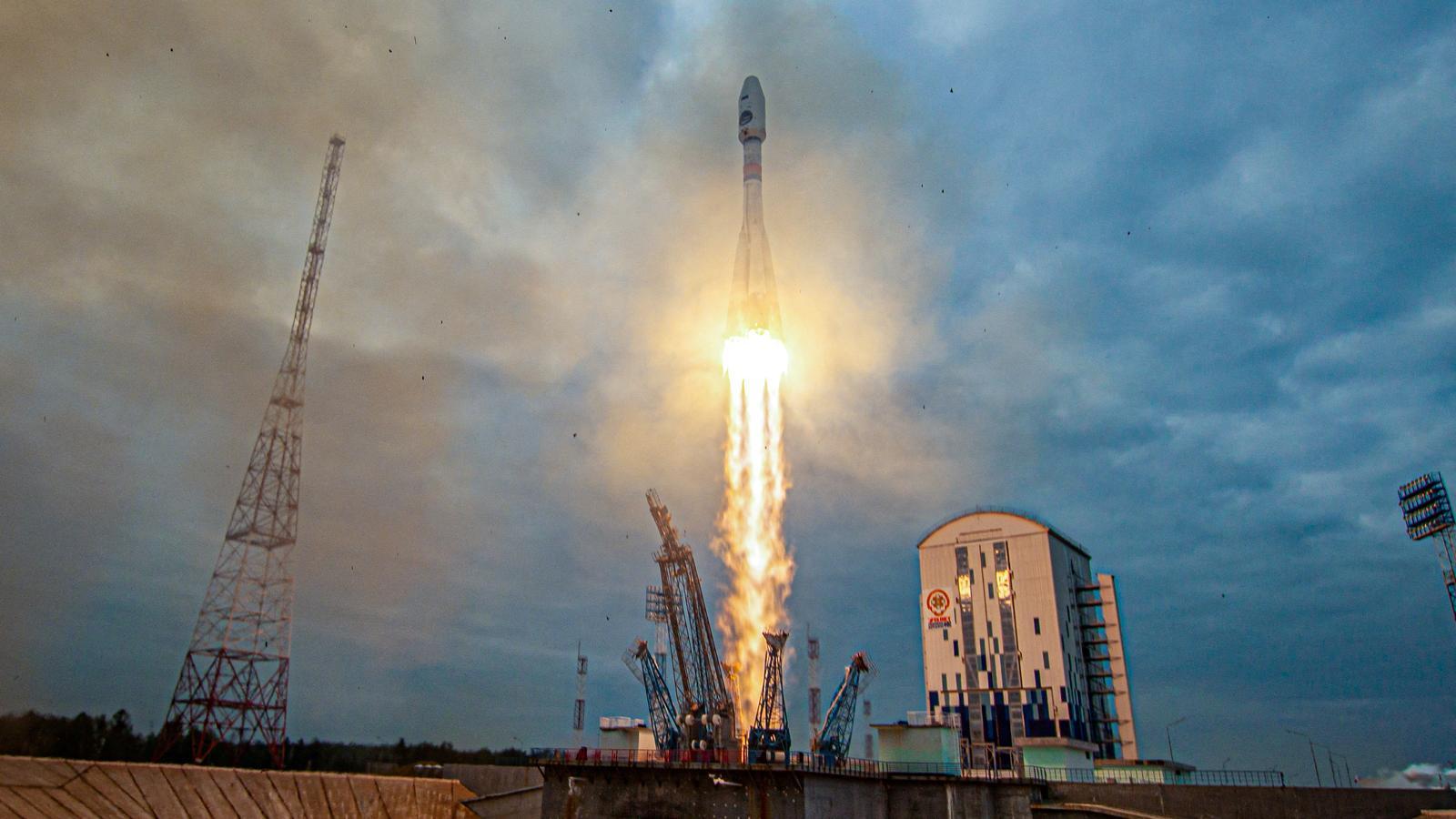
MoscowAugust 10, 2023. 2:10 AM, Moscow time. The Luna-25 mission launches from the Vostochny Cosmodrome in the Russian Far East. For the first time in 47 years, Russia is launching an unmanned lunar mission, which aims to touch down near the Moon's south pole, study its soil, and search for traces of frozen water. On August 16, the spacecraft enters lunar orbit and, three days later, begins its landing maneuvers. But at the crucial moment, something goes wrong. The engines do not shut off when they should, the craft adopts an incorrect trajectory, and it crashes into the lunar surface.
This was the Kremlin's last major attempt to reclaim a place among the great space powers and its latest major failure. Now that the 65th anniversary of the first human flight into space, that of Soviet Yuri Gagarin, is being celebrated, while NASA savors the success of Artemis II, Moscow has long been lagging behind in the race to the Moon. Sanctions following the annexation of Crimea in 2014, the end of international cooperation due to the full-scale invasion of Ukraine in 2022, and more than four years of a war of attrition have placed Russian cosmonautics, now dedicated to designing missiles instead of rockets, light-years behind the Americans and Chinese.
“The Luna-25 program failed due to the 2014 sanctions”, Vitali Yegorov, a specialist in space outreach, explains to ARA. Scientists had to resort to lower-quality, heavier materials, and that doomed the mission. At the time, however, building that spacecraft was still possible; now it would be “impossible”. It would be necessary to “revolutionize everything, look for new components, new electronics, and more reliable manufacturers”, he indicates.
Furthermore, the war left the Kremlin without international contracts, which accounted for a quarter of Roscosmos's funding ―the Russian NASA―, and put an end to joint programs with Western agencies. “It became clear that Russian cosmonautics had a certain toxicity; almost all partners turned their backs on us,” points out Yegorov. Without foreign clients, he adds, the organization “can do more than Russia needs” and, with government spending alone, faces a fatal lack of income. In 2025, Roscosmos's budget was equivalent to about 3.5 billion euros, while NASA's was almost 22 billion.
Changing the Moon for war
The paradox is that, according to the expert, Russian cosmonautics currently receives more public investment than ever, but it is not used for space exploration, but for the military effort. “Now the state's priority is war and cosmonautics serves this interest”, he summarizes. Thus, it produces spy satellites, communication satellites, as well as Kinjal, Iskander and Oreshnik ballistic missiles. “The state needs it, the state pays for it and civil projects become secondary”, concludes Yegorov.
This context explains why Russia launched only 17 rockets in 2025, the lowest figure since 1961, the very year of Gagarin's flight, while the United States launched 193. Even China far surpassed Russia with 93 launches. This week, Russian authorities also announced that they are postponing plans for several lunar missions until at least 2028.
Despite everything, Putin is reluctant to let space exploration die, aware of its propaganda value inside and outside Russia. “Manned space flights are a sacred cow”, states the popularizer, who assures that the Russian president does not want to go down in history as the leader who dismantled one of the reasons for international pride. However, the Kremlin's ambitions clash with reality. Yegorov laments that Moscow “cannot compete on its own anymore, not even with Beijing”, let alone send manned spacecraft to the Moon.
China may be the only hope for a Russian to end up stepping on Earth's satellite. The expert points out that the Asian country could invite one or two cosmonauts to be part of one of the future lunar expeditions as a thank you for Russia having manufactured a space nuclear reactor for the Chinese agency.
Russia and the West, in different orbits
One of the unknowns is whether the war in Ukraine will have meant a point of no return in relations between Russia and the West, also beyond Earth orbit. At present, Washington and Moscow continue to cooperate on the International Space Station, but both capitals are creating their own stations. "Our Western partners have behaved unpredictably and unfriendlily, it is dangerous to associate with someone long-term and that is why we are forced to do so," declared the Director General of Roscosmos, Dmitry Bakhanov, to TASS.
This worries Russian enthusiasts of space exploration. Yegorov is pessimistic: "Even if peace were signed, it would take decades to restore the authority of Russian cosmonautics, the ability to assemble new international projects, and to demonstrate that Russia is a reliable partner. In short, everything that was lost in 2022."
