Palestinians go to the polls as a Gaza municipality votes for the first time in 20 years
The municipal elections in the West Bank, in which Hamas is not participating, seek to reinforce the legitimacy of the Palestinian Authority in a context of war and skepticism.
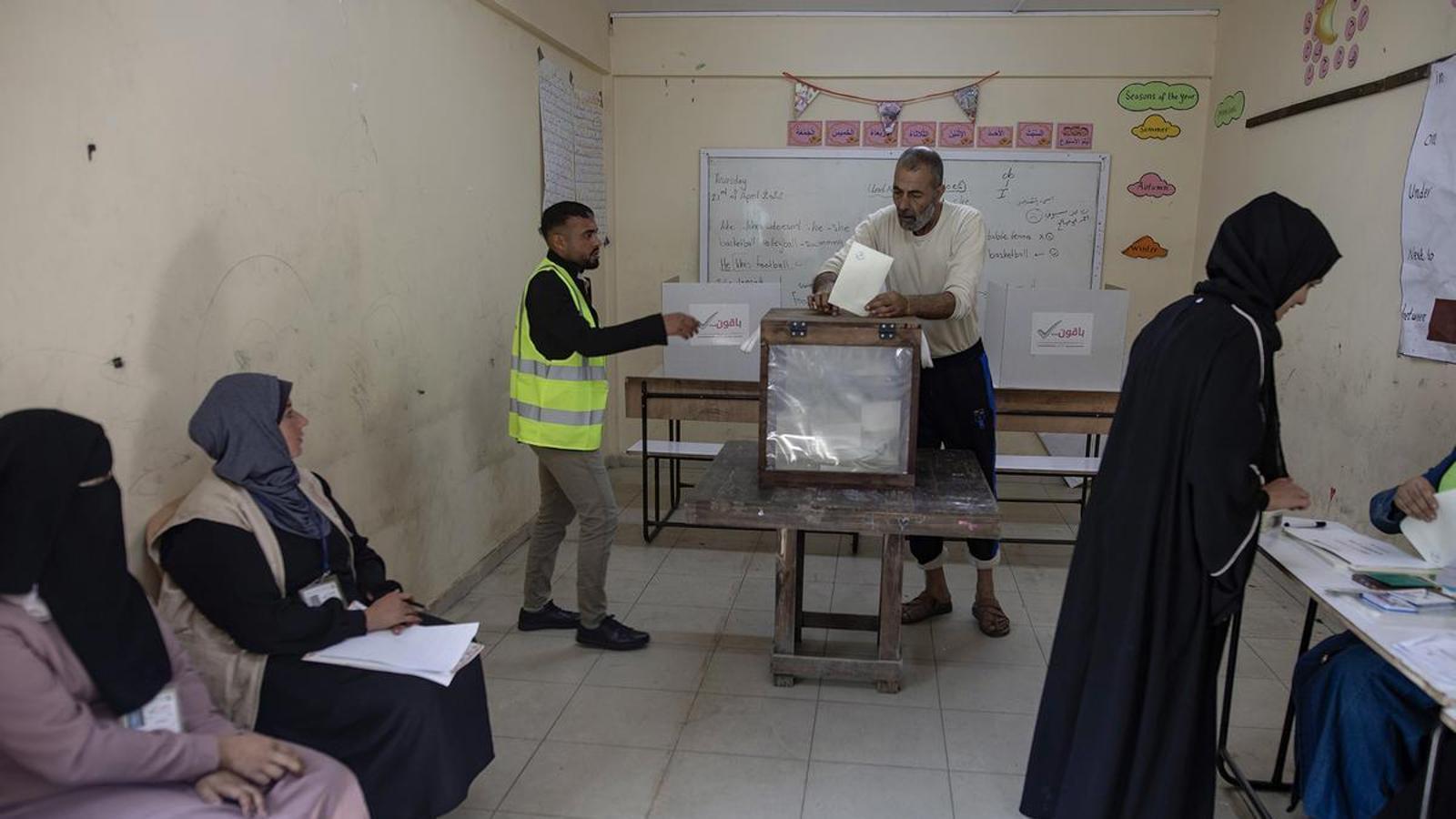
Nearly 1.5 million Palestinians have been called to the polls this Saturday in municipal elections to choose local councils in the first elections since the start of the war between Israel and Hamas in 2023. The event has allowed, for the first time in twenty years, for a vote to also be held in Gaza, in the city of Deir al-Balah, with 70,000 potential voters. In this municipality, one of the few that has not been devastated by the war, the elections have been eminently symbolic: the ballot boxes and ballots had to be improvised.The day dawned gray in the West Bank. At seven in the morning, the polling stations opened amidst a strange routine: short queues, quiet conversations, and the shared feeling that today was a vote driven more by responsibility than by any real hope for change.In a school in Al-Bireh, near Ramallah, voters entered one by one. Throughout the day, the trickle was constant. Turnout slightly exceeded 53% in the West Bank, while in Gaza – where polling stations closed earlier to count votes by natural light, due to the lack of a stable electricity grid – it stood at around 23%, according to the Palestinian Central Electoral Commission, the independent body responsible for administering the elections.“I don't think this will change much. But if we stop voting, we will disappear even more,” says Bisan, a 29-year-old teacher from Ramallah. “My students find it hard to believe it's worth anything. And I can't tell them otherwise with complete certainty.”The vote, which took place at more than 420 locations across the territory, was used to elect municipal councils responsible for basic services – water, electricity, roads, waste collection, and building permits – but its political scope is limited: any relevant decision continues to be conditioned by Israel.The day also arrived marked by a restricted political landscape and widespread disaffection with politics. In key cities like Ramallah, seat of the Palestinian Authority, or Nablus, there was no vote because only one electoral list was presented, which was automatically declared the winner. In total, more than forty municipalities and more than a hundred villages were resolved with the same logic, and in some areas not even candidates were registered.“We don't vote thinking about big politics. We vote thinking about whether we will have electricity, whether they will fix the streets. It's very little, but it's what we have,” explains Rasha, a 38-year-old nurse. Her husband, Mohammed, adds: “People have lost faith in the parties, in the Palestinian Authority, in everything.”Most of the candidacies were linked to the Fatah movement, led by the President of the Palestinian Authority, Mahmoud Abbas, who has been in power for more than two decades without being re-elected in general elections. In many municipalities, candidacies close to Fatah competed with independent lists linked to other factions, such as the Marxist-Leninist Popular Front for the Liberation of Palestine.Omar, a 45-year-old shopkeeper accompanying his elderly mother, both wearing the Palestinian kufia, summarizes the sentiment of many voters: “It's like choosing between one option and the same option; we don't vote out of conviction, but out of habit. And because not doing so would be worse.”Voting in tents
In Deir al-Balah, in central Gaza, the vote has had an eminently symbolic character, which the authorities themselves describe as a pilot project. This city is one of the few that has not been completely devastated by the war, despite the fact that in December 2024 an Israeli bombing destroyed the municipal building and killed the mayor and ten workers.With no capacity to deploy a conventional electoral process or even send ballots or ballot boxes normally, the Palestinian Central Electoral Commission has improvised the system with recycled materials: wooden ballot boxes and blue ink left over from a vaccination campaign. Voting has taken place in tents and open spaces. All this amidst a fragile ceasefire and new Israeli bombings.Hamas, which won the 2006 parliamentary elections in the Strip, has not officially participated in these elections, although some candidacies have been perceived as close to the group, as reported by Reuters.Beyond the election of municipal councils, the elections have been interpreted as an attempt by the Palestinian National Authority to reinforce its legitimacy in a context of growing distrust and the absence of national elections since 2006. In fact, some polls place distrust in the Palestinian Authority above 70%. Analysts point out that the Palestinian Authority has wanted to project an image of political, financial, and administrative reforms, using these local elections as a symbol. In parallel, the simultaneous holding of elections in the West Bank, in a context of expanding settlements, violence by Israeli settlers, and military control, seeks to reaffirm its institutional relevance. Nevertheless, the Authority's room for maneuver continues to be limited: it exercises partial autonomy in the West Bank, while Israel maintains effective control over a large part of the territory and resources.
