Pakistan seeks to establish itself as mediator between Trump and Iran
Energy dependence, economic vulnerability, religion and cryptocurrencies explain Islamabad's diplomatic offensive
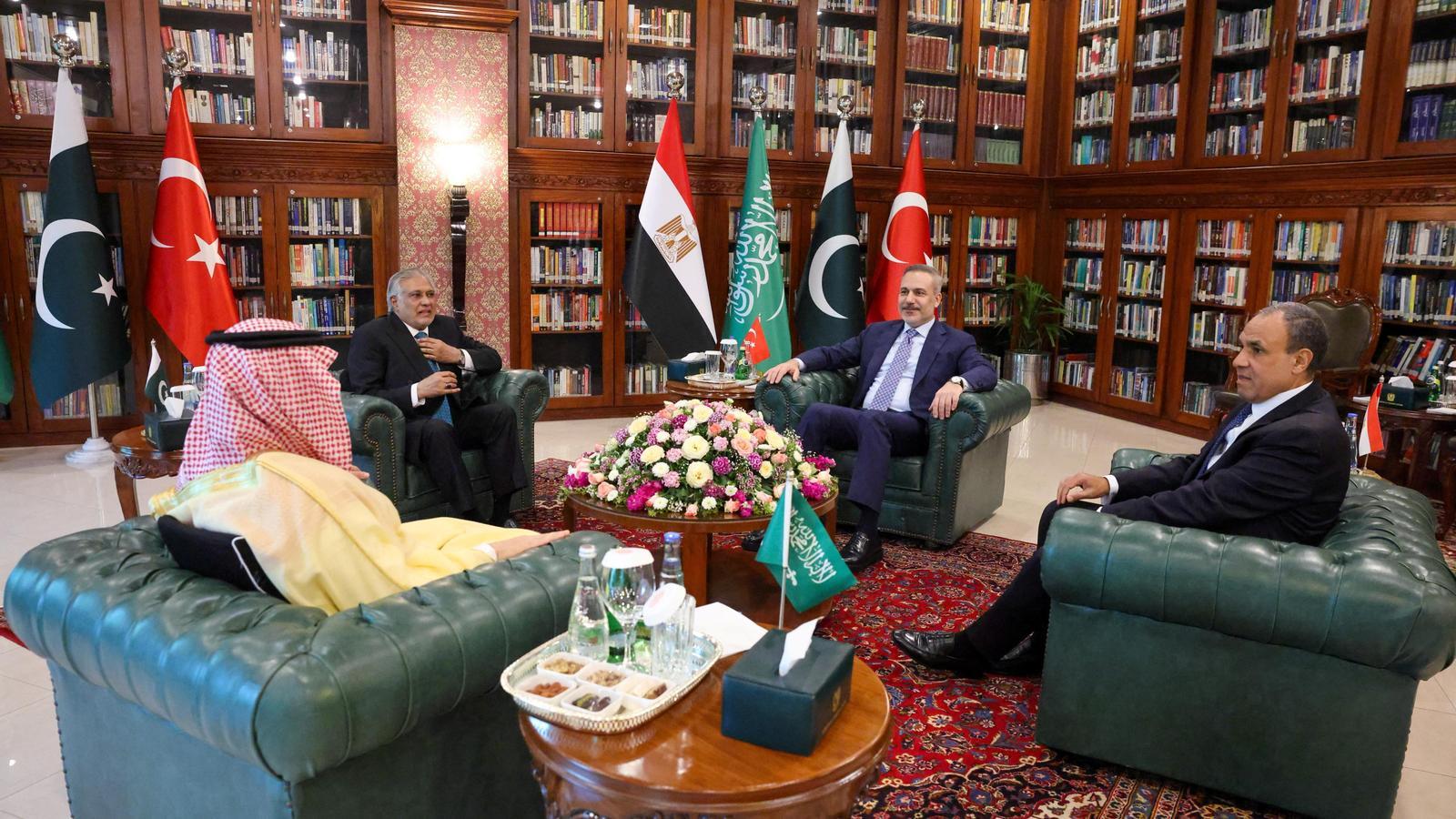
LondonCryptocurrencies, religion, sheriff duties in the area, the diaspora, and economic and historical reasons explain why Pakistan has sought to position itself in recent weeks as a central actor in the de-escalation efforts of the war between the United States and Iran. The diplomatic activity this weekend has been as intense in this regard as the risks the country faces.
Risks that have had an image that many might interpret as premonitory in the preamble to the meeting between the Foreign Ministers of Egypt, Saudi Arabia, Turkey, and the Pakistani host, held in Islamabad. Pakistan's head of diplomacy, and deputy prime minister of the country, Ishaq Dar, slipped and fell to the ground while receiving his Egyptian counterpart, Badr Abdelatty, at the Ministry of Foreign Affairs.
Beyond the anecdote, the country's main asset is an "unusual credibility", in the words of Adam Wenstein, from the Quincy Institute –a think tank from the United States that seeks to promote a less interventionist foreign policy from the White House–, which stems from a combination of functional relationships with both actors. At the same time, there is also a history of distrust with Washington that grants it a certain equidistance in the eyes of Tehran. Islamabad, in turn, maintains solid ties with Saudi Arabia, Turkey, or Egypt, which allows it to articulate multilateral initiatives. The balance, however, is very delicate. Even more fragile than that of its foreign minister. And the longer the war drags on, the more difficult this tightrope walk will be.
The Pakistani involvement cannot be understood without the economic factor. According to the most recent data from the International Energy Agency (IEA) and the Pakistan Bureau of Statistics, the country depends on the Persian Gulf region for approximately 80% of the crude oil it consumes and 99% of the liquefied natural gas (LNG) it imports. This dependence centers mainly on Saudi Arabia and the United Arab Emirates as oil suppliers and Qatar as a gas supplier. 30% of the country's total import bill is allocated to energy resources that transit through the Strait of Hormuz. And if the cost of this bill increases, foreign exchange reserves fall and domestic inflation skyrockets.
Between 4.5 and 5 million Pakistanis work in the Gulf countries. Any increase in the destabilization of the area, already very tense, could affect remittances to the country, which are key to the economy. Diplomatic sources from Islamabad cited by Al-Jazeera conclude that, "if the war continues, Pakistan will be one of the most affected countries." It is not for nothing that, in the final declaration after the Islamabad meeting, Minister Dar said on Sunday that "the ongoing conflict is extremely unfortunate for its devastating impact on lives and livelihoods across the region. This war favors no one and will only bring death and destruction."
Economic Impact
To the economic factor is added a very delicate internal religious dimension. Pakistan is the second country with the largest Shia population in the world, after Iran. The war has caused protests and social tensions, especially after the death of Iranian leaders during the first attacks. The risk of destabilization is not just political or religious. The authorities fear a regional contagion effect, especially considering that the country is already immersed in a conflict with the Afghan Taliban. An escalation with Iran could open a new front in an already severely deteriorated security context.
Pakistan's current role is also explained by the strategic rapprochement with the United States under Donald Trump's second presidency. The army chief, Asim Munir, has woven a very close direct relationship with the Republican president in an attempt to overcome years of mistrust. In one of his usual compliments to flatter his interlocutors, Trump said he was his "favorite field marshal," during a visit to Mar-a-Lago last December. An epithet that has become a reality when Pakistan has taken on the role of sheriff of Central Asia, keeping the Taliban under control, after the United States' withdrawal from the country, in the summer of 2021. A sheriff in favor of Washington.
The rapprochement between Islamabad and Washington is not only political, but also financial. It includes an economic and technological dimension, with agreements in the field of cryptocurrencies. Thus, Pakistan has signed a pact with a company linked to the Trump family, World Liberty Financial, to use the stablecoin USD1 in cross-border payments, a move that points to a bet on new financial infrastructures in a context of currency restrictions.
Between Tehran and Riyadh: a risky position
Despite this decided rapprochement with the United States, Pakistan maintains a functional relationship with Iran, with whom it shares a delicate border in the province of Balochistan of just over 909 kilometers. Despite episodes of tension –like the cross-border attacks of 2024–, the two countries have cooperated on security matters. At the same time, Islamabad is linked to Saudi Arabia by a mutual defense agreement that could oblige it to intervene if the conflict intensified. Minister Ishaq Dar himself has admitted this tension and reminded Tehran of the signing of the pact with Riyadh in September 2025.
This attempt at diplomatic prominence also responds to a desire for international projection and the recovery of a historical role. Islamabad already played a similar role in 1971, when it facilitated the rapprochement between the United States and China that culminated in Richard Nixon's trip and the so-called ping-pong diplomacy.
"Hosting talks between the US and Iran would represent a significant improvement in Pakistan's strategic position," Kamran Bokhari, from another think tank in Washington specializing in foreign policy analysis, the New Lines Institute, points out. After decades associated with profound instability, the country seeks to present itself as an actor capable of articulating solutions.
