The United States and Iran negotiate face to face with the stumbling block of Hormuz and Lebanon
While the two delegations negotiate with Pakistan as mediator, Trump assures that he is clearing the Strait of Hormuz

-
CAT -
CAST
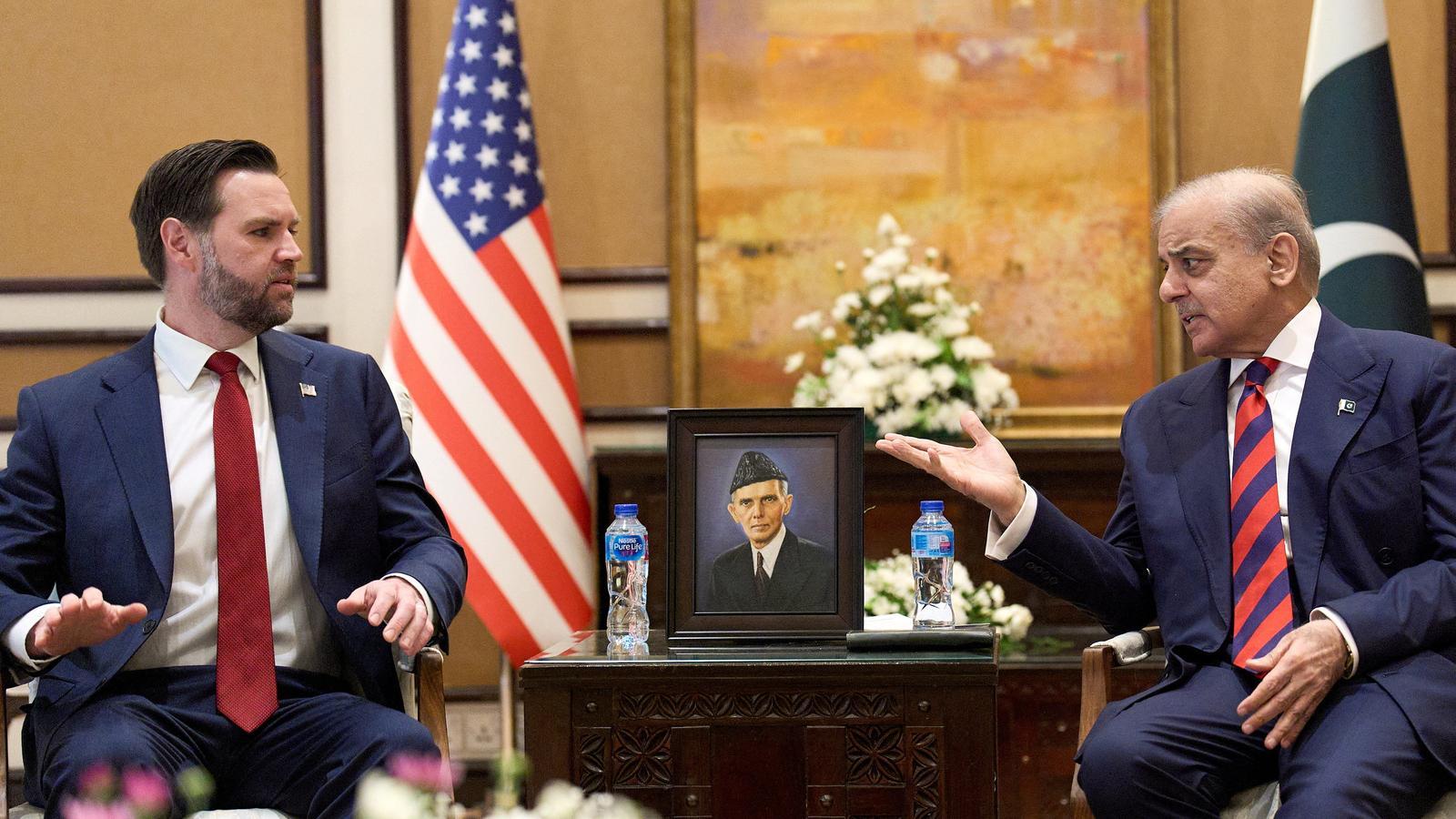
BarcelonaThe doors of the Serena hotel, where the conversations between the United States and Iran have taken place in Islamabad –the capital of Pakistan– to end six weeks of war, were barricaded by cars and security agents. Inside, American and Iranian representatives have negotiated face-to-face accompanied by Pakistani mediators, as confirmed by the White House. The meeting was the highest-level direct contact the two powers have had since the Islamic Revolution of 1979.
The Vice President of the United States, J.D. Vance, heads the American delegation, formed by real estate investor and special envoy of Donald Trump Steve Witkoff, and by his son-in-law and advisor, Jared Kushner. On the other side of the table sat for hours and in several negotiation rounds the president of the Iranian Parliament, Mohammad Bagher Ghalibaf, and the Minister of Foreign Affairs, Abbas Araghchi, before taking a break for prayer.
Outside, information was leaked bit by bit. After a first round of talks, sources from the Efe agency assured that the first stage had concluded with "optimism". "The first phase of the negotiations has concluded and now the delegations are exchanging the minutes. Both sides are optimistic about the outcome of the talks," it stated.

The meeting has been possible after each delegation met separately this morning with the Prime Minister of Pakistan, Shehbaz Sharif, who has called on the parties to engage "constructively". Well into the night, as the delegations continued at the Serena Hotel, Iran's Tasnim agency stated that a new round of trilateral negotiations was beginning. And it warned that they were "the last opportunity" to reach a negotiation framework with the United States.
Despite the optimism generated by the leaders finally meeting face-to-face, the starting positions are difficult to reconcile. Among the red lines marked by the Islamic Republic's plan are the release of Iran's blocked assets, the payment of war reparations, control of Hormuz, and the fact that the ceasefire applies to the entire region, including Lebanon. In contrast, the United States considers the reopening of the strait and Iran's commitment not to enrich uranium to be necessary.
Cross-accusations between both sides also complicate negotiations. "We will negotiate with our finger on the trigger," warned the Iranian government spokesperson, Fatemeh Mohajerani, on state television. "It seems the Iranians don't realize they have no cards, beyond a short-term blackmail of the world through the use of international waterways. The only reason they are alive today is to negotiate!", stated Donald Trump.

Clear the strait
While the participants of the conversations were locked in the negotiation room, the media noise tried to sneak under the door. Just as the trilateral talks kicked off, Donald Trump posted a message on Truth Social: "We are starting the process of clearing the Strait of Hormuz as a favor to countries around the world," said the American president, who had sunk 28 Iranian mining ships. A claim that the official Iranian agency Nournews has denied.
In contrast, the United States Central Command assures that two destroyers of the United States Navy have transited the strait this Saturday in a demining operation. This is the first operation of its kind since the start of the war, and it is part of a "broader mission to ensure that the strait is completely free of sea mines placed by the Iranian Islamic Revolutionary Guard Corps," the statement affirmed.
Hours later, in another message, he insisted that the Pentagon has destroyed the entire Iranian army, including its navy and air forces. "Your leadership is DEAD! The Strait of Hormuz will soon open and empty ships are rushing to the United States to "load up"," he wrote. "Everyone knows Iran is losing," he added.
Bombings in Lebanon
Far from Islamabad, in Lebanon, Israeli troops were attacking the population: 13 people have died in an Israeli airstrike against Tefahta, in the south. On the same day that authorities have put the number of dead in the country at over 2,000 since the start of the war, Israeli Prime Minister Benjamin Netanyahu has assured that he wants the agreement with Lebanon "to be lasting". "I have given my approval, but with two conditions: we want the dismantling of Hezbollah's weapons and we want a true peace agreement that will last for generations," he stated.
With Iran, he has not been so conciliatory. The Israeli leader stated —during talks in Islamabad— that "the campaign is not over yet". He boasted of having achieved "historic successes" in Iran, but says he has "more to do" against the Islamic Republic and its allied militias in the region. "We have succeeded in crushing their nuclear program, in crushing their missile program," Netanyahu said, boasting of having killed the twelve top Iranian nuclear scientists.
- The nuclear program Uranium enrichment was the pretext Donald Trump initially used to justify the war against Iran. He wanted to ensure that Tehran would "never be able to have a nuclear weapon." Iran claims it has never attempted to obtain one (a claim doubted by some Western governments) and, as a signatory to the Nuclear Non-Proliferation Treaty, says it has the right to enrich uranium for civilian purposes. To reach an agreement, Iran wants this right recognized, while Washington demands that it "end all uranium enrichment on Iranian soil."
- The Strait of Hormuz Having gained full control over this crucial waterway, Iran seems determined to assert its total sovereignty and impose rules to regulate who can pass through it. The United States, on the other hand, wants free passage for global shipping through the strait (i.e., the situation that existed before the war began) as soon as possible. Upon the conclusion of talks, the Iranian agency Tasnim reported that this continued to be a point of "serious disagreement."
- Lebanon Israel's offensive against Lebanon threatens to derail the ceasefire. Iran has repeatedly warned that it will "never abandon its Lebanese brothers and sisters." "The continuation of these actions will render negotiations meaningless," Iran's President Masoud Pezeshkian warned on X. Israeli Prime Minister Benjamin Netanyahu maintains that the ceasefire in the region has no effect against Hezbollah. His forces, deployed in the south of the country, have continued to issue evacuation orders and bomb towns and cities.
- Sanctions and reparations Iran has been suffering from international sanctions for decades, which are strangling its economy. On Friday, the speaker of parliament demanded the release of $120 billion in frozen Iranian assets as a condition for negotiation. A concession that Washington seems unlikely to grant. Furthermore, Iran demands that the United States pay war reparations for all destroyed infrastructure.
