Milei's recipe doesn't work: Argentines have to have two jobs to make ends meet
The Argentine president announces that he will run for re-election and is confident that macroeconomic results will benefit him

-
CAT -
CAST
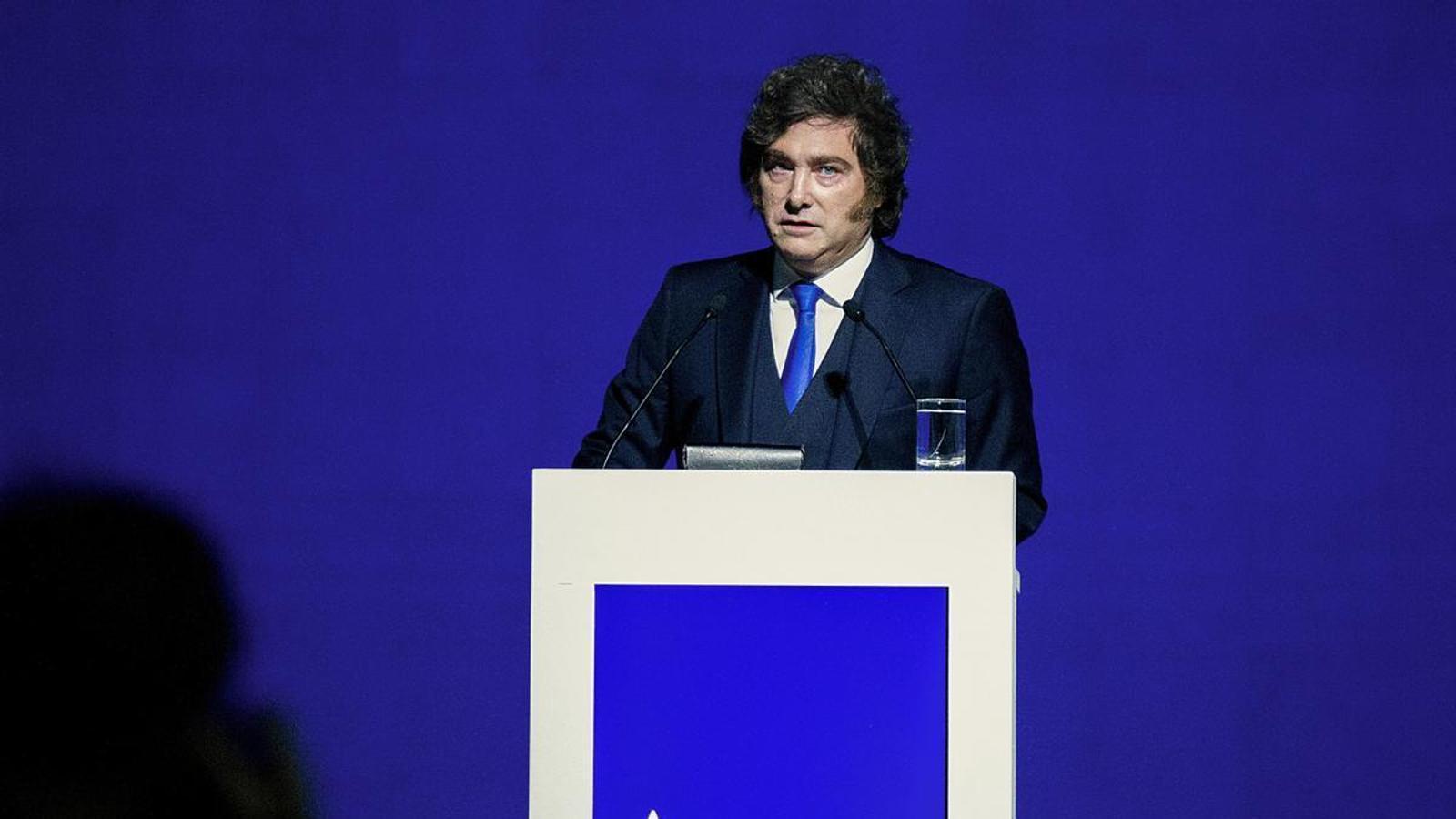
Javier Milei is going through one of the most thorny moments of his almost two and a half years at the head of the Argentine government. After implementing a brutal austerity plan, with the aim of sanitizing public accounts and reversing the country's fiscal deficit, the economy is not quite recovering, contrary to what he had promised, or at least it is not reflected in the pockets of the country's social majorities. Consumption remains depressed, especially in daily expenses, with inflation that is not easing – March's was 3.4% monthly – and amidst an increasingly visible precariousness of work, which forces the population to have two or more jobs to make ends meet. Added to this is the fact that the justice system is investigating the chief of staff, Manuel Adorni, for alleged illicit enrichment. Despite this scenario, Milei aspires to be re-elected in the presidential elections scheduled for next year: "I will run," he declared this week on the radio program Argendata. "Not only will I finish this term, but I will also run for another if I believe I have done things well," he insisted.Multiple employment
“Pluriactivity is beginning to be massive and widespread”, assures sociologist Julia Campos, coordinator of the Gender and Labor Union Observatory of the Association of State Workers (ATE), to l’ARA. “Time dedicated to work is increasingly encroaching on all hours of the day. Despite this, no double or triple shift can cover life’s needs”, she declares. In the public sector, for example, teachers work in more than one school, and doctors combine their work shifts in a public hospital with multiple on-call duties or overtime in a private clinic. Regarding the private sector, online sales and the offering of services through apps like Uber have become widespread. The sociologist also highlights that most households are in debt. "We are working to pay off debts", often informally and with usurious intermediaries, she assures. And the worst part, she continues to explain, is that workers' response is not forceful "because there is a fear of losing their jobs and because organizing requires time and mobilization, and people are exhausted". There are also voices that are optimistic: the International Monetary Fund (IMF), Argentina’s main lender and in good standing with the Milei government, forecasts for this year a 3.5% growth in the country’s economy, and up to 4% for 2027, which will be an election year. However, the same IMF calculates an interannual inflation of over 30% for this 2026, a figure ten points above the last projection. Despite this, economist Ramiro Castiñeira states: “It is expected that next year Argentina will enter a dynamic of genuine growth, and no longer just for exports, but also for investments”. After the modification of the glaciers law, the mining sector has investments – which according to the government are already approved – of more than 30 billion dollars. Castiñeira opines that “the great effort Argentina is making to adjust public accounts” is consolidated as a sign of confidence and predictability for foreign investors.Loss of popularity
However, polls indicate a significant drop in the president's popularity: 57% of the population disapproves of his management. Regarding voting intention, there is indecision and fragmentation, which would mean no majority. If the elections were held today, La Libertad Avanza (LLA) would obtain 29.4% of the votes; Peronism, 25.4%; PRO or traditional right-wing, 7.3%; and the left, 6.5%. Furthermore, there would be more than 5% of blank or null votes, 17.7% undecided, and 8.4% abstention. Analyst Gabriel Vommaro highlights that elections, scheduled for October 2027, are “still far off,” but acknowledges that, “if the government manages to close this year with declining inflation and continues to capitalize on the idea of macroeconomic ordering, it remains a very competitive government for re-election.” Vommaro asserts that there is still a frontal rejection of Peronism and Kirchnerism, which are mostly perceived as “the culprits of the ills that Milei supposedly came to repair.” Additionally, within Peronism itself, there is a strong internal conflict, with two main feuding factions: one, led by former president Cristina Fernández de Kirchner, under house arrest and convicted of corruption; and the other, by the governor of the province of Buenos Aires, Axel Kicillof, who appears to be a capable rival to face Milei at the polls in 2027.What Milei cannot shake off and what is conditioning his public image are the alleged corruption cases that are accumulating in the core of his government. Apart from the $Libra crypto scam and the bribes in the disability sector managed by his sister, Karina Milei, the one in the spotlight now is the chief of staff, Manuel Adorni, investigated for illicit enrichment: the justice system is investigating inconsistencies in his declared assets, involving properties and trips. In this context, and after two journalists filmed some corridors inside the Casa Rosada without permission, Milei has decided to press criminal charges against the reporters and ban all press access to the government headquarters. This was announced on Thursday by the deputy spokesperson, Javier Lanari, citing a matter of “national security.” The duration of the measure, which has provoked harsh criticism and is unprecedented in more than forty years of democracy in Argentina, is unknown.
