Jordan, the discreet kingdom caught in the regional war between Washington and Tehran
The country has consolidated itself as an essential platform for North American operations in Syria and Iraq

-
CAT -
CAST
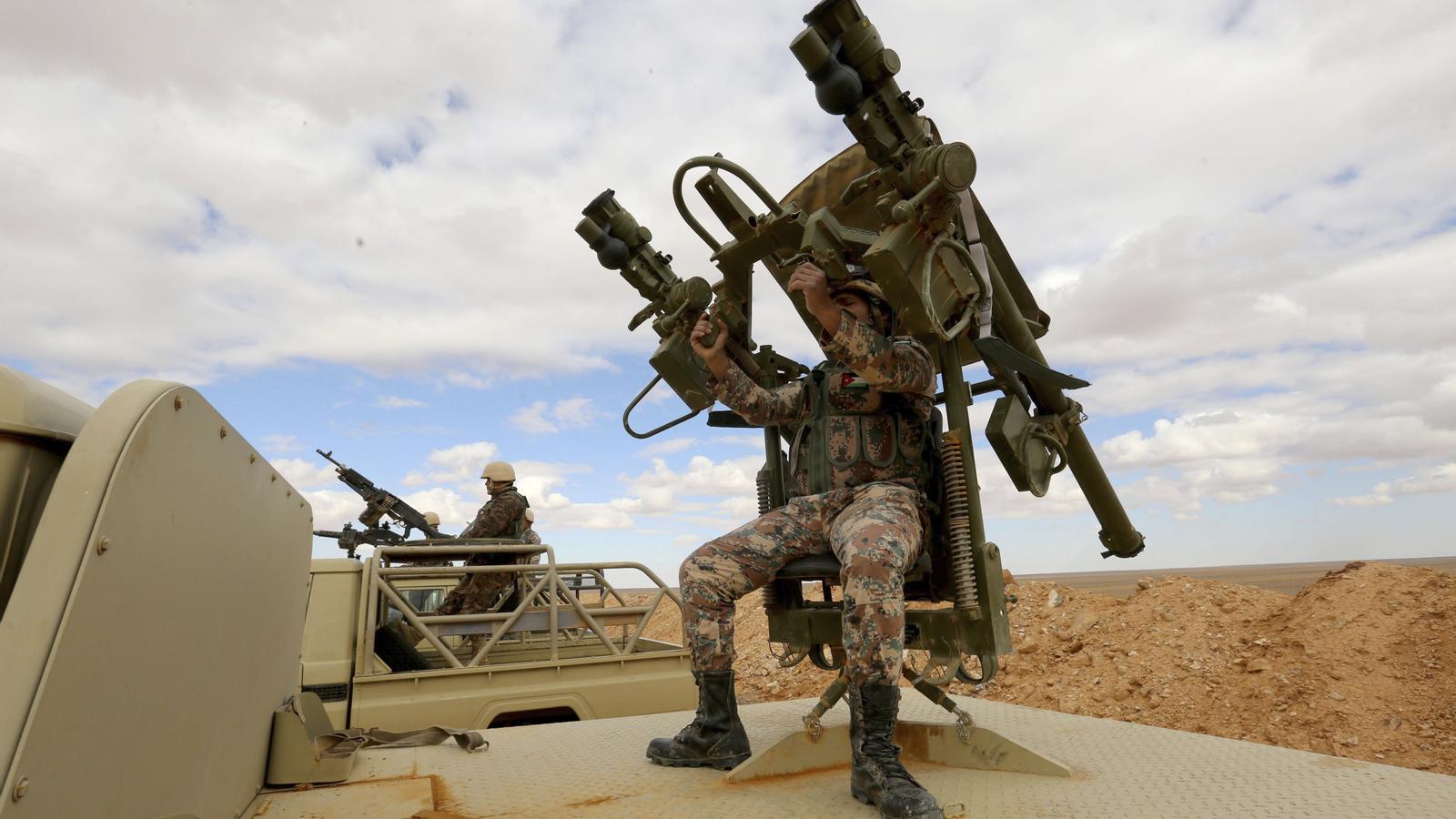
BeirutJordan has ceased to be a secondary theater of war. After last Friday's attack on a military position in the northeast of the country, in which several American soldiers died, Iran attacked Jordanian territory again this Tuesday. Tehran assured that it had reached the Rukban area, near the borders with Syria and Iraq, and that it had caused new casualties among the American troops deployed there, information that Washington has not confirmed. Beyond the victim count, the succession of attacks reveals a fundamental change: the Hashemite kingdom, for decades one of the most discreet allies of the United States in the Middle East, has moved to occupy a central place in the confrontation between Washington and Tehran.
Unlike Qatar, where the United States concentrates a large part of its air power, or Bahrain, home to the Fifth Fleet, Jordan had never made headlines when discussing American military deployment. Its role was different. Without making noise, the kingdom became one of Washington's most reliable partners and a key piece for the stability of a region marked by wars, revolutions, and changing alliances. Jordan borders Israel, the West Bank, Syria, Iraq, and Saudi Arabia. It is the only stable U.S. ally located precisely at the point where these four scenarios converge. This location, which for years has been a diplomatic advantage, makes it a military target today.
For decades, Washington has maintained troops, surveillance means, and facilities in Jordanian territory, jointly used by both armies. Amman avoids talking about American bases and argues that all military cooperation takes place under Jordanian sovereignty. But, in practice, the kingdom has consolidated itself as an indispensable platform for American operations in Syria and Iraq.
A strategic corridor for pro-Iranian militias
One of the most sensitive points is located in the northeastern tip of the country, with the border triangle with Syria and Iraq. There, in the middle of an immense desert expanse where the borders of Jordan, Syria, and Iraq converge, lies the Rukban area, the target of Tuesday's Iranian attack. Very close by is Al-Tanf, the American base already located in Syrian territory. It may seem like a lost place in the desert, but its strategic value is enormous. From this point, one of the land corridors connecting Iran with Iraq, Syria, and finally Lebanon is controlled, a fundamental route for supplying Tehran's allied militias.
For years, the United States has used this deployment to limit the freedom of movement of these Iran-allied militias and to hinder the continuity of this land corridor, which represents one of the main obstacles to Tehran's regional strategy.
Its importance does not end here. Jordan also constitutes the main shield of Israel's eastern flank. Any missile or drone launched from Iran, Iraq, or part of Syria towards Israeli territory must first cross Jordanian airspace. This reality explains why the country is part of the regional air defense network coordinated by the United States. In April 2024, Jordan was already caught in the regional escalation when it intercepted Iranian drones launched against Israel during Tehran's first direct attack on Israeli territory. Now, with the confrontation between the United States and Iran, the kingdom is once again on the front line.
A delicate balance
Jordanian authorities insist that these operations are exclusively in defense of their sovereignty and the protection of the civilian population. They also know that any other explanation would have a high internal cost. A very significant portion of Jordanians are of Palestinian origin, and the war in Gaza has fueled deep social unrest. King Abdullah II of Jordan has, in fact, become one of the Arab leaders who has most forcefully denounced the Israeli offensive and warned of the risks of a regional escalation.
This difficult balance has defined Jordanian foreign policy for the past three decades. Since the signing of the peace treaty with Israel in 1994, Amman has maintained close cooperation with its neighbor on security, intelligence, water management, and border control. At the same time, it sought not to break ties with Iran and to remain on the sidelines of the rivalry between Tehran and Washington. But this margin narrowed as Jordan began to intercept Iranian missiles and drones heading towards Israel, and American military presence in its territory increased. For Tehran, the kingdom ceased to be a neighbor protecting its airspace and became another piece in the American military deployment in the Middle East.
Thus, the Hashemite kingdom, which for years tried to stay out of major regional confrontations, now faces the risk of becoming one of their main scenarios. Not because its foreign policy has radically changed, but because the war has altered the strategic value of its territory.
The attacks of recent days show to what extent geography can end up prevailing over diplomacy. Jordan has not changed its place on the map. What has changed is the map of the war. And in a Middle East where borders are once again becoming lines of combat, the Hashemite kingdom has ceased to be a discreet ally and has become a strategic target.

