From 'Born in the U.S.A.' to 'Fuck off, America'
The generalized perception of Europeans and the rest of the world of the country and of President Trump is negative or very negative

-
CAT -
CAST
LondonOn June 23, 1985, I saw Bruce Springsteen at the dusty Richter Stadium in Montpellier. It was the eleventh concert of the European tour of Born in the U.S.A. and some forty thousand people filled the venue and accompanied the voice of the Boss when he started with the song that gave its name to one of his most famous albums of that decade. The song, misinterpreted as a wholesale patriotic exaltation, was in reality quite the opposite: a denunciation of the way the country had abandoned a generation of its citizens. Springsteen himself complained about it, many years later (2016), in his book "Born to run: "
Born in the U.S.A. continues to be one of my most important and, at the same time, one of my most misunderstood musical pieces".
The show that the New Jersey native brought to Europe after a four-year absence was made in America one hundred percent. Huge trailers coming from the roads of the United States, motorcycles that looked like they came out of the freedom airs ofEasy rider, merchandising and clothing ad hoc impossible to find in Barcelona. All of it made me envious of not having been born there and not being able to sing, by birthright,Born in the U.S.A.Do I have today the same desire to chant the song? Would admiration for the United States, undoubtedly shared by millions of Europeans, have an expiration date? Not for Springsteen, who continues to be an idol and an anti-Trumpist mirage in a country that is dangerously heading towards authoritarianism, but because Trump has taken off his mask, and has shown us the darkest face of the empire.
The Boss's song was far from what its sound suggested – a triumphant, epic-sounding rock – if you bothered to listen to the lyrics. Born in the U.S.A. contrasts an exultant music with the story of a worker sent to kill Vietcong soldiers who was then abandoned by his own government. Springsteen delves into one of the great wounds of North American society in the second half of the 20th century. As Michael Cimino had done a few years earlier in "The hunter.
That white working class that Springsteen and Cimino described has continued to sink for decades. The second season of The wire (2003) showed it through the Baltimore dockworkers; more recently, the bitter and Oscar-winning Nomadland has portrayed the expelled from post-industrial America, condemned to an itinerant existence. All three works tell the story of the losers of an economic model that would fuel a large part of the electoral support for Donald Trump. They explain, plain and simple, the failure of the American dream.
Paradoxically, the ability to turn the country's own contradictions and demons into cultural products – literature, music, cinema, journalism, television… – was one of the main sources of international admiration for the United States. For much of the 20th century, at least in Western Europe emerging from World War II, we admired them not because we considered them a spotless paradise, but because they seemed secure enough to expose their wounds in public and discuss them without complexes. As if they practiced a kind of blind faith in one of the most recurring quotes from "Democracy in America, by Alexis de Tocqueville: "The greatness of America is not in its being more enlightened than any other nation, but in its capacity to correct its errors".
There was a foundational ideal that transcended the contrast with reality. The declaration of independence – which now celebrates its 250th anniversary – proclaimed as a self-evident truth that "all men are created equal," and that the creator had endowed them with inalienable rights, "among which are life, liberty and the pursuit of happiness." The possible malfunction of the system did not overshadow the strength of the promise. On the contrary, it seemed to provide the standard by which Americans themselves measured their own shortcomings.
That is why we also admired the United States. Not only because they had decisively contributed to defeating Nazism and rebuilding Western Europe with the Marshall Plan – which also consolidated their global hegemony – but because they were the country of the New Deal and Keynesianism; of John Steinbeck and Arthur Miller; of the Beat Generation and Truman Capote; of John Cheever and John Irving; of Bob Dylan and Bruce Springsteen; of Friends and The Simpsons; of the New York Times (the Pentagon Papers) and Bob Woodward; of Carl Bernstein (the Washington Post: Watergate); of Jonathan Franzen, of The Corrections, and John Updike, of Rabbit, Run.Corpses in the closet
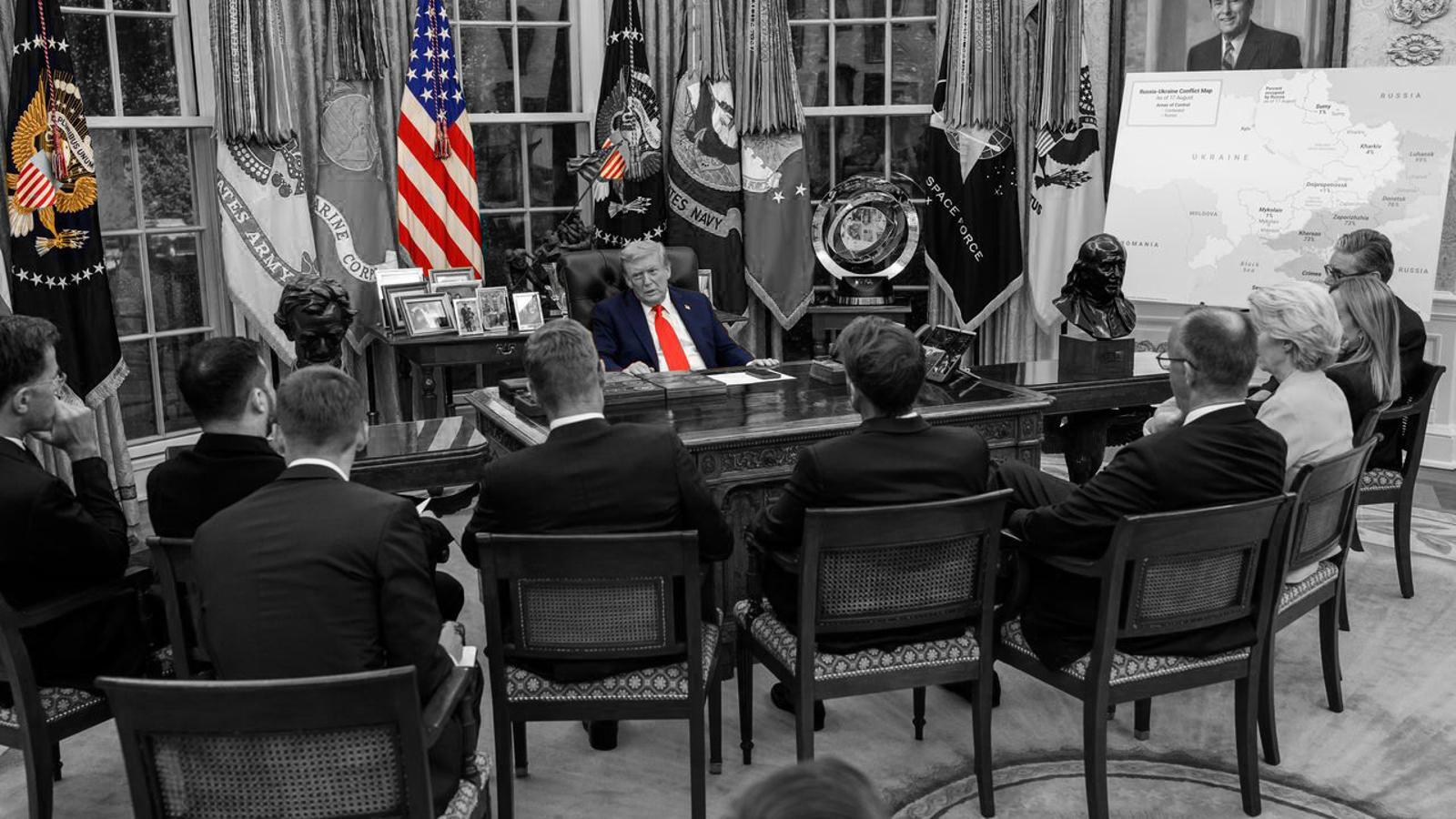
This does not mean that Europe or Europeans were unaware of the skeletons in the United States' closet. Anti-Americanism is not a new phenomenon fueled by Donald Trump's indignities. To mention just a few from his second term, one must recall Volodymyr Zelenskyy's humiliation in the Oval Office, the desire to acquire Greenland, the kidnapping of Nicolás Maduro, the war against Iran, the ability to belittle Western leaders and praise Vladimir Putin and Xi Jinping or the idea of making Gaza a tourist complex.
During the second half of the 20th century, the aforementioned anti-Americanism took on various forms, almost always linked to Washington's foreign policy: protests against the Vietnam War, the deployment of Ronald Reagan's Euromissiles during the eighties of the 20th century or the invasion of Iraq in 2003 mobilized millions of European citizens who showed their disagreement.
We could demonstrate against Reagan and Bush, father and son, and at the same time, we wanted to study at an American university, drive Route 66, and we considered Hollywood the great factory of dreams. Not forgetting that, as producer David O. Selznick already said in 1951, that machinery of illusions and propaganda had already been conquered by "a bunch of accountants," more interested in industry than in art.
Nor did we ignore the many moral defeats of the country. From the execution of Sacco and Vanzetti – it will be a century next year – to McCarthyism; from the CIA coups in Iran or Latin America, with Henry Kissinger turned into a symbol of realpolitik more stark, to racial segregation and the terror of the Ku Klux Klan. Later, the brutal police beating of Rodney King arrived, in 1991, and almost three decades later, the murder of George Floyd (2020), which again put structural racism at the center of the national debate. Today, Trump's immigration policies and the ICE raids in are its epigone: the poison spreads everywhere.
To what extent was that dream that the founding fathers believed in, and that we have swallowed one way or another, real? Claire Ainslie, former political advisor to British Prime Minister Keir Starmer, and current director of the center-left renewal project at the Progressive Policy Institute, responds from Washington with caution: "I believe in the American dream more as an inspiring ideal than as a literal reality." Its value, she adds, is "above all moral," because it conveys the idea that people and society can build their own future, a vision that Martin Luther King Jr. "identified with freedom, equality, and justice for all."
"Significant structural damage"
Another pertinent question is whether the United States of 2026 can sustain that moral ideal. Also from Washington, in an email interview, German researcher at the Brookings Institution Constanze Stelzenmüller, director of the Center for the United States and Europe, states that there is no single reason – "cultural, political, or institutional" – for the change in perception about the United States that Europe and Europeans have experienced. It is no longer political philosophy, it is geopolitics. First, she clarifies: "I do not think that all of the United States is behind Donald Trump; quite the contrary." And then, she adds: "What is new in this period is that the MAGA right is a genuinely revolutionary movement. Trump and his supporters want to transform not only the international order, but also the constitutional order of the United States. It is not yet clear if they will succeed, but it is evident that significant structural damage has already occurred. And at this moment, it cannot be said whether this damage is reversible".
In any case, the change in perception is measurable. The international survey by Pew Research Center (2016-2018) found that confidence in United States leadership plummeted across Europe during Trump's first presidency (2017-2021). Only 30% of Germans, 25% of French, and 14% of Spaniards stated they trusted his administration, compared to over 80% who expressed their trust in Barack Obama.
Disillusion has been further accentuated in the republican's second term, although it should not be forgotten that Joe Biden's policy in Gaza – not in Ukraine – has not favored confidence in the Democrats at all. The data, in any case, confirm the deterioration caused by Trump 2.0 about which Constanze Stelzenmüller has written. According to a recent Pew Research Center survey, published on June 23, only 23% of the population in 36 countries express confidence in the president on global issues. In many of these countries, this percentage has fallen compared to the previous year. General assessments of the United States have also worsened, with double-digit declines in Italy, South Korea, Indonesia, Nigeria, South Africa, and Turkey.
The perception of the US as a reliable partner has also plummeted. The most extreme case is Canada: from 83% in 2022 to 35% currently. There are significant declines in historical Asia-Pacific allies. The image of the United States as a country that respects individual liberties has also collapsed. In twelve of the thirteen states where comparable data has been available since 2021, and always according to the Pew Research Center, there have been double-digit drops. And in many other countries – Australia, Brazil, Italy, the Netherlands, Sweden, South Korea, South Africa – the percentage is the lowest since records began.
Europe has a problem
Europe no longer sees the United States as the institutional pillar it once was. And this has had practical implications. European strategic autonomy has ceased to be a theoretical abstraction and has become a political necessity. A necessity that is difficult to achieve, in Stelzenmüller's words: "Above all because of its internal divisions. However, both member states and the European Union itself are developing capabilities that they previously thought they could comfortably leave in the hands of the United States."
The distancing from the American friend – sometimes the attacks – not only questions its international reliability, but also the very moral ideal that the country proclaims since the declaration of independence: that promise that has sustained the narrative of its exceptionalism for decades, even if it was only part of a package with more shadows than light.
Springsteen sang about the disillusionment of a generation that had believed in a promise that the country has not fulfilled. Today, Europe is experiencing a similar disappointment. It is also an emotional break: the American dream, or the idea that we Europeans of the 20th century had of it, has become the Trumpian nightmare.
Critics of such naivety can always say that that declaration of independence is a piece of monumental hypocrisy, a text written, in large part, by slave owners, while millions of people continued to be subjected to servitude and indigenous peoples were expelled from their territories and exterminated in a process that many historians describe as genocide. From this point of view, Donald Trump has only exposed the worst monsters of an original contradiction born in the United States, "born in the U.S.A".
