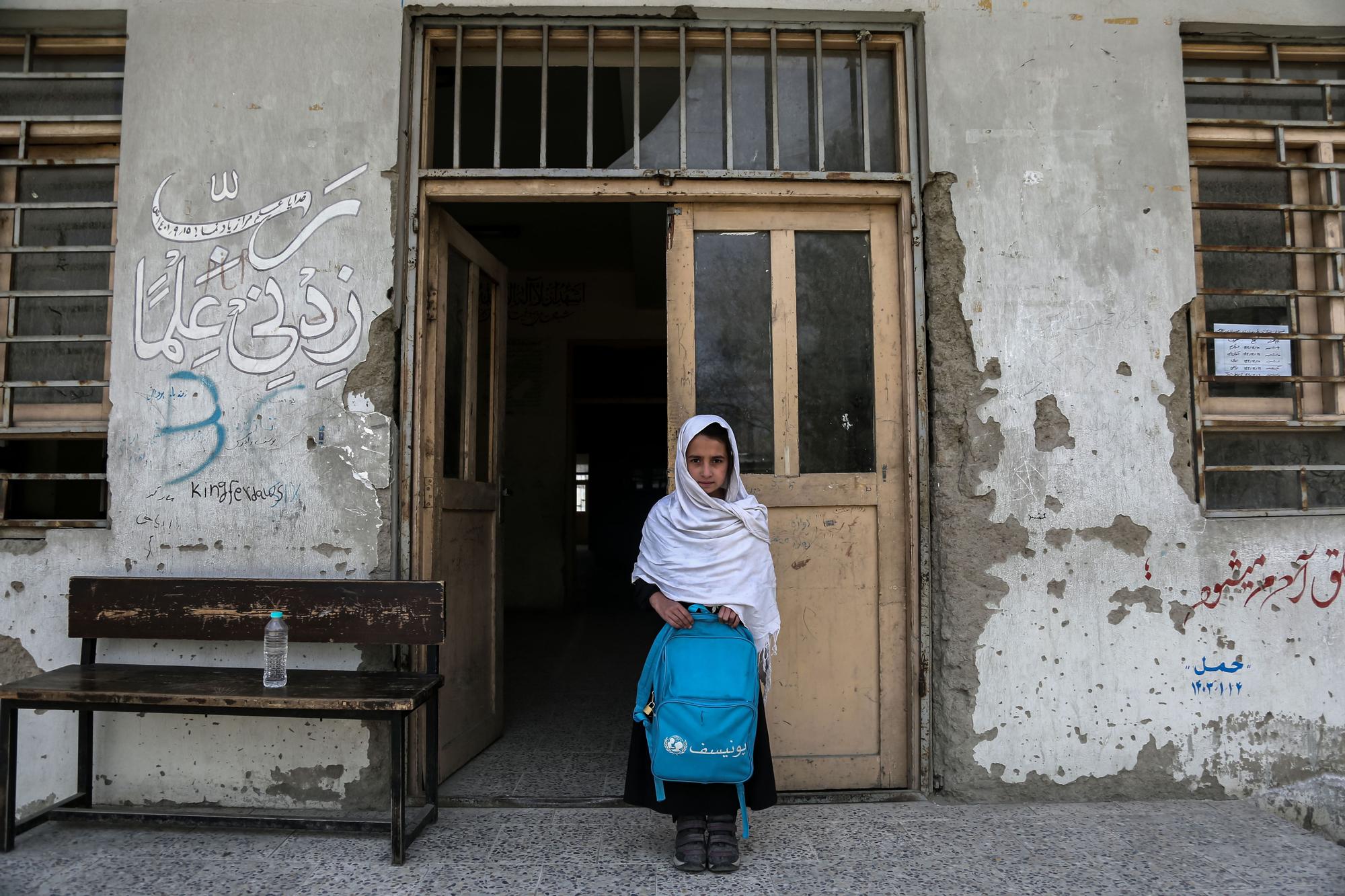
Fifth year without school for girls in Afghanistan: "I listened in silence to my cousin's cry"

-
CAT -
CAST
KabulThe school year in Afghanistan begins with the arrival of spring, because in winter it is so cold that it is then when the school holidays are held. Before the schools reopened on March 28, my journalist colleagues and I repeatedly asked Taliban spokespersons what would happen to girls’ education. We never received a clear answer. Still, there was a small hope that maybe this year would be different.
But for the fifth consecutive year, when the Taliban’s Minister of Education rang the bell to mark the start of the academic year, girls above sixth grade were once again barred from returning to school.
I was watching the announcement on television. I kept waiting to hear one sentence that the restrictions had been lifted. It never came. Instead, I felt a deep, overwhelming sadness for a country that continues to deliberately exclude half of its population, pushing them out of public life and confining them within the walls of their homes.
In that moment, I thought of my cousins. I have six female cousins. Three of them are of school age, but they are now deprived of education. Tamkeen is sixteen, Husna is fourteen, and only Asma, who is twelve and in sixth grade, is still allowed to attend school, just for now.
Guilt and disappointment
That day I called them. I thought maybe I could comfort them, like an older sister would. But the moment Husna answered, I knew her voice was heavy with emotion. She tried to sound normal, but her voice trembled. Then, in the middle of her words, she said: “You were lucky, you finished your studies, you reached your dreams”.
She is only fourteen. Her words stirred something deeper than sadness in me, a kind of guilt. I saw myself in her. I thought about how, if I had been born just a few years later, my life might have looked exactly like hers. I had no words to comfort her. I couldn’t tell her to be patient. I just listened to her quiet crying, to the weight of her disappointment.
The last time I visited their home, I saw Asma wearing her school uniform with excitement, getting ready to leave for school. It may be the last year she will ever wear it. Her mother told me that sometimes she refuses to take it off, as if wearing it could hold onto something that is slowly being taken away.
Tamkeen, her older sister, was busy with housework. She once dreamed of becoming a doctor. If things had been different, if the Taliban had not returned, or if girls had simply been allowed to continue their education, she would have graduated this year. Now her days are filled with sweeping floors, washing dishes, and cooking.
She has grown quieter over the years. It is not hard to see what five years of exclusion from school, from friends, and from the outside world has done to her. When I asked about school, she said simply, “The years I was supposed to study are gone. There is no point anymore.” She no longer speaks of her dreams. Only of marriage.
I remember being her age. I was preparing for university entrance exams, studying day and night with the hope of being accepted into Kabul University. Now, fate has reduced her world to the idea of marriage a way, perhaps, to escape one confinement by entering another.
Husna, however, still holds onto hope. Once, she told me she wants to become a journalist, just like me. Every time I bring her books, she runs her hands over the pages, flipping through them again and again. She tells me she loves the smell of books. She always asks me to bring her newly printed ones.
But even her world is shrinking. Her father, deeply fearful of the current situation, does not allow his daughters to leave the house alone. They have never gone anywhere without him. Their lives now resemble a quiet form of confinement.
Their days pass in repetition and silence, washing dishes, cleaning, cooking. Sometimes they read the books I bring them, simple novels and informational texts. It is a small attempt to keep learning alive in a home that has replaced a classroom.
Sometimes I think back to the past. mornings filled with movement, laughter, purpose. School was once a natural part of their lives. Now, even talking about it feels heavy. But this is not only their story. Millions of girls across Afghanistan are living the same reality.
Overwhelming silence
For a long time, I told myself that maybe things would change. But two days ago, while working on a report about girls’ education, I saw something that changed how I understand the situation.
I went into the city to gather public opinion. I visited neighborhoods like Macroryan, Shahr-e-Naw, and Qala-e-Fathullah, areas once known for being more open-minded, places where some of the best girls’ schools and educational centers once existed. Places where it was rare to find someone opposed to girls’ education.
People still want their daughters to go to school. But they no longer dare to say it. I spent hours trying to record just two interviews. Every person I approached quietly told me they wanted schools to reopen for girls. But when I asked them to say it on camera, they refused. They said they were afraid. One man told me, “I don’t want trouble.” Another simply walked away.
In that moment, I understood why there are no large protests. Why the silence feels so heavy. This silence is not acceptance. It is fear. And in that fear, hope is slowly fading.
The Taliban are not becoming more urban or more adaptable. Instead, people in the city are slowly being forced to adapt to the Taliban’s way of thinking. And in the middle of this quiet transformation, it is girls who are paying the highest price.
