Bolsonaro leads the count in Brazil: he surpasses 50% of the votes with 10% counted
Lula is playing his last chance to govern in an election with a normality that did not exist four years ago

-
CAT -
CAST
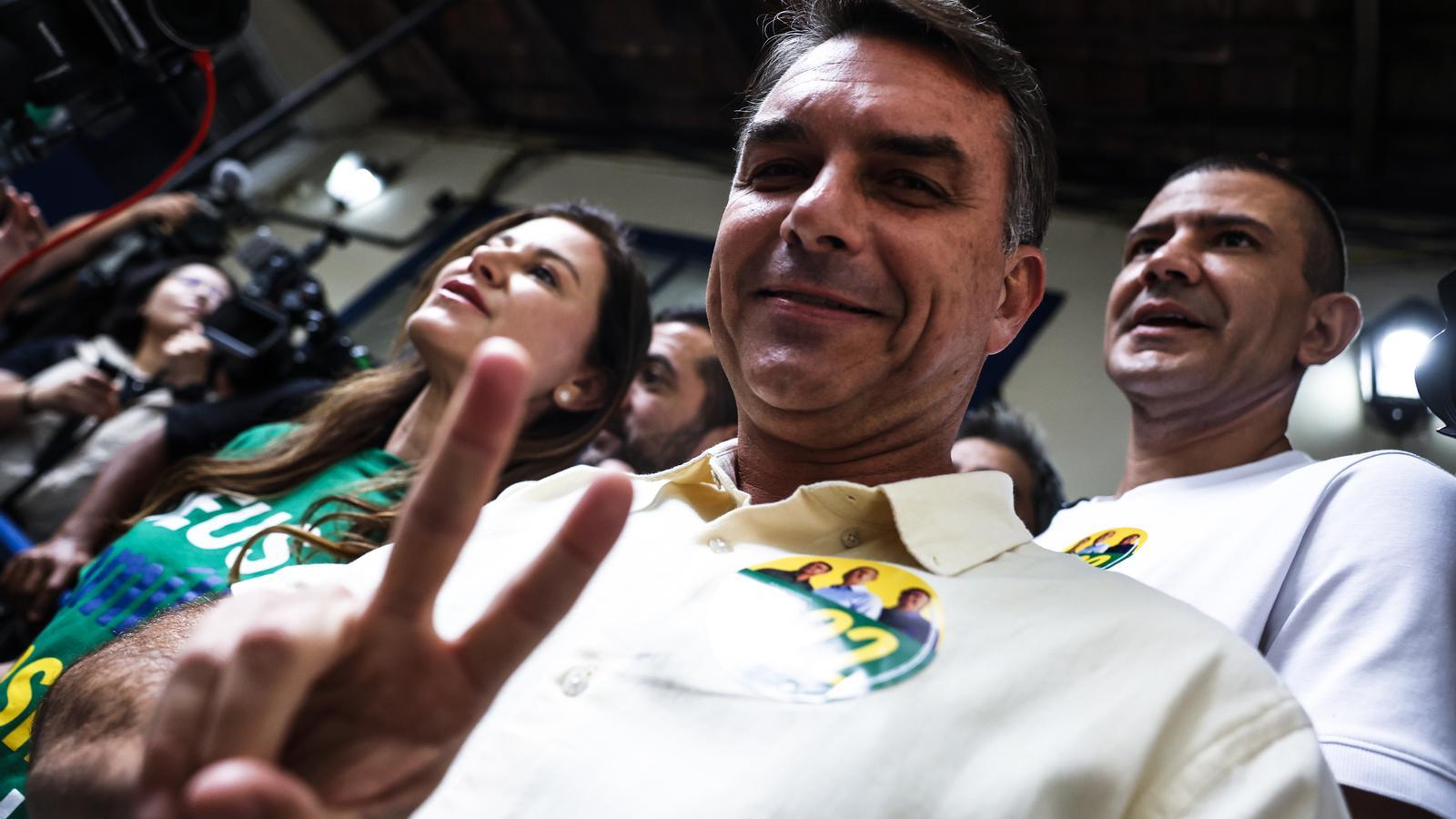
São PauloJair Bolsonaro's son, Senator Flávio Bolsonaro (Liberal Party), defeats the president and candidate for re-election, Luiz Inácio Lula da Silva (Workers' Party), at the beginning of the vote count for the first round of the Brazilian elections. With 10% of the votes counted, the eldest of the Bolsonaro clan has 50.96% of the support, compared to 40.67% for the 80-year-old veteran leader, who has become a symbol of resistance for the Latin American left. The partial triumph of the far right is based, for the moment, on the tactical vote, since the other candidates from across the right-wing spectrum have accumulated less than 8% of the votes.
With Lula da Silva in power, seeking the last re-election of his long career, internal democratic normality returned this Sunday –the interference of the United States, however, has hovered over the entire electoral process–, in a harsh clash with Bolsonaro.
The last time Brazilians stood before an electronic ballot box to elect a new president, in October 2022, the Federal Highway Police (PRF) carried out massive road closures with traffic checkpoints in the northeast region, which is the great electoral stronghold of the left, to suppress the vote for Luiz Inácio Lula da Silva. The Supreme Court and the Federal Police considered these blockades as part of the attempted coup d'état, for which the then-president, Jair Bolsonaro, now imprisoned, was sentenced to a 27-year prison term.
On social media, the constant polarization of the last eight years has been more present than ever throughout the day, fed by flawed algorithms: with posts ranging from personal disqualifications and fake news in a very harsh tone, mass-disseminated by far-right bots, to subtle irony and memes, as it is well known that Brazilians are renowned for their creativity in this area.

At the polling stations, however, the climate has been calmer, at least in general terms. Even so, former president Dilma Rousseff, who suffered an impeachment in 2016 and is now president of the BRICS Development Bank, was harassed by Bolsonaro supporters when she voted in Belo Horizonte. A similar situation was experienced by Fernando Haddad, Minister of Finance this term and PT candidate for governor of São Paulo.
Virgin Mary T-shirts
There have been many queues, some exceeding an hour in São Paulo and Rio de Janeiro, in a country where voting is mandatory for those between 18 and 70 years old and where, this time, the voting receipt from the first round served as proof of life for all retirees and pensioners who receive Social Security benefits, a sector in which Lula prevails over the far right.
The process required a lot of patience. Voters had to confirm up to six candidates at the electronic ballot box, who are listed by number, because this Sunday they chose, apart from the president, two senators, a member of Congress, the governor, and a regional deputy.
As in the last two presidential elections, there has been a re-edition of the chromatic battle at the polling stations. The absolute majority has been for Brazilian football teams, which are usually part of the Sunday attire of Brazilians, although today there was no round of the Brasileirão league. L’ARA has witnessed this at various voting points in São Paulo, the largest city in the country.
The far right insists on claiming the t-shirt green and yellow, of the Brazilian national football team –which, by the way, is experiencing one of the worst moments in its history–, as one of the symbols. Left-wing militants wore the traditional red attire, many of them with the image of Lula –which is not prohibited by the electoral justice system– and with adaptations communists of football team jerseys. Quite a few have been seen in São Paulo from Corinthians, the club of which Lula da Silva is a staunch supporter. Four years ago, the organized supporters (animation stand) of the São Paulo group opened the blockades on many federal highways of the far-right coup plotters who did not accept the return of the left to power.
The religious war that has marked the final stretch of the electoral campaign has reached the ballot boxes this time. The news that, in the event of reaching the Planalto Palace, Flávio Bolsonaro (reconverted to evangelicalism) would strip the Virgin of Aparecida, a black image venerated since 1717, of her status as patron saint of the country, has resulted in a Catholic mobilization.
This Sunday, the Brazilian Bishops' Conference published a message in which it defended sovereignty –one of Lula's arguments in the face of Donald Trump's support for Flávio Bolsonaro–: “We entrust our homeland to the protection of the Virgin Mary”. For the first time, Catholics, mainly elderly women, have been seen going to vote wearing t-shirts with the image of Aparecida, which have become an electoral symbol.

