Beirut, the ceasefire that brings no one home
More than a million Lebanese continue to live in temporary settlements despite the extension of the truce between Israel and Lebanon

-
CAT -
CAST
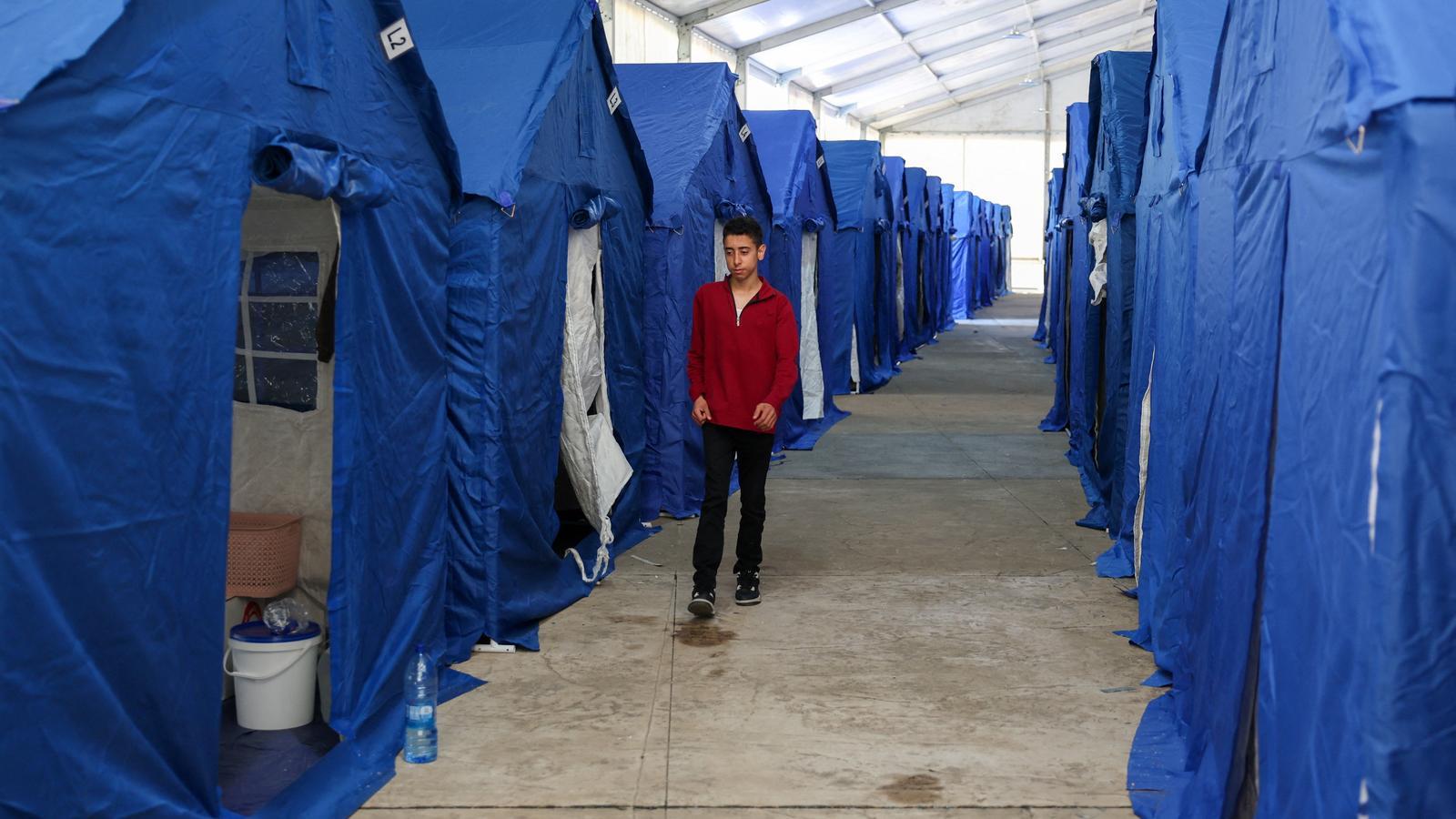
BeirutIn the port area of Beirut, amidst the metallic noise of containers, the wind coming from the Mediterranean, and the concrete blocks of the Biel exhibition center, displacement has ceased to seem like an emergency and has become a stable landscape of precariousness. The space functions as an informal settlement where hundreds of displaced people from southern Lebanonare concentrated, who have fled the Israeli bombs. Blue tarps stretched between metal structures, improvised tents attached to cement walls, and mattresses directly on the ground; a landscape that is beginning to become commonplace.
Biel, a space designed for fairs and events, has become an inhabited surface without infrastructure. There is no sanitation network, and water arrives by truck, when it arrives. There are no latrines, and showers practically do not exist. The smell of plastic, dampness, and fuel is part of the atmosphere.
La Rana explains it without drama, like someone describing a routine that has become normal. She is 34 years old and has three children, and lives on one edge of the compound, where several families have delimited their space with ropes, cloths, and wood scraps. “We sleep where there used to be cars,” she says, pointing to the cement floor. La Rana arrived from the border town of Khiam, after a chain of successive displacements. Her village first, a school converted into a shelter afterward, another saturated center later. “They always told us it would be for a few days – she explains – and then no one said anything else.”
In recent days, moreover, the uncertainty has become even more concrete. Lebanese authorities have begun to dismantle some of the tents set up in Biel and are pressuring to move families to other collective shelters, mainly the Camille Chamoun Sports City and nearby municipal land. The government presents the operation as a reorganization aimed at improving sanitary conditions and freeing up private land, but many displaced people resist leaving the compound.
"They sleep on top of each other"
Some are afraid to return to the saturated reception centers they already passed through before reaching the port. Others assure that they do not trust the government's security guarantees. The Sports City, where dozens of families have been living crammed together for months, constantly comes up in conversations. "There people sleep on top of each other. Here at least we have some space," says Rana. Several families explain that they have already been displaced three or four times since the beginning of the war and that they do not want to start over in another temporary place.
The ceasefire, the diplomatic talks

Humanitarian agencies have been warning for months of the growing pressure on Beirut, where the response to displacement has been to occupy buildings, empty lots, and infrastructure not designed for living. Humanitarian workers describe a progressive situation of exhaustion, with families displaced several times in a few months and a network of aid unable to respond to the pace of arrivals. The result is a city that absorbs population without the capacity to sustain it, where what is provisional begins to become permanent through accumulation.
More than 120,000 displaced in collective shelters
Rana's children have not been going to school since they arrived in Beirut two and a half months ago. Although there are attempts at informal education organized by NGOs and volunteers, they depend on the stability of the settlement and the possibility of movement. Dozens of public schools have been damaged by bombings or converted into collective shelters for displaced people, and have interrupted the school year for months. According to United Nations data, between 120,000 and 130,000 people currently live in official collective shelters, often in conditions of extreme overcrowding. "Omar, my eldest son, asked me if this is now our neighborhood," says Rana. She didn't know how to answer him.
In the south, meanwhile, the situation continues to be marked by a pause without pause – which has left half a thousand dead –, open diplomatic talks, intermittent bombings and a sense of war that never seems to stop. Negotiations for a lasting truce are progressing slowly, but on the ground, normality continues to be impossible. Many border villages are destroyed, others remain empty, and intermittent bombings maintain constant fear among those who are considering returning.
Rana does not speak of returning with conviction. When asked about her home in the south, the answer is brief: "It no longer exists," she says. In Biel, almost no one talks about an immediate return anymore. The ceasefire, the diplomatic talks and the promises of stability have hardly changed the lives of those who continue to be trapped between successive displacements, saturated shelters, and destroyed homes. The wait continues, suspended between a south to which many cannot return and a Beirut that also fails to offer them a place to stay.

