Andy Burnham sees hope and asks for ten years to change the course of the United Kingdom
The creation of a social care system for the elderly in imitation of the NHS, electoral reform and a new relationship with the EU, axes of the Labour promises
-
CAT -
CAST
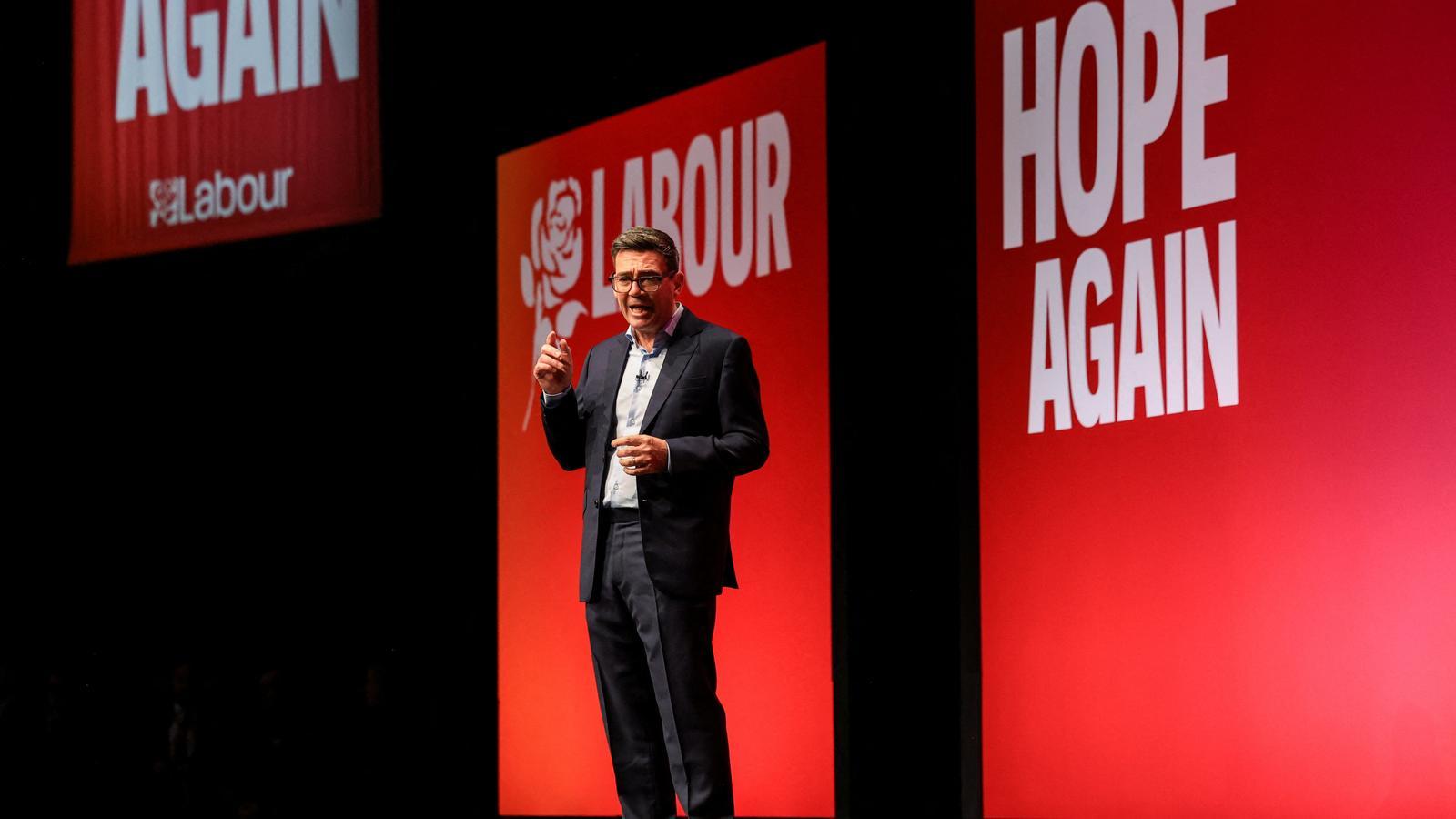
LondonAn almost ecstatic Andy Burnham at some moments of his first speech as Prime Minister before the Labour Party conference, he promised this Tuesday "a clear direction" and a "profound change of course" for the United Kingdom. A new model that aims to break with what was imposed in the 80s of the 20th century, with Thatcherism, which must be articulated around "a ten-year plan" that he will present in November, and with which he wants to regain public control over areas considered essential: from water to electric energy, and with which he also wants to foster economic growth, which the country needs like the air to breathe.
In a very emotional and moved performance, with constant and proud references to the working-class family in which he was born and to his recently deceased father, the Prime Minister has used as a reference significant moments in the history of the post-war United Kingdom –1945, 1964 and 1997, all three led by Labour governments–, to breathe "hope" into the audience and the country.
In fact, "we will have hope again" (Hope again) has been the slogan of the conclave held in Liverpool, which has sanctified Burnham, less than three months after he replaced Keir Starmer at Downing Street. Introducing himself as a outsider of the Westminster party system, has denounced the growing feeling among citizens that "the establishment" is acting against them instead of in their favor. "If there is one thing I want to fix, it is this," he stated, before defending a United Kingdom "for everyone".
Burnham has admitted that some of his proposals will be difficult to execute and that "not everyone, not even within the Labour Party," will agree with them. For example, he has announced the risky intention to eliminate "the triple lock system on pensions" for one that guarantees that the state pension increases with wages over time, but that it never rises less than inflation. The goal is to finance with these savings a new national care service for the elderly, "universal and free," which should prevent elderly people from having to "pay for care in the final stage of life with their basic pension or risk their savings and housing." An idea, however, that specialists see as very difficult without raising taxes.
Housing has been one of the pillars of the plan. Burnham wants to promote the largest municipal housing construction program since the postwar period, reforming the Right to Buy –the right to purchase social housing that was rented, which Margaret Thatcher promoted– so that new public housing cannot be sold within the private market.
Return to the European Union?
Perhaps the most politically significant moment of the speech arrived when Burnham addressed Brexit. "It has done more harm than good," he said. With an eye to the summit between London and Brussels scheduled for the end of the year, he announced that he will present the different options for a new "long-term relationship with European partners," and that he will try to reach a consensus on one of them. He did not specify which model he defends, but he explicitly placed the redefinition of the relationship with the European Union on the horizon of his government, as Keir Starmer had already done, albeit more timidly. In any case, the current premier has always defended the need, in the long term, to return to the EU. For the moment, however, he does not dare to reopen the debate in all its rawness.
The reform of the electoral law was the other major political announcement of the speech. Burnham criticized a Westminster more concerned with partisan combat than with solving problems and announced a national commission on electoral reform, open to all parties. Labour, he pledged, will run in the next elections with the commitment to reform the system so that "every vote counts and every voice is heard." Simply put, he wants to end the current majoritarian system, which rewards a single winner in a district and throws the rest of the votes in the bin, and replace it with proportional representation.
The speech had several very emotional chapters, especially at the beginning and at the end. At this point, almost in tears, Burnham returned to remember his father, Roy, who died the same day that the Scottish First Minister, John Swinney, stated that he would be the last Prime Minister of the United Kingdom. He explained that the phrase made him feel "totally determined" to prove him wrong. "I will not be the last Prime Minister of the United Kingdom," he proclaimed, but rather "the first to reconfigure it so that it works for all people and all territories."
His final call was to leave behind "a decade of stagnation and division" and recover "trust and hope in the country". Will he have time to do it? Will he have the ten years he has asked for? In a month Andy Burnham will present his first budget and voters will begin to notice, in their pockets, whether Labour stands up to a status quo and global economic forces that, as the premier himself has denounced, "do not work for the citizens". The stakes are very high. For the moment, he has the polls in his favor, but the winds of inflation and the international situation are blowing against him.
