Andy Burnham, crowned new leader of Labour
The next British prime minister promises that his government will face "the big problems that politics has left aside"
-
CAT -
CAST
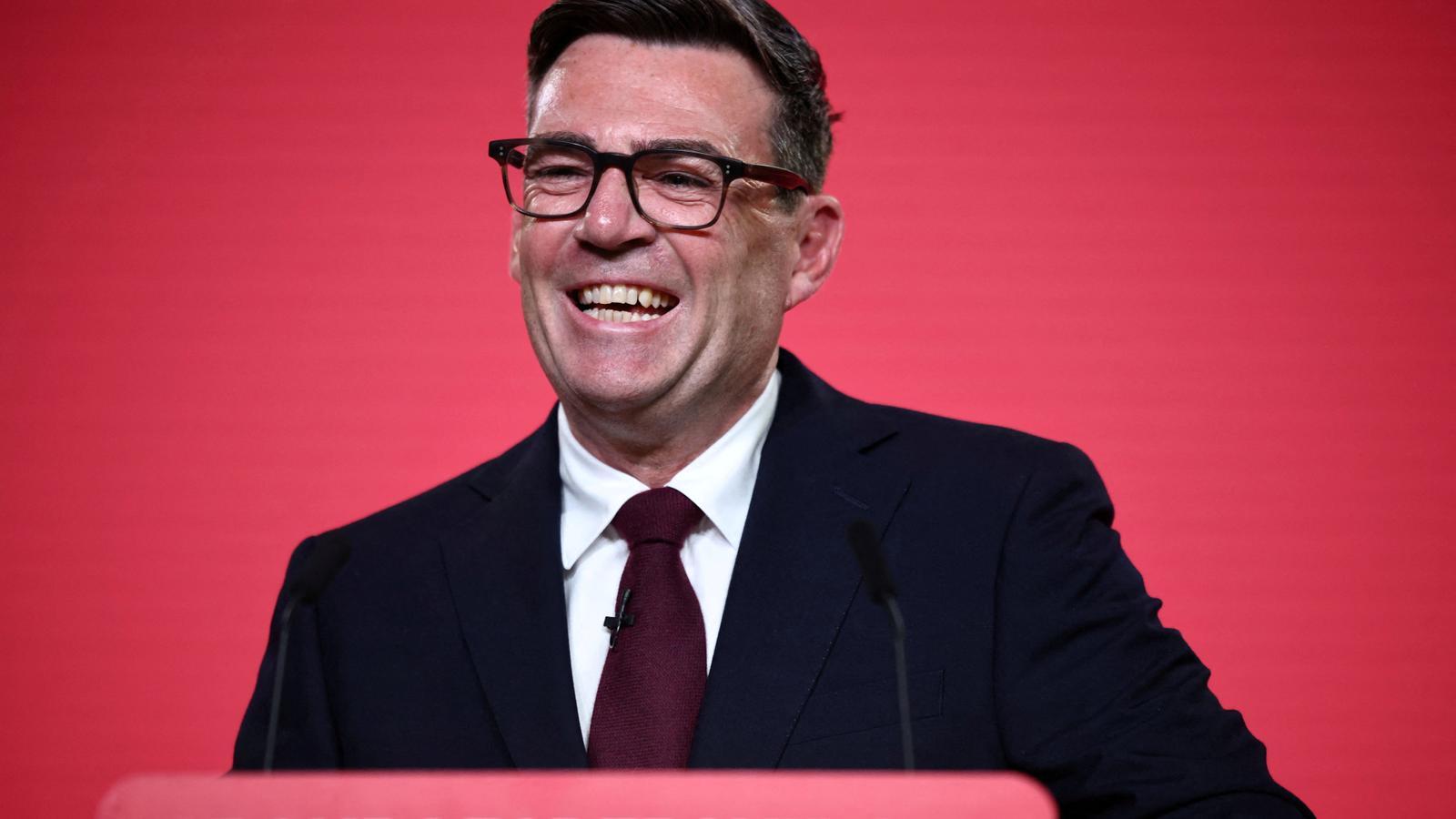
LondonSecond chance for Labour, but with little room for error. Andy Burnham was officially chosen as the party leader this Friday at an extraordinary congress with the overwhelming support of 379 out of 403 parliamentary group deputies, and will enter Downing Street on Monday with the mission "to tackle the big problems that politics has left aside", according to the first words he uttered after the formalization of his leadership.
Faced with a devoted party, Burnham also assured that he will deploy a "clearly Labour" economic renewal program, based on greater public control, reindustrialization, and the return of power to local communities. Under his leadership, he said, the party will be "unequivocally Labour in our priorities and in the decisions we make, placing people and territories at the center of everything we do". He also promised to drive "the most important moment of change in the last forty years" of British politics.

In the hours leading up to this Friday's event, Burnham's communication team has released a video on social media that says a lot about his style: between familiarity and affable populism. Sitting on a chair in the center of Cardiff, he asked passers-by to sit on another next to him so they could "ask Andy anything". And faced with the different questions posed to him, about healthcare, housing, etc., the answers from the premierin pectore have been little more than a list of good wishes: "The simple answer is this: to drive forward the largest social housing construction program since the post-war period." Or "my father has Alzheimer's and this has made me know the English social care system very closely, from the point of view of a family".
A system that Baroness Louise Casey, tasked with reviewing it, has defined as a structure that stands up "with bits, sticky tape, and glue". In the video published on X, Burnham has promised to "spend political capital" to reform it. And referring to it in his speech at the extraordinary congress, he has assured that he will seek agreements "with other parties to face the country's great long-term challenges", such as social care. This is not a new battle for him: he already tried to fight it sixteen years ago, when he was Minister of Health, but then he achieved practically nothing.
The benefit of the doubt
Burnham currently has an asset that Keir Starmer has been losing for just over two years in government: the benefit of the doubt. The problem is that his credit is very limited and the first decisions he makes could condition the future perception of public opinion. Key, therefore, will be who he appoints as Treasury minister, as the name of the position will mark the ideological orientation of the government and indicate if, indeed, his will be an "unequivocally Labour" government, as he has assured. On Wednesday, the Financial Times pointed to Shabana Mahmood, the current Home Secretary and positioned in the right wing of the party, at least on immigration matters. However, little or no detail is known about her economic thinking. In this regard, The Times reports this Friday that Burnham could face an early revolt from the party's left if Mahmood is confirmed as Chancellor of the Exchequer.
Making an amendment almost in its entirety to his own political past, Blairism, the future prime minister told the congress, held in central London, that "the United Kingdom made a series of wrong decisions in the eighties [when] political power was centralized and economic power was privatized," specifically, essential sectors such as housing, water, energy or transport, "which have concentrated wealth in few hands and left many communities behind." The new Labour of Tony Blair and Gordon Brown did not correct it. Thus, to build an economy and a country that work for everyone and all territories, Burnham has argued that we need "a new path different from the one we have taken over the last forty years."
One of Burnham's strengths is that he is still, largely, a blank slate, with a prologue written at Manchester City Hall and little more. Unlike Starmer, who has accumulated a very negative image, the new leader arouses less rejection among voters who have leaned to the right (Nigel Farage's Reform Party) and to the left (Zack Polanski's Greens). Many Britons, however, still do not have a formed opinion about him. The most frequently appearing descriptor in surveys and focus groups is simply, "unknown."
The economy: the crux of all battles
The economy is, in fact, Burnham's great challenge, because everything else depends on it: social benefits, public services, elderly care, infrastructure investment, reindustrialization, or defense. And the country the new premier inherits has little vital pulse: growth is weak or non-existent, productivity is stagnant, and there is a persistent cost of living crisis.
The former mayor of Manchester, who has not yet faced an open press conference, having chosen his public appearances drop by drop, left the door open this Wednesday to a wealth tax, in what would be a significant shift in Labour's fiscal policy. In an interview with former footballer and podcaster Gary Lineker – they spoke about both politics and football – he did not rule out the measure when asked directly about the issue. "We need a greater sense of fairness," he stated, implicitly admitting that the United Kingdom remains a deeply unequal country.
Burnham commented that his executive will have to make difficult decisions: "I won't hide from it. We will have to work hard to ensure we can meet our expenses. And, at some point, that may mean having to ask for a little more." He clarified, however, that these decisions "are not for now, but for later on."
Perhaps Britons no longer expect miracles just for being British, but they do expect clear signs that the government understands the problems they face, especially the cost of living. Among the most common demands from public opinion are measures to help reduce energy bills –an almost impossible mission in the midst of the escalating war in Iran–, protect employment, and support small businesses. There is also broad support for strengthening public control over water and energy – and Burnham has referred to this in his speech – and for continuing to increase the minimum wage. In contrast, the increase in social contributions borne by employers, inherited from the previous government, remains deeply unpopular.
Immigration and relations with the EU
On immigration matters, Burnham faces a dual challenge: managing flows in a country with a demand for labor and, at the same time, responding to the pressure of an far-right that demands more control. He maintains the official Labour line: a more efficient and orderly system, but without punitive rhetoric. Brexit –the elephant in the room that Starmer never wanted to address head-on despite his rapprochement with the EU–, continues to affect sectors dependent on foreign labor –elderly care– and forces a rethink of entry and regularization routes.
Polls show broad consensus in favor of toughening the response to irregular arrivals across the English Channel, while any relaxation of immigration policy generates immediate rejection. One of the issues that Starmer has left in suspense with his departure, although it seemed about to be agreed upon, is the free movement program with the European Union for young people under 30. This would allow them to work and settle on both sides of the Channel for four years. Whether he likes it or not, Burnham will have to navigate the minefield that is the relationship with the European Union. At last year's Labour conference, he stated that he would one day like to see the UK "return" to the community bloc. But during the campaign for the Makerfield by-election that catapulted him to leadership, he assured that he did not intend to "reopen old debates". What no specialist doubts is that Brexit, a difficult circle to square, continues to be a burden for the country's economy, from which it will be difficult to free itself without facing it directly.
Defense and foreign policy
Burnham arrives at Downing Street at a moment of global tension. He has accepted the increase in military spending to 3.5% of GDP by 2035, which implies finding additional immediate funding. At the same time, he advocates for a close relationship with the United States, but with greater strategic autonomy, and wants foreign policy to strengthen national industry – that of armaments – and reduce dependencies in supply chains. The conflict in Ukraine, the war in the Middle East, and global technological competition will mark his international agenda. Without ignoring, of course, the relationship with Donald Trump. Sooner rather than later, the first will travel to Washington and the visit to the White House will allow for a thorough reading of his ability to navigate swampy waters.
The British seem willing to give Labour another chance. Expectations for Burnham are much higher than they were for an uninspiring Keir Starmer. That is why the risk is much higher and he has less time to make the promised changes felt.
