Where should green energies be located in Catalonia?
An act organized by the IEC and ARA reflects on which areas need to be explored to protect agricultural areas to the maximum

-
CAT -
CAST
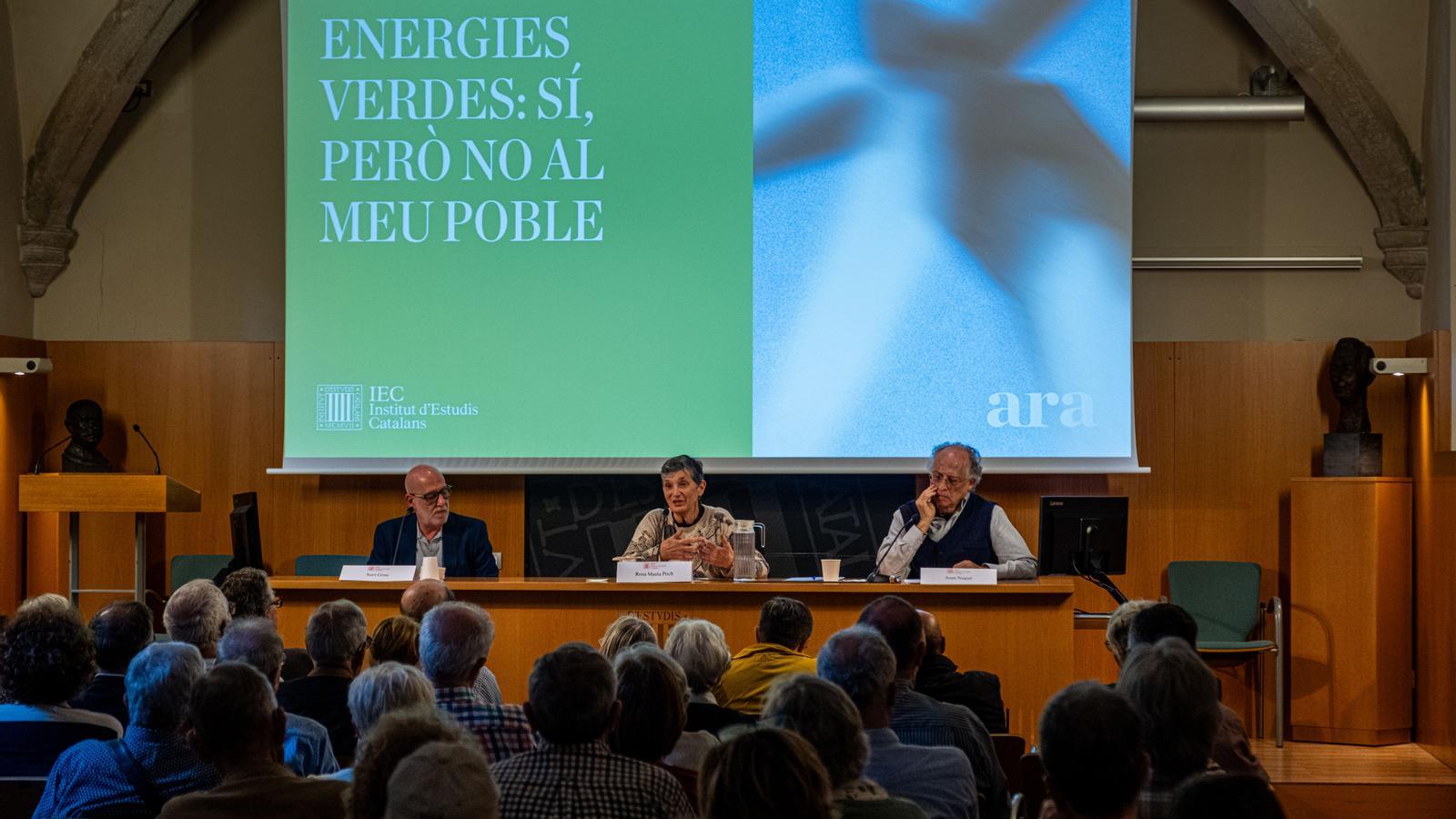
Barcelona"It's not about not installing solar panels or wind turbines, it's about doing it well and with common sense". In recent years, Catalonia has not been able to progress enough in renewable energies and currently the country is very far from the objectives set by both the European Union and the Parliament of Catalonia itself. But how should they be deployed in the territory? Where should solar panels or wind turbines be installed? In an event organized by the Institut d’Estudis Catalans (IEC) and ARA, a reflection was held this Tuesday on which areas should be explored in order to protect agricultural land as much as possible.
The meeting, moderated by the head of the Economy section of ARA, Xavier Grau del Cerro, featured presentations by Joan Nogué, professor of human geography at the University of Girona, and Rosa Maria Poch, professor in the Department of Environment and Soil Sciences at the University of Lleida. Both agreed in pointing out that their deployment should not be concentrated in agricultural areas. And even less so on land that is of first quality.
As an alternative, the speakers suggested that other areas should be exploited: Poch proposed exploring low-quality forest areas that have been left to deteriorate in recent decades and which currently pose a headache for maintenance; while Nogué stated that, before thinking about rural land, it is necessary to exploit already anthropized areas. "The problem is that it is being done the other way around: currently large corporations seek to find the cheapest land with the best yield, and this is found in rural areas. It should start with urbanized areas such as industrial estates, reservoirs, or roads," Nogué concluded.
Criticisms of the plans
In this line, both the geographer and the agricultural engineer have been critical of the current strategic energy projects in Catalonia. "The biggest mistake has been to delegate the Sectoral Territorial Plan for the implementation of renewable energies (Plater) to the Catalan Energy Institute (ICAEN)", said Nogué, who added: "It is clear that they have not set foot in the territory". In recent years, the Plater model has been the subject of debate among entities because its urban-centric vision has been criticized, leaving the rural world as the great victim of the implementation of renewables. Different platforms have also pointed out that it does not sufficiently prioritize the reduction of energy consumption: "If we learned not to waste so much water in times of drought, now it is time to know how to reduce energy consumption", assured the geographer.
For his part, Poch has requested a "territorial planning plan" that takes into account all the conditions of each area. "Using productive land for agricultural purposes will end up being counterproductive for the country; we need to determine which lands are more productive for one thing and which for another", said the agricultural engineer. Regarding the landscape impact, Poch acknowledged that it is "totally subjective" and that "we are in an era where we will have to start getting used to seeing solar panels" in our environment. Nogué, however, added that the landscape is not "purely aesthetic". "We cannot put wind turbines as if we were putting pins in a cushion", he lamented.
