This is the Raval, the first electric car manufactured in Martorell
The company expects to sell 40,000 units this year

-
CAT -
CAST
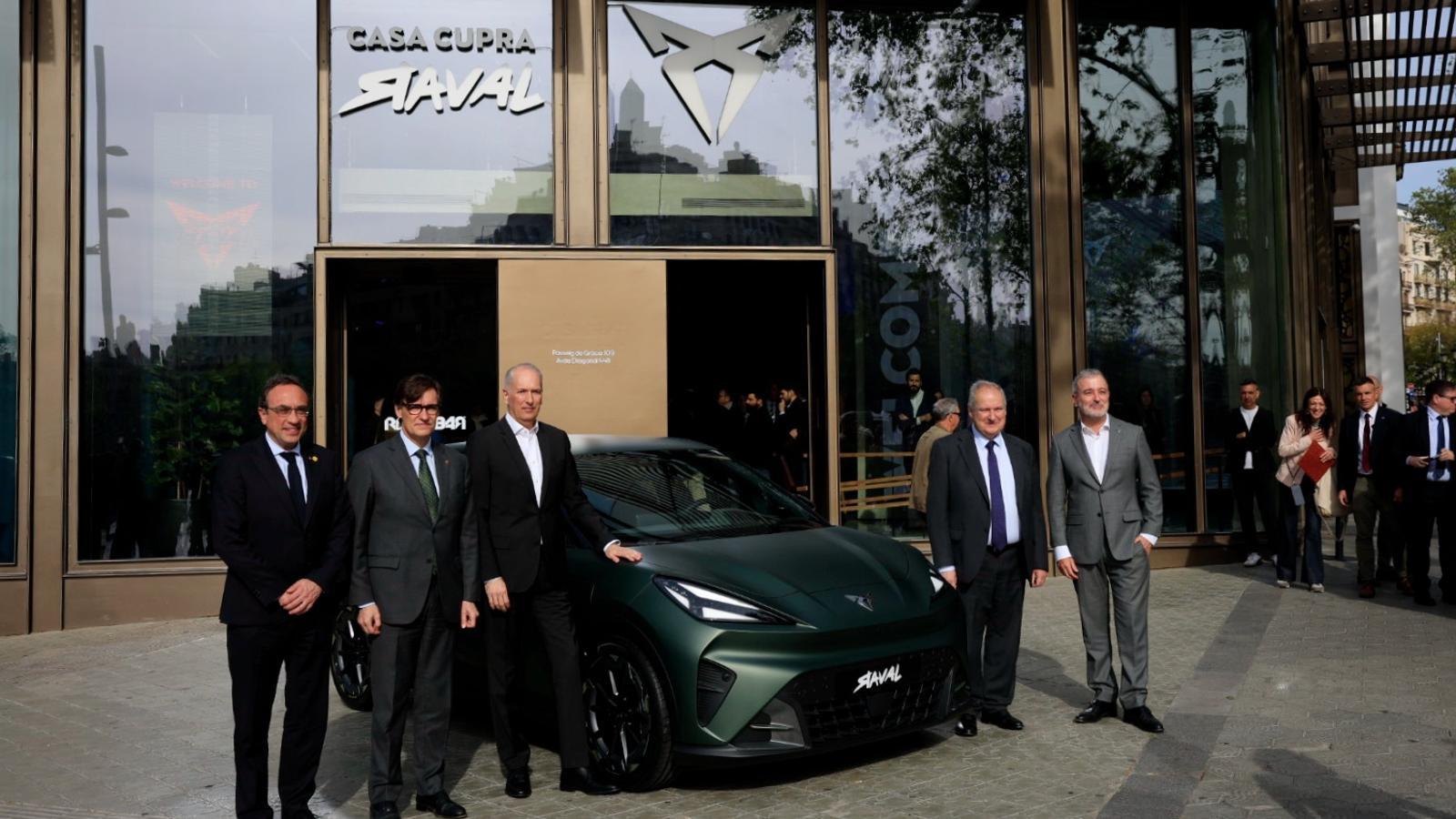
BarcelonaAn autonomy of 400 to 450 kilometers –depending on the version– and an entry price, for the cheapest version, of 26,000 euros –not counting electric car subsidies, which could lower the real price to 22,000– for a 100% electric car four meters long. These are the main features of the Cupra Raval, the first pure electric car designed and manufactured at the Seat plant in Martorell, and which was publicly unveiled for the first time this Thursday at Casa Seat in Barcelona, a space that will temporarily be renamed Casa Cupra Raval.
The presentation ceremony was attended by the President of the Generalitat, Salvador Illa, the Mayor of Barcelona, Jaume Collboni, the Minister of Industry, Jordi Hereu, and the President of the Parliament, Josep Rull, in addition to the CEO of Seat-Cupra, Markus Haupt. After the event, Haupt told journalists that his "ambition" is to sell around 40,000 units of this car this year.

The mass production of the Raval will not begin at the Martorell plant until the end of May, and the car will start to be sold in the summer. But from today, customers can already access the configuration menu on the website to customize their order.
Haupt recalled that to reach this day, Seat has invested 3 billion euros in electrification, and another 300 million euros in a battery assembly plant in Martorell, which are part of the 10 billion euros that the Volkswagen Group and its partners and suppliers have allocated to the electrification of mobility.
Seat's chief executive reiterated, but without setting a date, that the goal is to manufacture 300,000 electric cars in Martorell. Regarding the possibility that the group will award the plant a second electric platform, as the unions are demanding, to ensure viability and employment, Haupt did not want to provide details, arguing that it corresponds to the Volkswagen Group.
Haupt pointed out that the Raval is key for Seat to comply with the emission regulations that the European Union imposes on manufacturers. Furthermore, he believes that this model must be fundamental to achieving the goal of 6% profitability by the year 2030.
Improvement of accounts
In fact, Seat (which includes the Seat and Cupra brands) closed 2025 with a meager operating result of one million euros, despite closing its best year in turnover, at 15,115 million euros. Haupt then already announced measures to contain costs which, as he said this Thursday, are already yielding results. In fact, he highlighted, without giving data, the good performance of the first quarter of this year. "March was the month with the most sales in the company's history," he said, and he celebrated that the year has started "on the right foot and with good speed".
The company has also shed a burden that last year had an impact of more than 100 million euros on results: the tariffs on the Cupra Tavascan model, which is manufactured in China. Shedding this ballast will have "a positive impact on the company's results," said Haupt.
Strategic Autonomy
At the presentation of the new model, both Minister Jordi Hereu and President Illa highlighted the strategic and industrial autonomy that the manufacture of electric cars in Spain represents for Europe. Illa highlighted the adaptation of the Seat plant in Martorell to the electric car as an example of "the industry's ability to transform itself and do so reasonably well." Illa encouraged the purchase of electric cars not only to combat climate change but also for energy autonomy, which is increasingly necessary, as evidenced by the current conflict in the Middle East. "Let's buy electric cars, and if they can be made at home, even better," he concluded.
Regarding the new model, President Illa highlighted that it can contribute to democratizing electromobility, something that Mayor Collboni also emphasized, drawing a parallel with the role that the Seat 600 and later the Ibiza played in putting Spain on wheels.
For his part, the Minister of Industry highlighted that the different administrations are aligned in their support for the electric car because it is "fundamental" for the "strategic autonomy of Europe." He also highlighted that sales of electrified cars in Spain grew by 95% last year, "a transcendental change" for Spain to continue leading the automotive industry in Europe as the continent's second-largest manufacturer.
