10,000 M€ later the first 100% electric car made in Martorell is presented
Cupra will show this week the Raval model with the uncertainty of when Seat will be awarded the second electric platform

-
CAT -
CAST
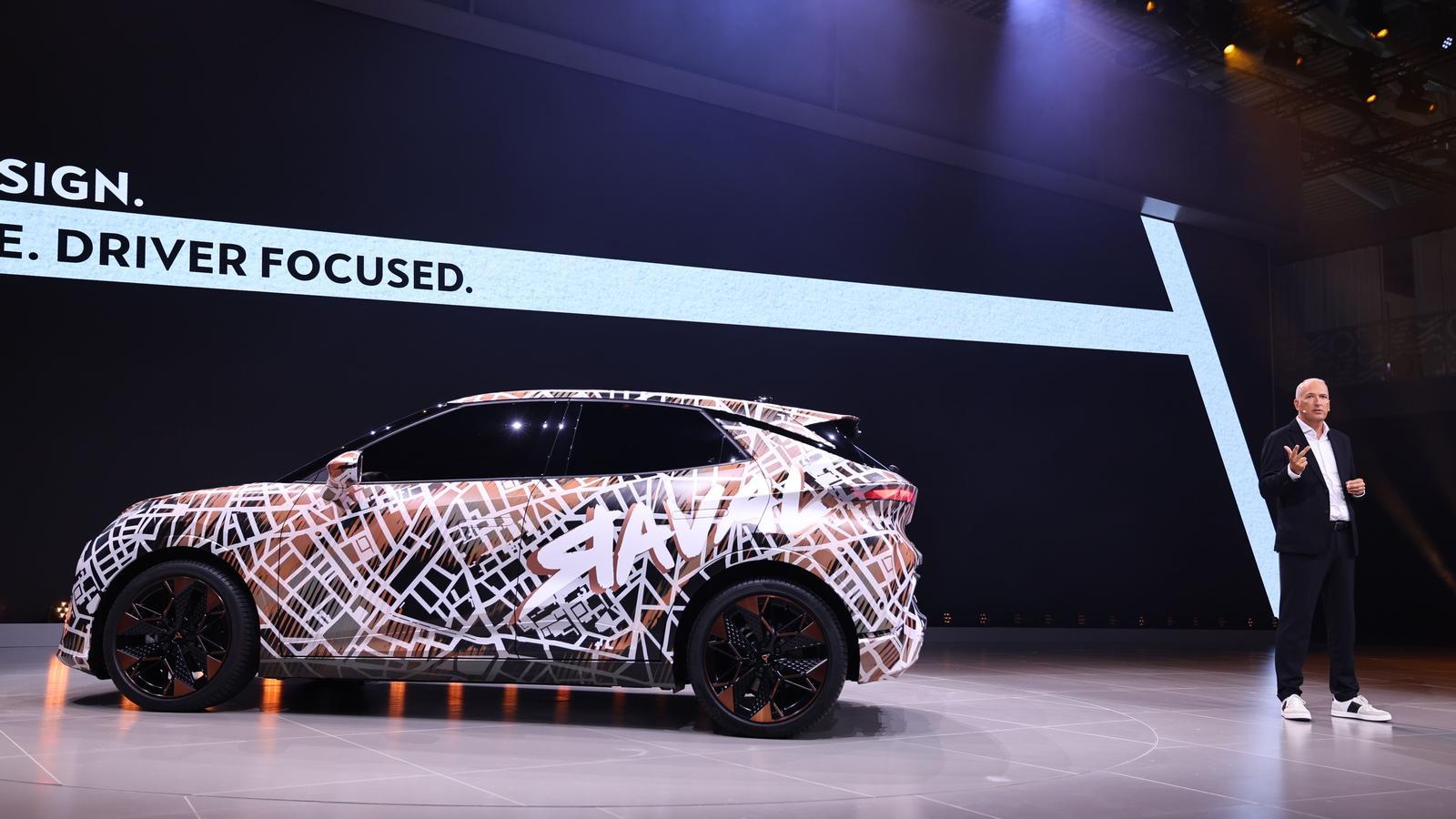
BaercelonaThe day on the calendar is Thursday, April 9. Cupra will present the Raval model, the first 100% electric car designed and manufactured at the Seat plant in Martorell. It is the tangible result of a Volkswagen group plan to electrify mobility in Spain and which, despite presenting its first fruit, still holds many future uncertainties.
It was at the beginning of 2019 when the then president of Seat, Luca de Meo, publicly expressed the intention to manufacture 100% electric cars at the Baix Llobregat plant. Then the pandemic arrived and his successor, Wayne Griffiths, joined the Spanish government's plans to boost electric cars with a PERTE. The Volkswagen group supported these plans and announced the mobilization of an investment of 10 billion euros between the German group itself, its Spanish subsidiary Seat, and various partners in the value chain.
The main investments have been allocated to the battery plant in Sagunt, as well as to the adaptation of the Seat plant in Martorell and the Volkswagen plant in Navarra to manufacture electric cars. In fact, Seat leads the manufacturing of urban and affordable electric cars (around 25,000 euros base price). 300 million euros have been invested in the Martorell plant to build a battery assembly factory and one of the three production lines has been adapted to make electric cars.
The result is that the Cupra Raval will be manufactured in Martorell, as well as the Volkswagen ID Polo, and in the Landaben plant, the Volkswagen ID Cross and the Skoda Epiq will be made.
In this way, Seat, of which Markus Haupt is now the CEO, after Griffiths' departure, will lead the manufacturing of urban and affordable electric cars for all the group's high-volume brands – Volkswagen, Cupra and Skoda –, but without there being any Seat electric car. In fact, the Raval is not the first 100% electric Cupra; there are two models of the brand, the Born and the Tavascan, which are also purely electric. The former, however, is manufactured at the Volkswagen plant in Zwickau (Germany), while the latter is manufactured at the Volkswagen plant in Anhui (China). In fact, this model has sunk Seat's profits in 2025 because it was subject to the tariffs that the EU imposes on Chinese cars. Now, however, the group has agreed with Brussels to reduce these taxes.
Objective and uncertainty
The medium-term objective for the Martorell plant was set by Markus Haupt on the day of the 2025 results presentation: the Martorell plant should produce 600,000 cars a year, of which 300,000 should be electric. In 2019, 500,000 units were manufactured in Martorell, the second-best year in history. But with the pandemic, production levels fell and recovery has been slow. In 2025, 470,347 cars were manufactured, a figure lower than the previous year, but it must be taken into account that the manufacturing volume was affected by the plant's adaptation to the electric car.
Although the Martorell plant has good manufacturing figures and better expectations with the launch of the Raval first and the ID Polo afterwards, the fact is that the future worries the company and also the workers. First, due to the decline in the production of combustion engine cars. Diesel engines, in Spain, are practically banished. And gasoline ones are clearly on the decline. Furthermore, there is the precedent of what has happened in the Volkswagen group. It does not affect the business in Spain, but in Germany things are already happening in the group. For the first time in 88 years, Volkswagen has closed a factory in Germany, the Dresden factory, also known as the glass factory. But it is not the only impact; the company wants to reduce its workforce in the Germanic country by a third, which would mean eliminating about 50,000 jobs by 2030.
For this reason, Seat is demanding a second electric platform that will ensure its viability as a factory apart from combustion engine cars. The different executives who have led Seat in recent years have demanded it. The workers too. The chairman of the works council, Matías Carnero (UGT), says in an interview with Efe: "I believe that Martorell cannot survive from 2030 onwards without a second electric platform." Carnero recalls that Seat has set a profitability target of 6% by 2030 and emphasizes: "Manufacturing small cars will make it very difficult to achieve this profitability that they are asking us for."
"In addition to these two electric cars [Raval and ID Polo], we need another one that adds more added value," Carnero assures Efe, and points out that one possibility would be to manufacture the electric version of the Cupra Formentor, the flagship of the Cupra brand, in the near future.
