The State plans to increase the capacity of the electrical network by 50% by 2030
The plan will add 3,800 MW to satisfy the energy demand

-
CAT -
CAST
BarcelonaThe Spanish government plans to increase the capacity of the electricity grid in Catalonia by 50% by 2030. Thus, the grid will add 3,800 megawatts (MW) to the electrical system, which will allow for addressing the growing demand from both private individuals and public infrastructure investments. This increase is the part that corresponds to Catalonia in the plan by Pedro Sánchez's executive to improve the electricity grid throughout the State, which includes investments worth 17 billion euros in all autonomous communities over the next four years.
"There is a before and after" for this plan, the Minister of Territory, Sílvia Paneque, assured this Thursday. The minister met with the Secretary of State for Energy, Jordi Groizard, to specify the electrical planning in Catalonia within the state plan: The plan provides for creating new electrical substations—and expanding current ones—that will serve both current and new consumers, but at the same time to ensure the supply for new infrastructure and business projects that will require high levels of energy consumption.
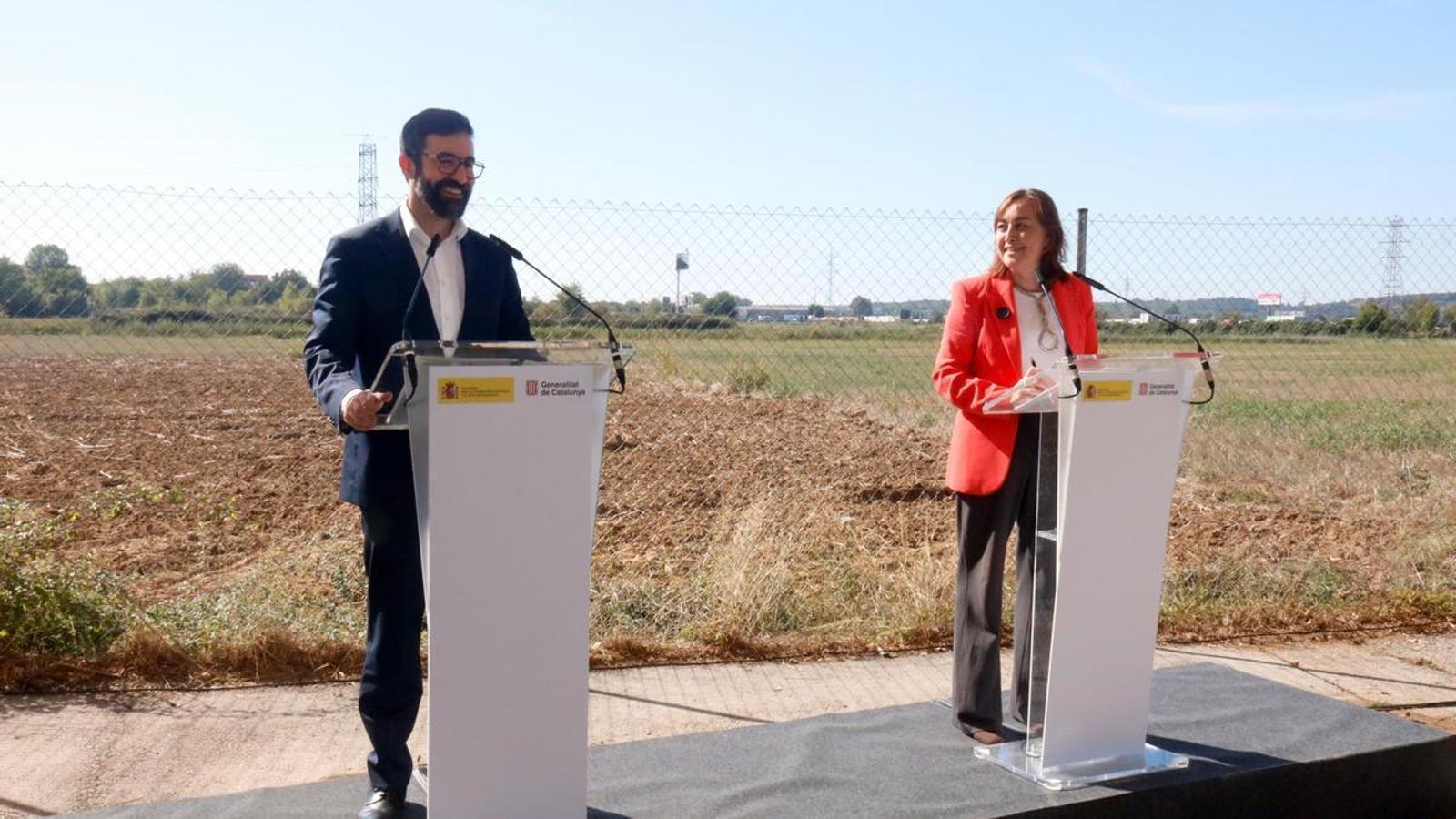
Among these projects is, for example, the construction of a new substation to serve the two health campuses of the Hospital Clínic in Barcelona and the Hospital Josep Trueta in Girona. In fact, Paneque and Groizard met with the media from the land that this second campus will occupy in Salt (Gironès).
In addition, Paneque highlighted other projects that will be carried out thanks to this expansion of the electricity grid. One of the main ones is the construction of a substation for the artificial intelligence (AI) gigafactory in Móra d'Ebre that the State is promoting in a consortium with the Catalan Government and a group of private companies led by Telefónica, ACS, and Banco Santander.
Apart from these, the representatives of the state government and the Generalitat have also agreed to include in the plan the electrical connections for the new desalination plant on the Costa Brava, the Torreblanca-Quatre Pilans industrial estate in Lleida, the hub for the audiovisual sector Catalunya Mediacity in Sant Adrià del Besòs (Barcelonès), and to bring 400 kilovolts (kV) to the port of Barcelona. A new substation named Químico will also be created to increase the capacity of the petrochemical industrial estate in Tarragona and another one in the Cardener river basin, in Central Catalonia.
Improvement in renewables
"We are preparing the grid so that more energy can reach it and also more can be generated through renewable sources," declared Paneque. Furthermore, both governments have agreed on what should be the "major entry points for electricity in Catalonia," she said.
Groizard explained that the investments will serve to improve "the extra-high voltage grid of Red Eléctrica," the public operator of the transmission network, as well as to "strengthen the distribution network that reaches final consumers." With these new investments, the two administrations aim for "Catalonia to be able to advance in renewables and electrical storage" and to "respond to industrial aspirations" and infrastructure that improves public services, the Secretary of State added.
In this regard, the state-owned company Red Eléctrica (REE) will be in charge of constructing the transmission infrastructure and substations, while connections to consumers will be carried out by electricity distribution companies, as is customary. Paneque has announced the creation of a "periodic monitoring commission" with distribution companies to track compliance with schedules. In this sense, Groizard indicated that "the idea is that this new planning can be approved before the end of the year and the projects that are part of it can begin to be implemented."
