The mystery of the tolls remains alive five years later
Catalan economists warn that "free of charge does not eradicate the cost" of roads and ask themselves "who must assume it"

-
CAT -
CAST
BarcelonaFive years after the end of tolls on the AP-7 and AP-2 —the main motorways in Catalonia—, some 250 economists and mobility experts spent Wednesday morning reflecting on the management of the country's main roads. "As economists, we know that apparently free decisions also generate costs and that, if they are not assigned explicitly and transparently, they fall on taxpayers or are passed on to the future," warned the dean of the Association of Economists of Catalonia (CEC), Carlos Puig de Travy.
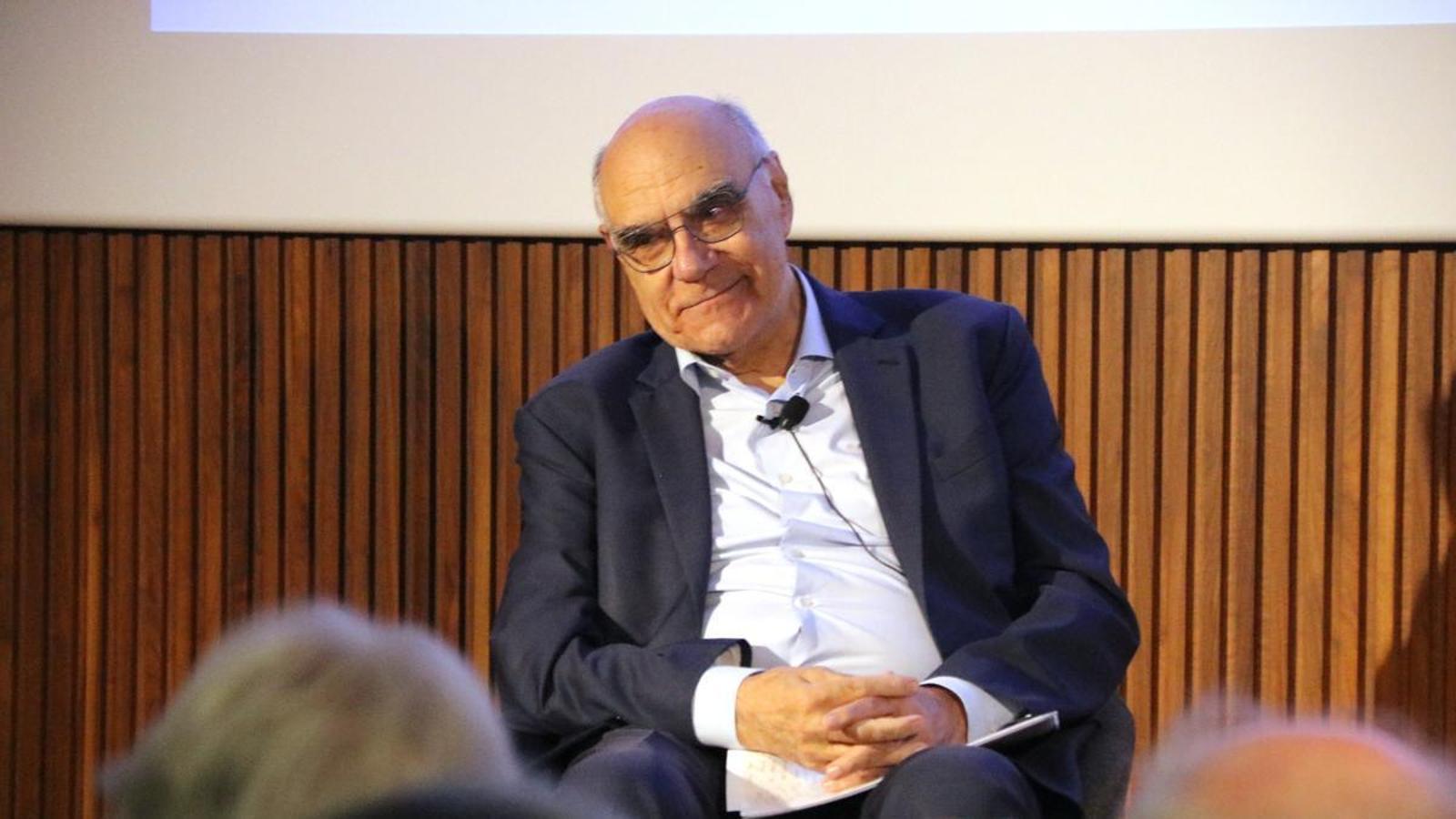
Salvador Alemany, former president of Abertis, the operator that managed the bulk of the controversial tolls, recalled that road infrastructure has "a very significant cost for maintenance, management and transformation" and that, without a financing model, "it is difficult to guarantee the resources to maintain them in a stable manner."
In the conference Free and sustainable motorways? An oxymoron, Alemany warned that "the question is not whether roads have a cost, which they do, but rather who should assume it." "We were wrong, not so much in the decision [to remove the tolls], as in not having designed an alternative model. In fact, it would be a model, not an alternative one, because before there wasn't one," he criticized.
Not just money
The No Vull Pagar movement of 2012 —which in many cases explicitly targeted Abertis— was born from the comparative grievance suffered by Catalan roads compared to other territories of the State where drivers did not have to pay per trip. In fact, Catalonia also led in shadow tolls, a system of building infrastructure during the cuts in which a private company made the investment and the Government committed to paying it for its use. Obviously, the concessionaire not only amortized the investment but also obtained a profit from it.
The end of the tolls was "the result of a system that had accumulated inconsistencies and territorial inequalities for decades", in Alemany's opinion, and "not just an economic issue". For years, "while the private sector invested, it did not count as public debt for the administration", he pointed out. In 2021, most of the concessions ended. And now what?
The numbers
According to the Ministry of Transport, the State's high-capacity network is made up of 17,700 kilometers of roads, which require an annual investment of between 2.1 and 2.2 billion euros to ensure their maintenance. Each year, the distance traveled through this network is around 180,000 kilometers: 3 out of every 4 are made by cars, and the rest by trucks and trailers.
Alemany has assured that the lack of investment causes congestion and has economic and environmental consequences, and he did not want to enter into the issue of accident rates: "It is believed that infrastructure maintenance can wait, because it is detrimental for a moment, but it is the condition of the moment that creates the narrative".
Faced with this situation, he has initially ruled out "reintroducing tolls" and has opted to propose a unified tariff system (STU) in which new infrastructure and major transformations depend on public budgets, but in which "the user pays for what they wear down, for what they will later find replaced or not". In his view, "the amounts will be substantially lower" and "it is the best way to make the user understand" how the model works.
The magic formula
Beyond the particularities of the proposal by the former president of Abertis—which involves creating a Public Mobility Agency governed by a principle of budgetary balance—, Alemany and De Travy share the underlying conclusions.
On one hand, both agree that "the complexity of the moment cannot become a reason not to face the problem," to which, "for years, partial solutions have been applied." On the other hand, they have called for "overcoming the short term," "providing cyclical responses," and seeking a "broad political and social consensus," shielded "by law." Premises that have inevitably led to the creation of "a working group"—in Alemany's words—and "a broad political pact"—De Travy's—, which could also close the chronicle of an event about the future of the road network.
