Salvador Illa announces 3.300 million for "accelerating" infrastructures in six years
The President of the Generalitat clashes with the Cercle over rent control in housing

-
CAT -
CAST
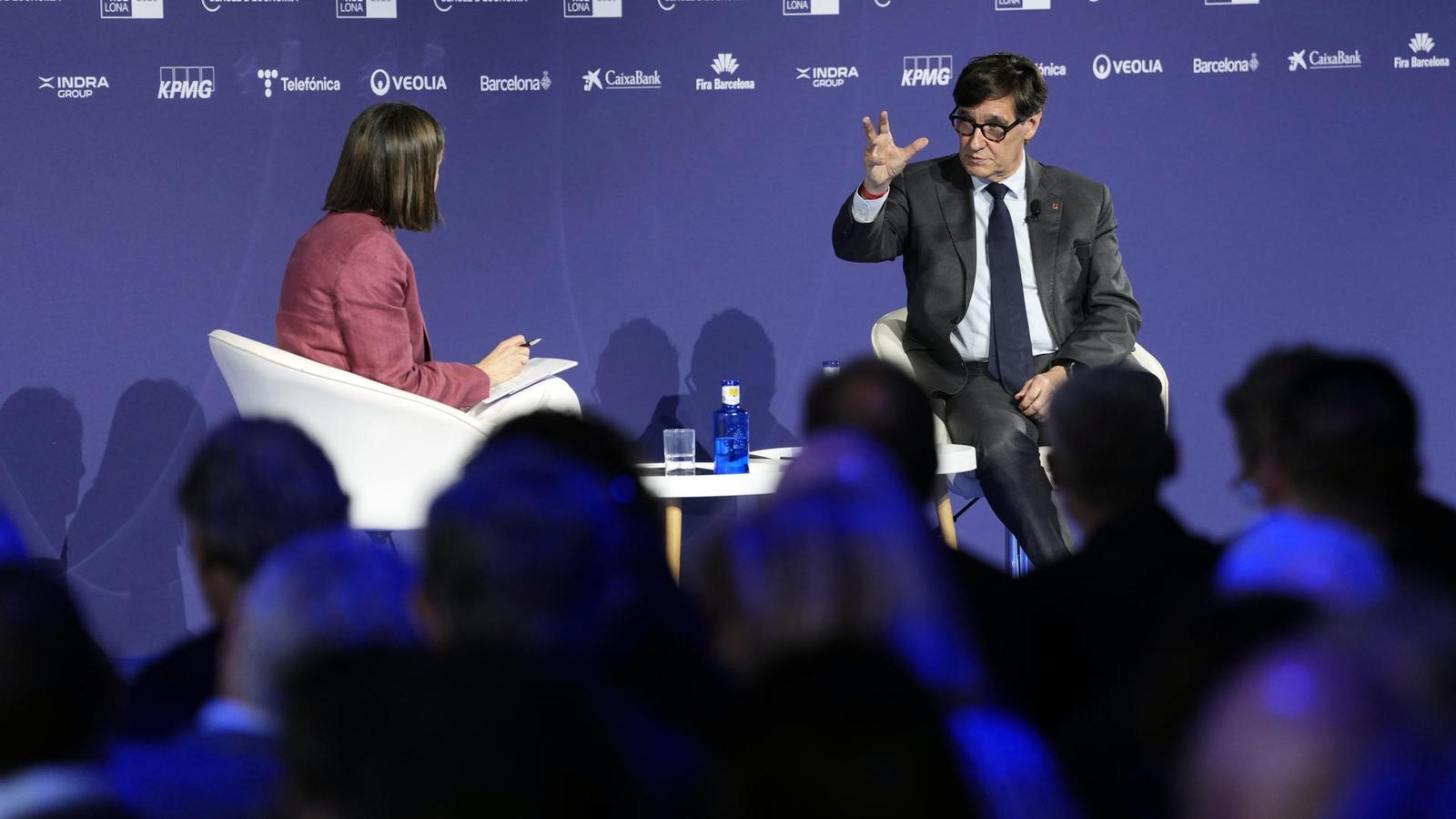
BarcelonaWith the budget agreement under its arm, Salvador Illa landed this Monday at the annual conferences of the Cercle d'Economia with the tranquility of presenting himself to the Catalan business fabric with an "stability" that the sector values – in the words of the Cercle's own president, Teresa Garcia-Milà. If the orbital railway line – which must connect cities in the second metropolitan ring, from Vilanova i la Geltrú to Mataró, without passing through Barcelona – was the key to the pact with ERC for the accounts, the President of the Generalitat has taken advantage of the platform that the Cercle has given him to put infrastructure back on the table and make an announcement: the Government will mobilize 3,300 million euros from public-private collaboration to "accelerate strategic infrastructures". "Now is the time to recover a system that has been stalled since 2010, a public-private model for infrastructure," Illa defended before the Catalan business community.
How will this injection of resources translate? About 1,800 million will be mobilized "immediately," said the president. This money will be allocated to works such as the stations of the central section of metro line L9 (budgeted at 500 million euros), the deployment of 2+1 road axes, i.e., doubling one lane on 366 kilometers (720 million euros) or also the partial doubling of the Berga-Bagà section (470 million euros). For the remaining 1,500 million, the Government plans to allocate them to the doubling of the C-55, the second phase of the tramway of Tarragona and Reus, bus interchanges, and the railway terminal of Lleida-Quatre Pilans.
Illa defended this investment to carry out works in the "next 6 years" which, if not done with this model, could not be done for another "20 or 25 years," he stated. According to the president, in the "market consultations" that the Government has carried out to move forward with some of these projects, they have already received a positive response from 70 entities. "Let's build the infrastructure that the Catalonia of 8 million needs," he concluded.
In addition to the investment in infrastructure, Illa also announced that, given the Middle East crisis, a new route between Barcelona and Taipei will be launched. Last Friday, Starlux Airlines CO announced this proposal to its shareholders for early 2027. Barcelona now has direct flights to Shanghai, Beijing, Seoul, and Singapore. "We need, we can, and we want to make Barcelona airport a hub of reference for its excellence in all aspects: technical, strategic, and environmental," defended the president.
The new financing model
The Cercle liked Illa's announcement and its president has highlighted it, who has also asked the President of the Generalitat for an impetus to materialize the new financing model. "Neither Catalonia nor the common regime autonomies can wait any longer," stated Teresa Garcia-Milà. Illa took her up on it, committing to make "every political effort for it to prosper and be approved this legislature." "We have to push, I am aware that it will be so," she added.
Garcia-Milà and Illa also showed harmony when addressing the migratory issue. The president of the Cercle advocated for a "country debate" and the President of the Generalitat emulated former president Jordi Pujol to defend an integrative migratory policy that shies away from "populist" discourses. "Today Catalonia has 8 million inhabitants and Catalan identity has not been threatened, the economy is working well. There are historical arguments that we should keep in mind," she stated. The president also defended that current legislation must be applied to everyone who does not follow the rules of coexistence, regardless of their origin.
The housing problem
Where they have clashed is on housing matters. The Cercle does not share the policy of capping rent prices and has made this known to Garcia-Milà. "Rent control can moderate prices in the short term, but it slows down supply and ends up being a regressive measure," he said, after prescribing "increasing supply" with the participation of the private sector, as well as the mobilization of available land and "legal certainty." The president, however, defended the cap, but admitted to being "willing to study any action." "I prefer to be wrong and correct myself than to do nothing," he added. Illa, however, warned that this problem will not be resolved "next month or next year."
