Less growth and more inflation due to the war in Iran: the Chamber revises economic forecasts
Inflation could exceed 4% if the conflict becomes entrenched, according to the business institution

-
CAT -
CAST
BarcelonaThe Catalan economy will slow its growth this year, accompanied by an increase in prices, if the armed conflict in the Middle East is maintained or worsens, according to the economic forecasts of the Barcelona Chamber of Commerce.
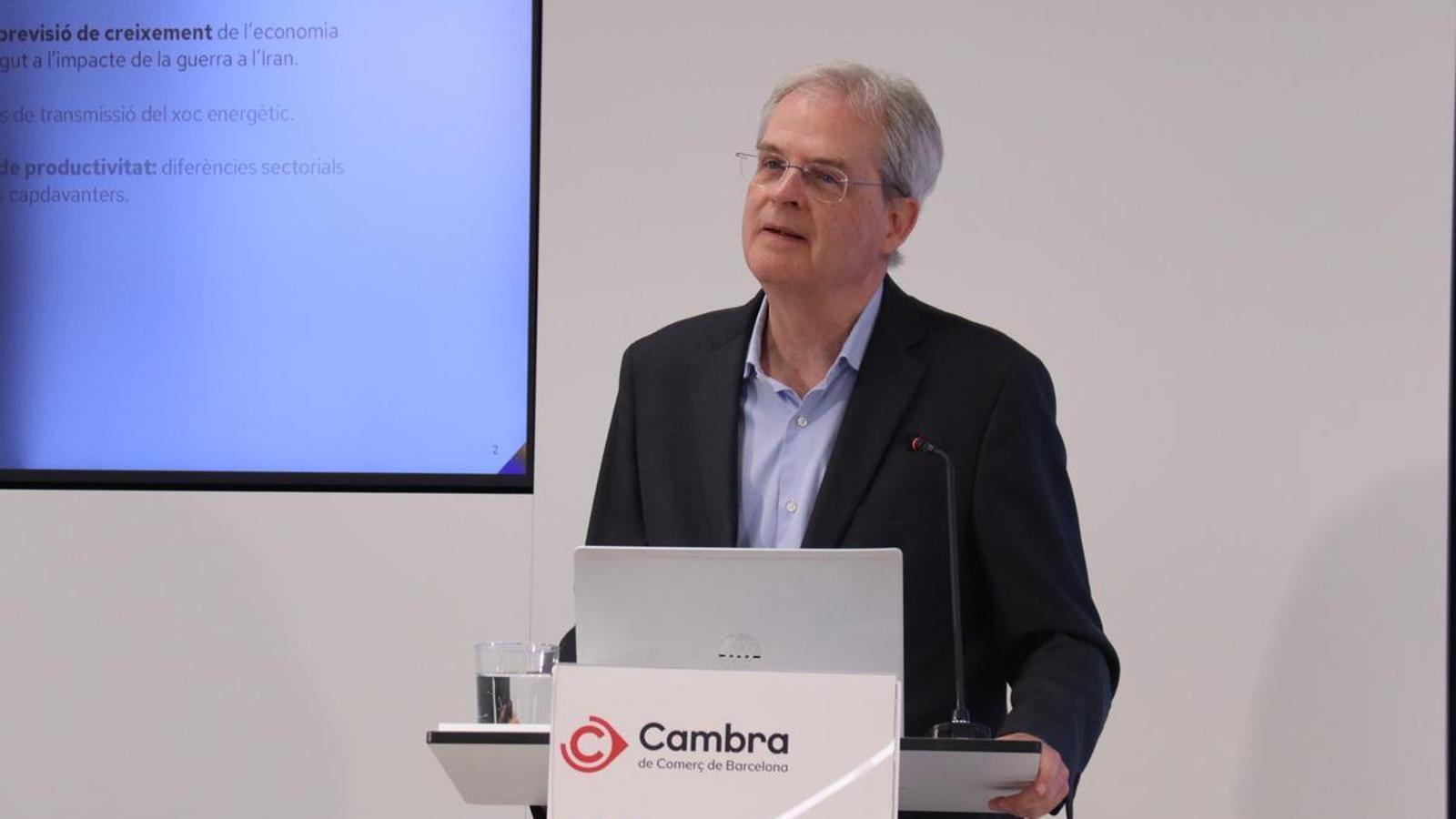
The business organization has updated its growth forecasts for 2026, which in its latest estimate, three months ago, had placed at 2.4% and which it now lowers by two tenths, to 2.2%. Regarding growth for 2027, the Chamber places it at 1.7%. However, growth could decrease and the Chamber leaves the door open for further cuts if the war continues. "If the conflict has intensified by July, it would certainly imply another downward revision this year", and would even reach, in an extreme case, 1.4% annual growth, explained the director of the Chamber's studies department, Joan Ramon Rovira, at a press conference this Tuesday in Barcelona.
Likewise, the war in the Persian Gulf will have a direct impact on the cost of living for families. The chamber expects the annual inflation rate in Catalonia to climb this year to an average of 3%, compared to 2.5% last year and one percentage point above the long-term target set by the European Central Bank (ECB). This revision of forecasts, however, is "highly conditioned" by the "great uncertainty" that exists, especially in the international context, indicated Rovira, and in the case of an adverse scenario regarding the evolution of the war, inflation could skyrocket between 4% and 5%.
Consumption and investment are driving the economy
Despite the poor prospects related to the external situation, internally the Catalan economy maintains a good performance, thanks to job creation and the good performance of family consumption and investment, especially productive investment by companies. "The Catalan economy has great capacity to resist and advance," declared the president of the Chamber, Josep Santacreu.
In fact, this past Tuesday, employment and Social Security affiliation figures published by the Spanish government once again showed a record of workers with jobs in Catalonia, which contrasts with the data from the Labor Force Survey (EPA) last week, which registered a leap in the unemployment rate in Catalonia. "Employment is growing at a very good pace in the Catalan economy as a whole," said Rovira, who explained that the increase in unemployment is mainly due to the incorporation into the labor market of more people seeking work than those who find it.
"Employment is still on the rise and real wages are still growing, albeit very moderately, along with the savings rate" of families, added the Chamber's studies manager. This explains the strength of household consumption in the fourth quarter of last year, which was the engine of 68% of economic activity in Catalonia.
Likewise, productive investment – that made by companies to improve productive assets, such as machinery, computer programs, energy systems, and patents, among others – grew by 21% between 2019 and last year and represents 32% of activity. "The capital endowment per employed person is growing a lot and should boost productivity," commented Rovira.
If in the internal sphere the economy still remains firm, exports are "the other side of the coin", as was to be expected due to the effects of the war in Iran. In recent years, Catalan goods exports had withstood a drop in volume in tons thanks to an increase in the total value in euros of what was exported – that is, Catalan companies exported less, but sold at a higher price – but in the first months of 2026, a decline has already been registered in both tons and total value; a fact that, according to Rovira, was "to be expected".
In this regard, the external sector subtracted 25 percentage points of growth from the Catalan economy in the last three months of last year, which were offset by public administration consumption. Nevertheless, tourism – which is also part of the external sector, as it represents the inflow of money from abroad – continued to contribute positively to growth, although in recent years a moderation in overnight stays by foreign visitors has been noted and there is room for growth in spending per person, which is still below pre-pandemic levels.
Rovira believes that the increase in the price of kerosene "will have a very clear and very negative impact" on the tourism sector this year, although at the same time he foresees a "positive impact" due to the "diversion" of tourism from Middle Eastern countries "to other Mediterranean countries like ours".
More employment in high value-added sectors
In the study on growth forecasts, the Chamber also pointed out that, contrary to what is often stated in public debate, the high creation of employment is not concentrated solely in low value-added sectors. In this regard, between April 2024 and March 2025, high value-added services –a broad segment that includes diverse sectors, such as information technologies, telecommunications, consultancies, engineering, or IT services– increased employment by 7.7%, far above the average of 2.2% in Catalonia as a whole, and the 1.4% and 0.9% for tourism and manufacturing industry, respectively. Commerce, moreover, destroyed 0.3% of employment.

This creation of new jobs in high value-added services should serve to increase the productivity of the Catalan economy. Despite this, the Chamber has presented data for various productive sectors showing that the differences in productivity levels between Catalonia and the rest of Western European countries are generalized across all sectors and, therefore, productive improvement is "a transversal challenge for the entire economy", commented Rovira.
