Catalonia imports 80% of the wood it consumes
Different voices point out that its potential in Catalonia is much higher than the use it is currently being given

-
CAT -
CAST
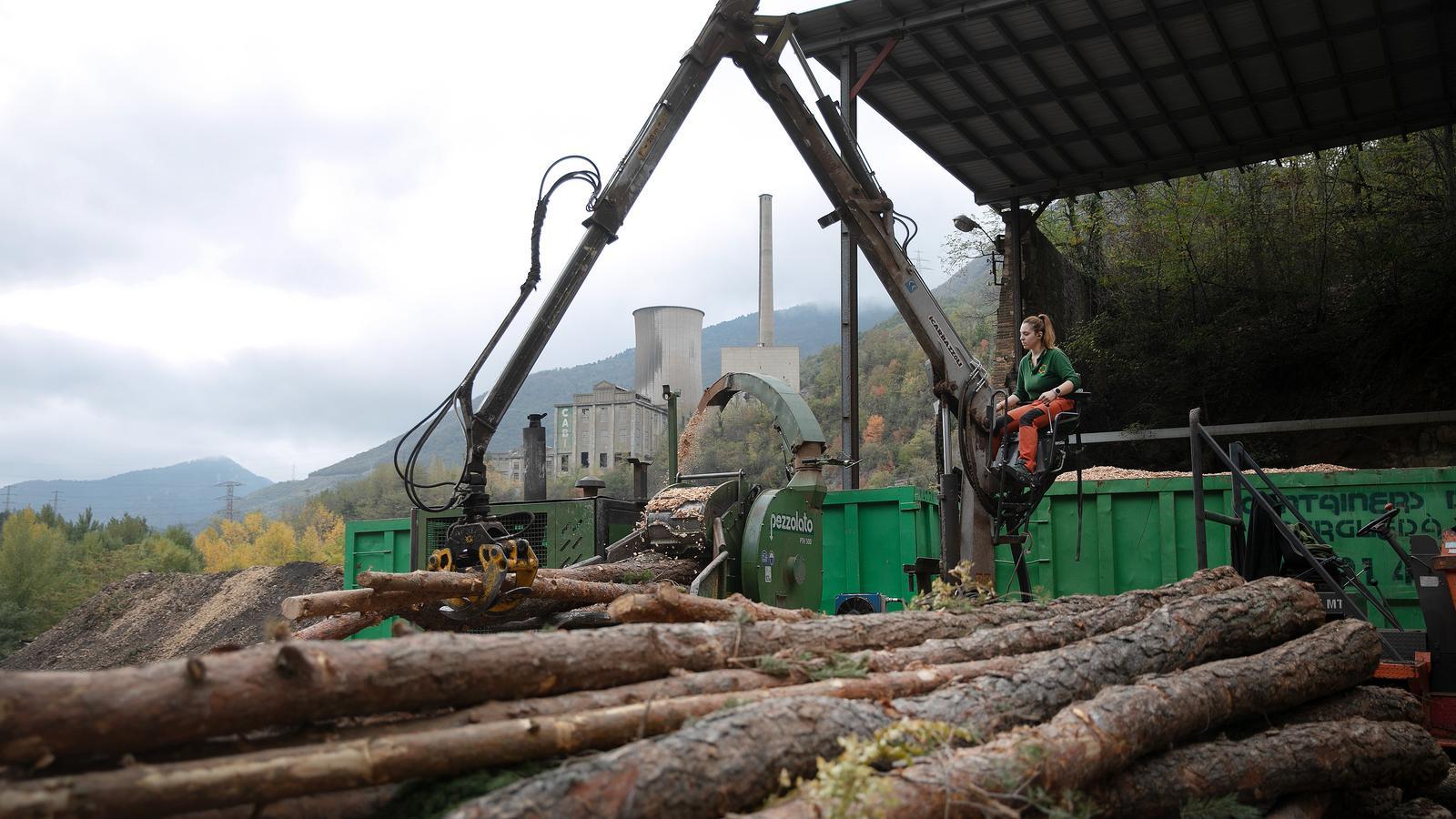
MadridThere are no more woodcutters. This forest trade from the mid-20th century disappeared due to the energy transition – the replacement of natural resources with fossil fuels – and the rural exodus towards cities. It is an example of how the economy of many territories has been transformed and, consequently, their landscape, especially the forest. Reflections like this have been brought back to the table following the major fires that have ravaged Catalonia and the State, and which have put the need – although some speak of an obligation – to manage a forest that, added to the climate crisis, has an unprecedented fuel load. And behind it all, a key but wasted resource: wood and its potential. "It has much more than we are giving it," anticipates Mario Beltrán, technician at the Centre for Forest Science and Technology of Catalonia (CTFC). This does not mean that wood is not used in our country, but much of it comes from abroad. Today, Catalonia imports 80% of the wood it consumes. Of this amount, 40% comes from other parts of Spain and the rest from abroad. In Spain as a whole, more wood is also imported than exported, especially in the form of products with higher added value such as sawn timber and paper pulp.
It may seem like a paradox considering that, for example, Catalonia has a significant forest mass and a relevant local production in specific parts of the territory. In fact, 70% of the territory is forest land.
To begin with, it is not a quantity problem, points out Beltrán, who not only believes there is enough wood, but that the governance model in the Principality is "robust" enough to ensure that, for example, illegal logging does not occur. "We must be able to trust that if we promote wood, there is no environmental problem, because it should be done [in a] sustainable [way]," adds this technician.
Nor is it a quality problem for wood, points out the CTFC engineer, although he acknowledges that technically it is different from the wood that is imported. "[In Catalonia] there is good [wood]," state the Centre for Forest Science and Technology of Catalonia. In this case, David Vivet, a technician from the forest area of Unió de Pagesos, assures that the wood production from Catalan forests is not what the industry wants, which demands a higher "quality."
A matter of price
On the other hand, there is one element that does generate discord: the price of wood, which helps to understand, in part, the loss of use of local wood and import levels. The Catalan Forest Observatory highlights that, in general, the price of wood is "stable", although with occasional upticks in the case of structural conifers —wood from pines, firs, or white firs used for products such as beams, trusses, and roof or wall frames— and wood for packaging. Furthermore, the growth peak recorded in 2021 and 2022 due to the economic shock of covid-19 and the supply crisis stands out.
For Vivet, however, this price is not adequate, but rather "artificially low". Additionally, the head of the forestry sector of Unió de Pagesos points to a lack of competition in the sawmilling sector. "The production price and costs are not reflected in the final price," he indicates. On the other hand, it is more profitable for buyers of this wood to purchase it from abroad, points out Beltrán. "However, this import has negative externalities that are not taken into account, such as the impact on climate change," he adds.
Beyond high-value products
However, for some time now, different voices have been calling for looking beyond the use of wood solely for construction or pallets. "It is necessary for society to demand forest and agroforestry products, not just wood for construction, but also biomass for thermal use, among others [...]. This consumer awareness is one of the keys to change," reflects Marta Corella, a forest engineer.
"Any school or office should be able to be heated with biomass, but this requires a forest plan to guarantee energy for 10 to 15 years," adds Vivet. Precisely, biomass consumption in Catalonia grew by 19% in 2025, according to data from the annual report of the "Strategy to promote the use of forest and agricultural biomass, published a few days ago. Forest biomass consumption rose to 652,500 tons annually, and the managed forest area increased to 27,186 hectares.
But regarding the total area, there is still a lot of work to be done in terms of management, both for public forests (which is only a quarter of the total, according to ACN data) and private ones. The problem, they all agree, is "the profitability of forests." In the case of the private sector, Vivet points to a lack of aid. "It is true that nothing is gained from it and it generates a cost, but we are talking about only 5 million euros per year being allocated for all of Catalonia when the forest mass accounts for 70% of the total territory," indicates Vivet. According to estimates by Unió de Pagesos, in the latest calls to request lines of aid for forest management and planning work, the value of the applications amounted to 17 million euros.
At the same time, there is a social factor that, in Beltrán's opinion, is also important: the perception of the use of raw materials. "If the exploitation is done with wood from here, it is negative; but when it is tropical wood, we do buy it."
