Banking drags European stock markets to a day of losses
The war in Iran aggravates the setbacks of Ibex financial entities, which falls 2.4%

-
CAT -
CAST
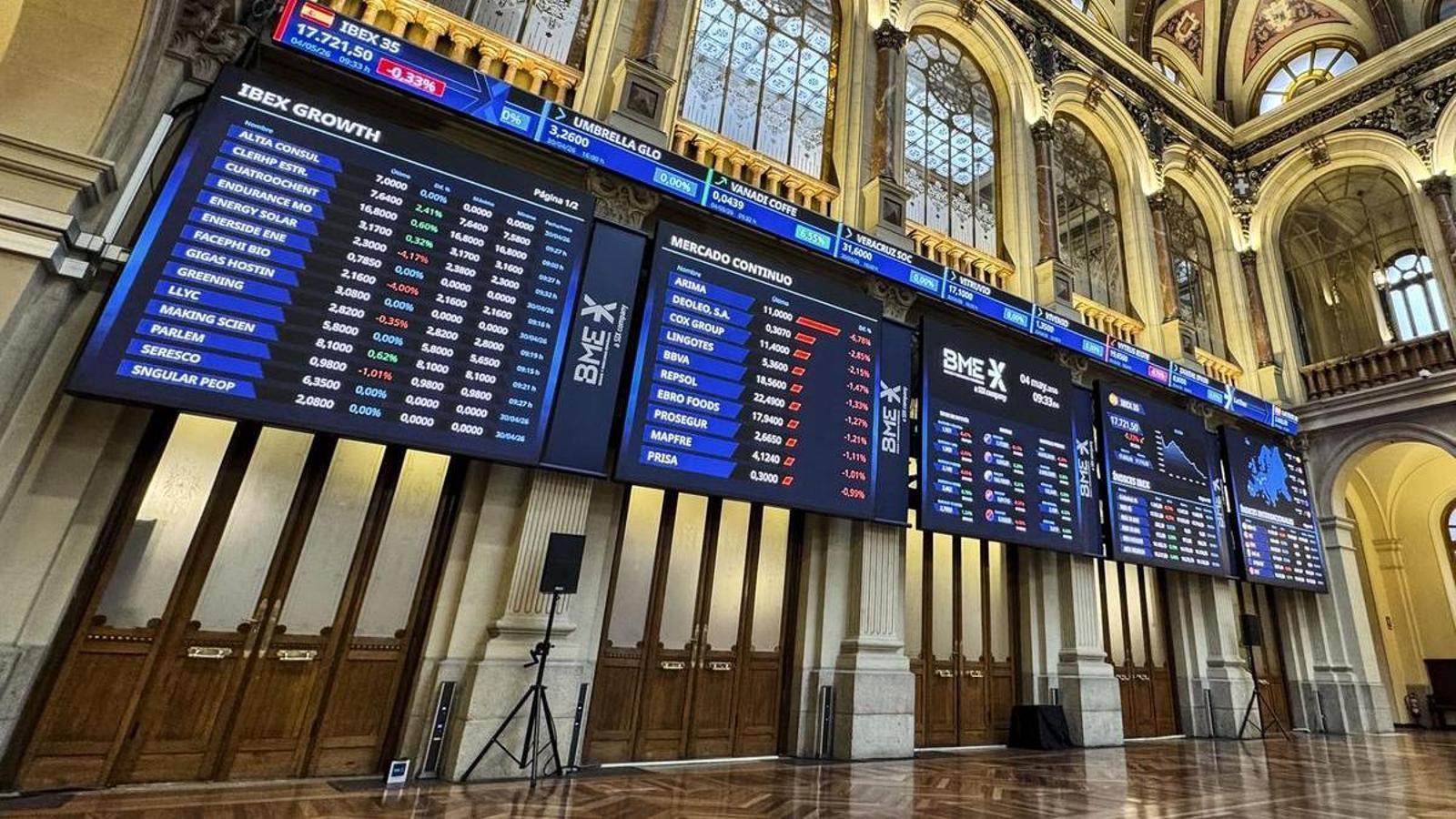
BarcelonaBanking has suffered a black day on the stock market. Financial institutions have painted European main indices red, dragged down by forecasts of economic contraction due to the war in Iran. All countries have seen their banks lose momentum since the opening, but the Spanish state is among the main victims. The Ibex-35, much more heavily weighted with banking stocks than the rest of the relevant EU indices, has fallen by nearly 2.4% this Monday, and is once again moving away from the 18,000-point threshold that marked its rally since the start of 2026. Far from these figures, the German Dax 40 has survived the declines in the stock prices of Commerzbank and Deutsche Bank, and has stopped its freefall at -1.2%; while the French Cac 40 has dropped by nearly 1.7%.
The biggest losers in Spanish banking are also the worst performers of the day on the Ibex: BBVA has seen its stock devalue by nearly 4.8%, while Unicaja has fallen by around 3.8%. In the case of the bank chaired by Carlos Torres, the setback has pushed it away from the 20-euro ceiling set by analysts, and it ended Monday just above 18.1 euros. This is despite having declared a first-quarter profit of close to 3,000 million euros, an 11% increase compared to the same period last year. The other internationalized bank, Santander, has also lost ground, closing the session with a drop of almost 3.9%. On the other side of banking stocks, the two brands of Catalan origin, Banco Sabadell and CaixaBank, are the least affected by the bearish whirlwind, with a drop of 1.4% and 2.3%, respectively. Bankinter is in the middle, retreating 2.3%
Analysts see a "structural" drop in bank valuations. During the first weeks of the war in Iran, according to XTB expert Javier Cabrera, the oscillations were more moderate because the sector still expected a short conflict, one that would not cause lasting damage to the global economy. Two months later, however, investors seem convinced that complicated months are approaching. "There is a clear fear of a drop in credit demand in the second quarter, because people will stop taking out mortgages, or other loans," warns Cabrera. Furthermore, in the economist's opinion, "the sector's results have not managed to convince" shareholders, who have decided to be conservative with their positions. This would explain Sabadell's performance, which is less alarming than that of its competitors: "Without the figures on the table, it is normal that there is no movement." In the short term, he observes the possibility of a "rebound" once the sector stabilizes, but considers that the poor forecasts for mortgages and consumer financing "will weigh" on the stock price.
European banking also falls
The situation of financial entities in the European environment has not improved the Spanish one in the early hours of the week. However, the drop in quotations has affected the general health of the respective stock markets less, because the weight of banking is substantially higher in the Ibex than in its community counterparts. In the case of the German Dax 40, only two credit companies are listed: Deutsche Bank and Commerzbank. The firm led by Christian Sewing falls by 2%, below 26 euros per share; while the bank commanded by Bettina Orlopp loses more than 3.3% of its value, and remains at 34.17 euros per share.
In the French case, also below the Spanish selective index, there are three listed entities that appear in the Cac 40. One of the three makes a difference compared to the European financial sector: Crédit Agricole falls only 0.5%, held back, among others, by the acquisition of the private bank Milleis, which was completed last week. BNP Paribas registers a similar performance to that of Deutsche or the two Catalan banks, with a drop of 2%; while Société Générale plunges nearly 4%. This is the second bearish session for the giant led by Slawomir Krupa, after a collapse last Friday of 6%. The market has received the first-quarter results with criticism, which showed a 5.5% increase in profits, below the expectations of the main analysts.
