"You look at yourself in the mirror and say: 'Who is this lady who has usurped my voice?'"
Cristina Genebat presents her debut novel, 'Sorra'

-
CAT -
CAST
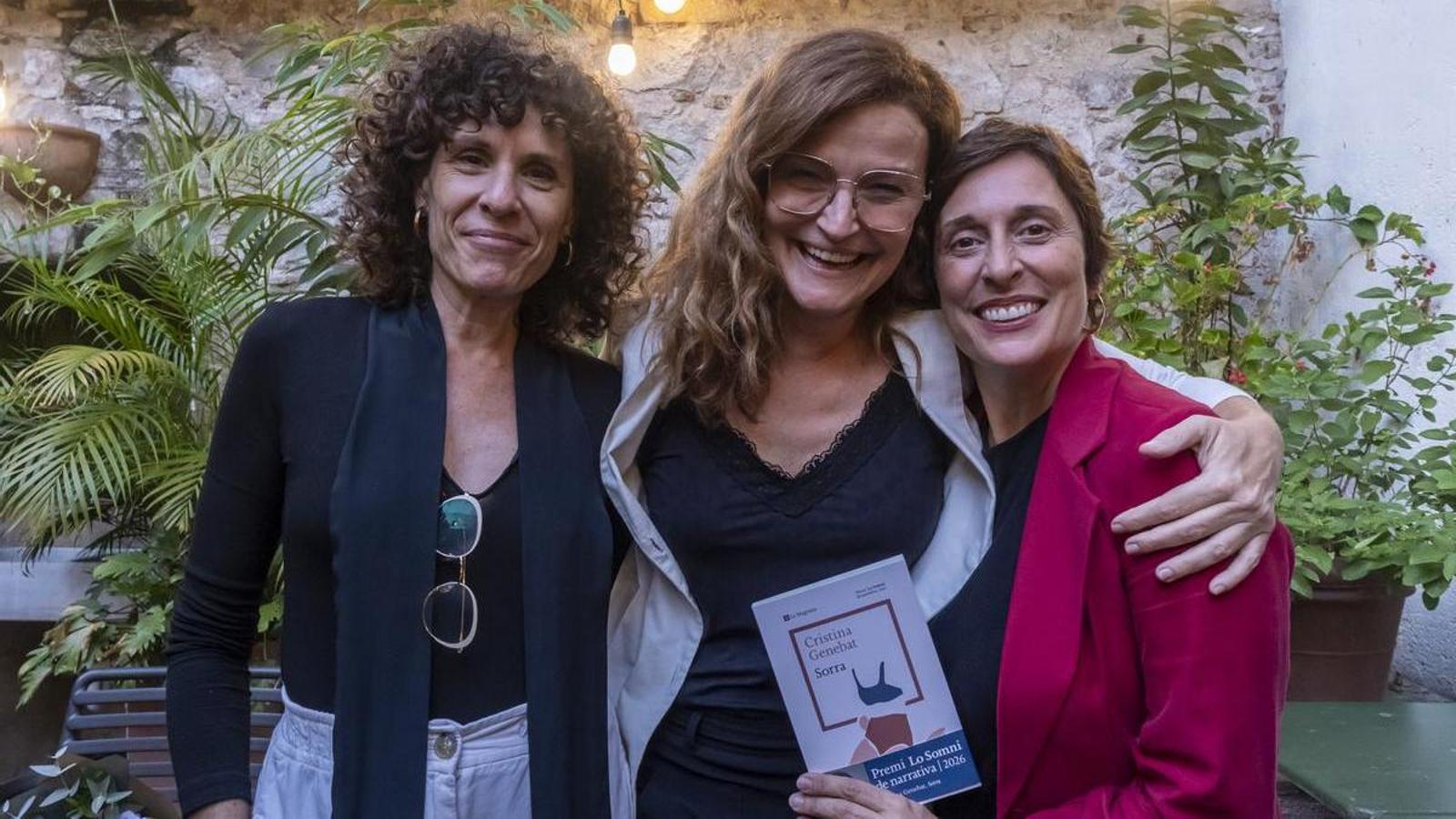
BarcelonaIf Clara Segura, Marta Marco, and Cristina Genebat read fragments at a book presentation, you've got half the work done: they can already add a pile to the stall and take out the card reader, because we'll be heading to the checkout. The three musketeers of Catalan theater have unsheathed their swords in the little garden of La Central to present —all for one and one for all— the new novel by one of them: Cristina Genebat debuts with Sorra (La Magrana), which won the Lo Somni prize at the Night of Catalan Letters.
Today they are staging a play in reverse: among the audience are people who are usually on stage, and Clara Segura and Marta Marco are acting as journalists, in a sort of friendly press conference. I see a good part of the author's theatrical family there: Laia Marull, Andrew Tarbet, Marc Artigau, Marc Rodríguez, David Selvas, Albert Triola, Carlota Olcina, Montse Vellvehí, Julio Manrique, and I'm missing some.
Theater is a reference for understanding the title, Sorra, which refers to the beach in Shakespeare's The Tempest and that "we are such stuff as dreams are made on". "Sand is necessary to make castles. It is an ode to fantasy, to never losing the desire to build sandcastles —says the author—, to putting oneself in the place of desire from very different ages". Her characters do it, and it is what Cristina Genebat has done throughout her career. First, she expanded her facet as an actress with that of a translator, and then with that of a playwright, and then with that of an essayist (Are we equal or not? Interpreting feminism, 2010), and then with that of a director, and now with that of a novelist. "It gives you a lot of freedom not to have to think about budgets, about writing for four actors; you can go to the Moon and back, and you can put a storm in it," she says. The slavery is having to work alone, only with the computer, without the tea and the conversation before the rehearsal, for hours and hours over the last four years.
Reaching fifty
In the book, she weaves three perspectives (I, you, she) and three ages (12, 23, and 47 years old). Inevitably, the conversation shifts to talk about the elasticity of time and its effect, which is even more relentless for actresses, who are "vulnerable little animals," says Marco. "I wanted to talk about the vertigo of getting older, of reaching fifty and saying 'wow!', things change, bodies change, everything changes, but there is an essence that is you and it doesn't change, no matter how much the world places you in an age. Sometimes you look in the mirror and say: «Who is this lady who has usurped my voice?» because you are the same as always," explains Genebat.
Clara Segura doesn't know whether to bring up a topic that it is clear they have talked about in the dressing rooms. Genebat encourages her: "I understand you, it's just frustrating to have to talk about invisibility". The fact is that the invisibility of women at fifty is already a cliché, but at the same time it is a reality that is taken for granted and normalized, despite being absurd: "This invisibility has to do with the patriarchal gaze. Do we exist to be looked at? No, everyone exists because they exist. When I look at myself, I find myself, I see myself!", says Clara Segura. And we do want to look at them.
