"We think we know Renoir because we find him at the dentist's, but he is an incredible painter"
An exhibition at the National Gallery vindicates the originality and modernity of the French painter, far from the kitsch and the clichés

-
CAT -
CAST
- National Gallery in London.
- From October 3, 2026 to January 31, 2027.
Renoir's painting does not admit half-measures: either you hate it or you love it. Detractors consider him the height of kitsch. About ten years ago, the movement Renoir is a terrible painter emerged on Instagram, and a few dozen people demonstrated at the door of the Museum of Fine Arts in Boston demanding that his works be removed from the museum. The motto on the placards could not have been more blunt: "God hates Renoir". Today this group has 17,800 followers. For now, however, the followers of one of the pioneers of Impressionism are outdoing them. The exhibition Renoir and Love will open its doors at the National Gallery in London on October 3rd with a record number of advance ticket sales: 32,000, ahead of Van Gogh.
Is Renoir a cloying painter? "We shouldn't be afraid –says the director of the National Gallery in London, Gabriele Finaldi–. There is a certain kind of Renoir painting that is too sweet, almost like a caricature of Impressionism. There are artists who paint too much, but I think Renoir's initial phase, which is what this exhibition is about, has a lot of originality and strength. On the other hand, the second part is less attractive". Chiara Di Stefano –the curator of the exhibition along with Christopher Riopelle, both curators at the National Gallery– is very blunt. "We think we know him because we can find him in the dentist's waiting room or at grandma's house, and in all kinds of reproductions. But, in reality, he is an incredible painter", said Di Stefano at the presentation of the exhibition, which was attended by the artist's great-great-granddaughter, Megan Renoir.
The only Impressionist from a working-class background
Renoir and Love, which can be visited until January 31, 2027, includes about 45 works and has been organized by the Musée d'Orsay, the National Gallery in London, and the Museum of Fine Arts in Boston, where it will arrive on February 28. One must be very attentive to get the most out of it. The curators project a new vision of Renoir that emphasizes the sociability of the characters, especially the subtleties of body language, and the historical context. "Renoir distinguishes himself by how he represented relationships between the mid-1860s and the 1880s. While other Impressionists focused on the idea of alienation caused by modern urban life, he did something completely different, and for that reason, he has not been considered as modern as other artists in his circle," warns Di Stefano. "Renoir had a different idea of what modernity was," adds the curator. "It is clear that he was fully aware of the difficult times he lived in; he was the only one of the Impressionists who came from a working-class background. He had financial difficulties during the first decades of his life. He lived through the Franco-Prussian War, the Paris Commune, and the Siege of Paris. He lived through very hard times, but instead of focusing on the harshest realities of modern life, as other naturalistic painters and writers like Zola and Maupassant did, Renoir focused on the joyful moments and the poetry of everyday life.
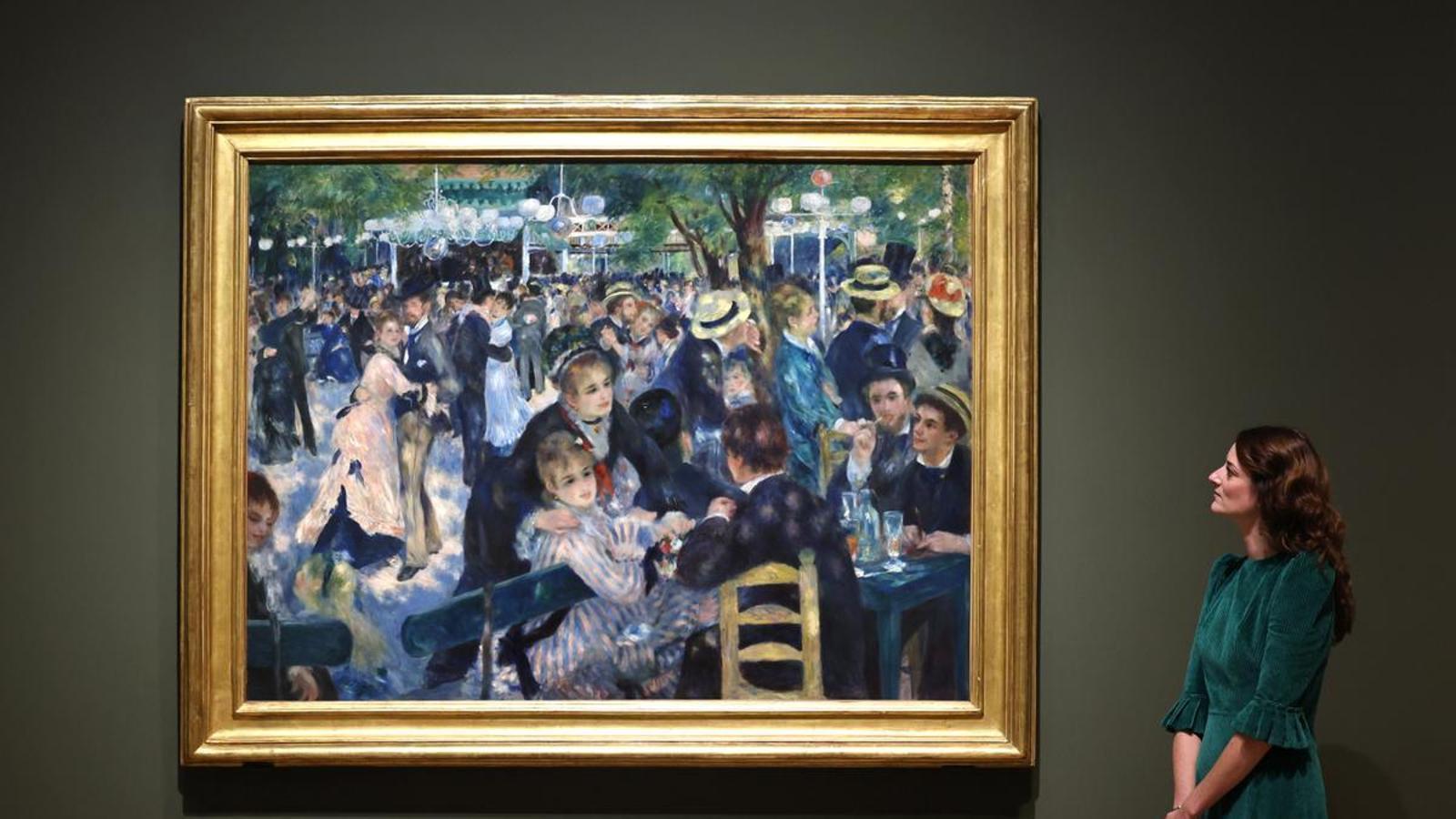
Thus, from this perspective the masterpiece Bal du moulin de la Galette, which can be seen for the first time in the United Kingdom in this exhibition, acquires a political character. On one hand, Renoir updated the pictorial genre of the fêtes galantes in a proletarian key. Furthermore, according to the director of conservation and collections at the Musée d'Orsay, Paul Perrin, this painting has a very direct link to life in Montmartre, which was a popular and left-wing stronghold five years after the Paris Commune ended with a massacre in that neighborhood. "Renoir always denied any involvement in political aspects, and at the end of his life he held very conservative political views. But in those years, a painting like this becomes quite political because it speaks of the resilience of the people of Paris after the trauma of the Franco-Prussian War. At first glance it does not look like a serious painting, but Renoir did take it very much to heart, because for him this was the real way to build a society and bring people together," says Perrin.
For Riopelle, sociability is "the staging of friendship, of love, of intimacy, of desire, of motherhood..." On the other hand, among the women Renoir portrayed there could have been prostitutes or other young women known as grenouilles, that is to say, who changed lovers easily, as Perrin explains in the catalog. But Renoir, who was the impressionist who delved deepest into scenes of seduction, never made any distinction explicit because he did not want to pass any moral judgment.
The first great work
The tour begins with a self-portrait highlighting eyes that reveal his nerve, which he maintained until the end, despite the rheumatoid arthritis that deformed his hands until he had to stop painting. Shortly after, one can see his first great work, the ambitious Mother Antony's Tavern. "He is prepared to compete, to face the old masters, to work on a large scale, and to create complex groupings of figures. And yet, the imagery itself comes from his own life. It is a constant that he portrays people when they have just finished lunch or dinner and everyone is relaxed, smoking, or simply enjoying each other's company," explains Riopelle. Precisely in this painting appears the artist Alfred Sisley with a copy of L'Événement, the newspaper where Zola published criticisms of young artists.
Later on, The Exit from the Conservatory captures the moment a father gently pushes his son toward a girl, in a ritual that could lead "to courtship and marriage," as Riopelle points out. Afterward, family affections take over from flirting and romance, as can be seen in the double portrait of the children of art dealer Paul Durand-Ruel and in another of the children of friend and patron Paul Bérard. In addition, one can see a portrait of his future wife, Aline Charigot, breastfeeding their first child, Pierre. "Renoir was absolutely overwhelmed with joy when Pierre was born. That is why one of his biographers said that, when he was born, he left behind all artistic and intellectual debates," notes Di Stefano. Another of the paintings in this area, Children's Afternoon at Wargemont, with two of Bérard's daughters, shows that Renoir thought he had exhausted all avenues of Impressionism and returned to a certain classicism.
The last part of the exhibition is dedicated to intimacy in domestic interiors and theater boxes. At Renoir's Home, Rue Saint-Georges is an unusual portrait of male sociability, expressed through his own friends and colleagues, whom Renoir portrayed drinking and smoking quietly. It is the only painting in the exhibition where there are only men. Among female portraits inside theaters, A Box at the Theater (At the Concert) shows how by 1880 he became more decorous because he was increasingly famous and receiving more commissions from high society.
