Arnau Tordera (Obeses): "We are losing territory we don't know very well in favor of what"
Musician. The group he leads publishes the second part of the album 'L'ai al cor'

-
CAT -
CAST
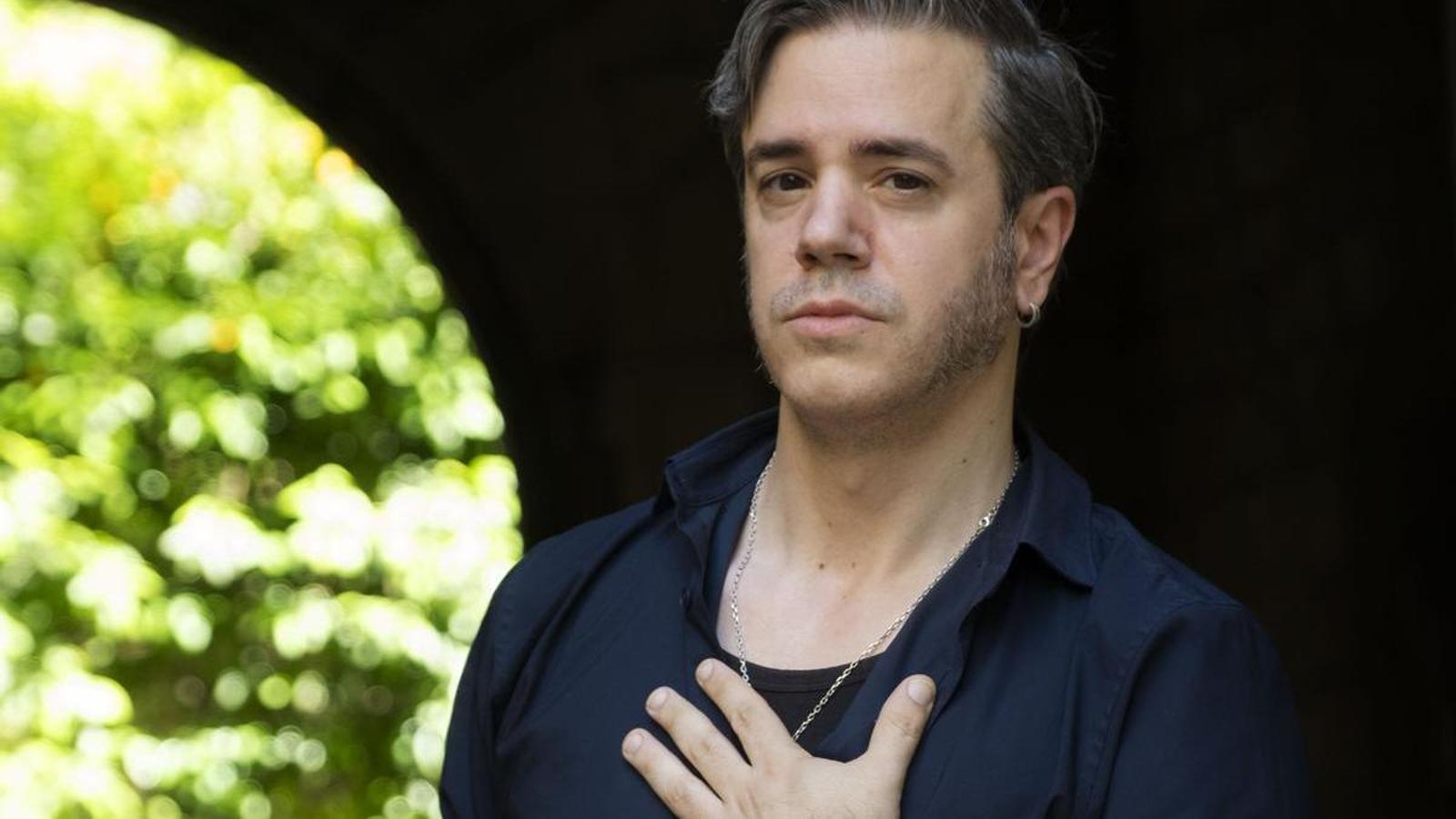
BarcelonaMany of Arnau Tordera's (Tona, 1986) musical interests are present in I hold it in my heart (Global Music, 2024-2026), an album by the group Obeses released in two parts. Now comes the second part: Diastole. Eight songs that mix rock, metal, musical, pop, sound of quartans band and a version of the Virolai with the Coral Canigó. About the album, but also about the position of resistance in the Catalan musical ecosystem, about various political and economic breakdowns, about the Obeses festival and the program The Renaissance, speaks the leader of the group completed by Arnau Burdó (keyboard), Maiol Montané (drums) and the poet Jaume Coll Mariné (below), winner of the Carles Riba prize 2025 with the poetry collection Like the leaves (Proa).
You had the second part of the album quite put together when you published the other one?
— There were elements that yes, and others that were to be part of the second part that I discarded. I had a more or less clear and defined horizon, but it has changed.
Why?
— Because there has been a whole period of time between one part of the work and the other, and this has led me to look for other themes to explore and to delve into styles that perhaps initially I wasn't so clear would go where they have gone. And also because of what we received from the first part of the album from the public. This, whether you like it or not, also stimulates you. It's not that it hypothecates what you have to generate in the future, but in some way you are receptive to what is commented. This second part resembles what I projected at the moment of culminating the first, even though it is not the same as the idea I had then, because a creative process also takes you down unexpected paths.
Was the path that led you to a metal song like Dust in the Era so unexpected?
— I don't think so. Those who know Obeses from the beginning, I think they were satisfied with the piece, but it didn't surprise them as much as perhaps a more general audience who associates Obeses with the song Regala petons. For people who don't know the project, yes, naturally, I can understand that it shocks them quite a bit. But, I insist, it's a piece that expresses itself 100% with the singularities that Obeses has been experimenting with throughout its career and in no way deviates into territory that is not its own. Perhaps it explores it in a more intense way, with more extreme resources, but, nevertheless, it is part of the same language of music that we have been making since the beginning, sixteen years ago.
I have the feeling that Dust in the era is a song in which there is little patience. You start with a very specific color, which is almost death metal, and you immediately change it and change it again, as if you were paying a small tribute to different metal styles.
— Maybe. For a matter of vocal training and expressive need when returning to a certain more or less tonal harmony, the most abrupt and intense brushstrokes are not absolute, but rather a color that appears throughout the unfolding of the piece. Anyway, it seems to me to be a coherent piece, even though different metal registers and different ways of singing are deployed. According to the way I conceive music, perhaps an extreme piece in its entirety would not have satisfied me either.
In your work, the musical treatment aligns greatly with what you want to explain, be it for ironic contrast or simply because you believe music should accompany what you want to express with the lyrics. This forcefulness was essential to convey the indignation you express in Dust to the era?
— I think so. We arrive at this forcefulness precisely because of the message the piece contains as we witness this world that expels the peasantry, which agonizes before a death that more or less seems inevitable. This intensity is linked precisely to the loss of a shared history that has also defined a good part of our country's landscape since time immemorial, with trades that are also indisputably linked to society and that at the same time remain essential for continuing to live if we do not want to depend on other producing countries. It is a cry that I thought needed to be expressed with this forcefulness. It would not seem coherent to me with the way I understand music to talk about this subject with other aesthetic registers. And conversely, it would not seem coherent to me either to talk about other subjects that I address here with this aesthetic register.
You don't make programmatic music as such, but there is a lot of coherence between the musical aesthetic and the theme.
— I would say that, perhaps in what can be conceived as programmatic music in the field of contemporary popular recorded music consumption, it would be the thing that could resemble it the most. Music places you in a context where there is semantics and you can perceive it regardless of what the lyrics say. Sometimes they say different things, but precisely in this permanent dialogue there is a deeper reading.
In this same song there is a criticism of the overexploitation carried out by some agri-food industries.
— Yes, yes, naturally. This piece captures the cry of rage of the peasant revolt, but also the degradation of agricultural land, which in large part is also the responsibility of the disproportionate superfarms that feed half the world and which in no case are sustainable for the good of the country. There is an association from Osona called Per una Plana Viva which precisely fights for this issue. And following a act of protest they held and to which I was invited, I became more sensitized to this circumstance.
Do you still live in Baix Llobregat?
— Yes, I am an "osonenc" who has emigrated.
Has the reality of Baix Llobregat opened other perspectives for you?
— Yes. I live in Sant Esteve Sesrovires, which is a town engulfed by a colossal industrial estate where Seat, Mercadona, Lidl are located... Hectares and hectares of vineyards that degrade month after month while new industrial estates appear. It seems like a monster of capitalist ambition that has no end. As an Osonenc, I was already a witness to this, but I lived in Tona, which at that time was a town that did not yet have this reality so latent and so close. But in Sant Esteve Sesrovires I have perceived it clearly. We are losing the territory, we don't really know in favor of what, because in the end, what does this excessive ambition bring? The degradation of our land's heritage treasures? I don't know, I don't see any sense in it.
It's not the first time you've put a political horn in songs, but it's evident that you've never made a song like Capitalist Circus.
— I suppose there also comes a moment in an artist's creative life when you tackle certain themes that you previously avoided, sometimes out of fear of not knowing how to handle them sufficiently. In any case, with the world collapsing all around, it seemed opportune to write this satire ridiculing our own existence as we have organized it. Various characters appear in a sufficiently stimulating interplay of images. At the same time, the expressive possibility of sarcasm has always stimulated me, and when I had the idea of moving forward with a piece like this, I knew it had to be about exalting this parodic dimension of the circus but in an absolutely symbolic way.
Musically, you're a collision between La Trinca and Andrew Lloyd Webber, to put it simply.
— Yes, it has diverse influences. From American musicals, in instrumentation and some resources. And La Trinca is a group that understood precisely what you were saying before about the possibility of programmatic music in modern music. They had great arrangers to generate these spaces of musical understanding that would place the listener in a familiar context. Obviously, this works when the listener speaks the same musical language as the author and understands that the author wants to place them in a specific context. La Trinca did this a lot. For me, they were masters in this regard. Yes, we take advantage of the circus context to develop this, circus music, fun, despite the tragedy being narrated.
Towards the end of the song, you talk about politicians, who "pretend to be the voice of the people but are not". Don't you think that anti-politics is dangerous because it can be precisely the door to the far-right or populism?
— Yes, I would say that it can be. Indeed, we see that it is, but, nevertheless, we have seen that, in the evolution of contemporary Western societies led by professional politicians trained in the career of political management, politicians have not been capable of leading societies or human collectives towards a more positive place than what seemed perhaps fifty years ago. Social realities are complicated, and I don't think there is an explicit, concrete, or specific solution beyond the assumption of individual responsibilities that reverberate in the collective. In this sense, seeing the world as it is, falling into the same errors it has fallen into before, politicians clearly have responsibility, but likewise each one of us has a share of responsibility that we are surely not assuming. That's why we are where we are, I think.
Let's go back a bit to the programmatic craze: A thimble, a song you sing a cappella.
— A thimble stylistically refers to the barbershop, a polyphonic style that was born in American barbershops where people would meet and sing. It was a style I had wanted to explore for a long time, but it requires learning the choral technique. I allowed myself the necessary time to learn it. And it was very good because, just after publishing it, two groups wrote to me about "barbershop from around here, The Humphrey's Quartet and Metropolitan Union, who asked me for the score because I had captivated them.
It's a triumph when two barbershop groups ask you for the sheet music.
— I didn't expect it at all. It was a surprise.
And from triumph to failure. In the song Elogi del fracàs, there is a moment when the character singing says: "I have been wrong so many times". What are the most resounding mistakes you have made?
— I gather existential possibilities and it seemed stimulating to me to make a piece of this type that would vindicate failure as part of life, as an even more necessary part for possible success than success itself. Success is momentary, instantaneous, it is a moment of light in the middle of a path that generally has no lights. My failures as an artist are many, but they are compensated by a stubbornness, a will, and a self-awareness that the path is truly important and necessary to travel despite the difficulties. Obeses has never been a band that has projected itself into an extraordinary media dimension, nor has it been helped in this regard, but we are still here and that is also a vindication. Obeses' path is very long. In this country, we are not very used to seeing musicians with long careers. Yes, there are musicians who celebrate forty years, but who quit halfway and who haven't said anything more interesting after returning. The merit of a project like ours is to accumulate experience, accumulate years and failures, of course, but to continue being able to make the best album of our career at every moment. To this day, this is what has been achieved, also learning from disappointments and the most difficult moments.

Have you ever thought about the artist's anguish when they realize that after the halfway point of their career, they are not doing anything important?
— It is not a concern for me because, in general, I have never felt connected to these types of careers. My teacher is Albert Guinovart, who is a musician by career and trajectory, and every piece he generates in his creative maturity is extraordinary and is a new masterpiece, just like Verdi in his time, for example. They are artists who have been able to continue saying things as the years went by; and the success of their proposal has not been simply an effervescent matter that connected spontaneously with a certain audience, especially among young people. Obeses also has this journey and now, sixteen years after starting the project, I think it is evident that it is a career with a trajectory that is built more slowly than many others or than the immense majority, but with much more firmness.
In another song, The tune of the wheat, you make the sound of cobla more delicate, like a cobla of three quartans.
— Yes. In fact, the cobla of eleven musicians that we know today, which Pep Ventura more or less established, comes from this formation of a cobla of three quartans: flabiol and drum, tarota and bagpipes, and sometimes also trombone. It was the musical formation that was responsible for bringing music to the villages for celebrations in past times and centuries. This evolved and ended up being the cobla we know today. I wanted to make a sonic reference to this germinal cobla of three quartans with some instruments for which I had not written. For flabiol and drum, yes, but for bagpipes and tarota, no. Well, for tarota I had done something specific for a project called Filomena. In any case, I wanted to play with the idea of a work song. Nowadays people don't sing because the music already plays without having to be materialized, but during the immense majority of history people sang. And I liked to link it with this tradition of the country, which is the cultivation of wheat, and imagine what a song linked to wheat could be like and that could be used when we harvest, when we winnow, when we cut. Therefore, in this meeting between the traditional world and certain electronic resources, the piece is inspired by this new way of explaining tradition and by tradition itself.
Are you connecting to it, with this meeting, too?
— Yes. It is quite fashionable and quite successful. It is one of the ways to maintain tradition; it is not the only one, because sometimes it is also good to go directly to tradition and not mix it.

You were talking about the function of music. Where it is most poetically evident is in Fort in death. The song makes its way until a moment arrives when you say: "The day I leave, sing the song for me". You place music as that which preserves our legacy in the memory of others.
— Correct. Music has been since time immemorial a repository of knowledge that was transmitted orally, until we reached the 20th century, recording was invented and it ruined our existence as musicians because, imagine the paradigm shift it entailed on all levels... Before, music was always re-expressed. I like to invoke music itself and address the listener so that they are part of this communicative chain which is the possibility that someone else can interpret the piece at a given moment and make it their own. Fort en la mort addresses a fascinating topic: death. But I wanted to explore the possibility of approaching it from another perspective: death in solitude can also be a good death in the face of a life lived in fullness. Therefore, it vindicates life, because in the end death is inevitable, it is absolutely democratic and there is no way to dodge it. Faced with this certainty, the piece proposes a vital fullness.
Joan Pau Cumellas' harmonica places the song in a mythical territory, like a twilight western, but it is not a sad song, nor an elegy.
— The echo of the harmonica already places you in a kind of lament, but it is not a lament of tragedy, but a song of life, which has difficult moments but can be lived fully.
Has your stance of not participating in some dynamics of the live music sector, such as certain festivals, been self-sabotage or are you convinced that you have done what was necessary?
— Seen in perspective, I am completely satisfied with Obeses' choice. It is a much more complex path than others, but here we are, sixteen years after starting and at one of the band's best moments. With drive, with happiness, with the certainty of having completed this album that has cost us so much, of having completed it just as we wanted and free from ties that limit expressive and creative capacity. Therefore, with an autonomy that at times has been a hindrance, because, when you don't subordinate yourself to the laws of the music industry, and not only do you not subordinate yourself to them, but you publicly denounce them, your life becomes complicated from a professional point of view. Here there is a struggle, a way of understanding the world, the country and Catalan music and its richness, and therefore there is an explicit confrontation. Our commitment is this, and we defend it.
Can you explain to me what the Festa Major of Obeses is? On August 1st, you are celebrating its third edition.
— Yes, precisely following the release of the first part of the album, we didn't have places to present it because it was extremely difficult to move forward with a musical project that wasn't determined by the canon and that didn't subordinate itself to business logic. It was very difficult to find concerts, so we decided to organize one in a self-managed way with people from Roda de Ter who run a cultural project and a creation space. And we did that first edition, which was a success. We coordinated it with more than 500 people who paid for tickets and came. Last year we repeated it and now we have decided that it will be an annual Obeses event to reclaim the project and the way of doing things, with this will to be independent of third-party wishes. Our followers have celebrated it as a moment of collective reunion, where a very satisfactory, very pleasant atmosphere is breathed, which rightly claims not only the music of this band, but also their way of facing the difficulties they have in this country.
By the way, how do you feel about the program La renaixença, on 3Cat?
— Satisfied with the work we do and frankly comfortable in that context. It's a fantastic team, in a different register than many people didn't know about me, actively working for the country's music. Naturally, it's a humor program, but we try to bring a certain knowledge, a certain critical contrast to it.
