They locate the remains of 14 individuals who could be the first inhabitants of the monastery of Sant Llorenç del Munt
The preventive archaeological intervention is part of the sustainable future plan for La Mola
-
CAT -
CAST
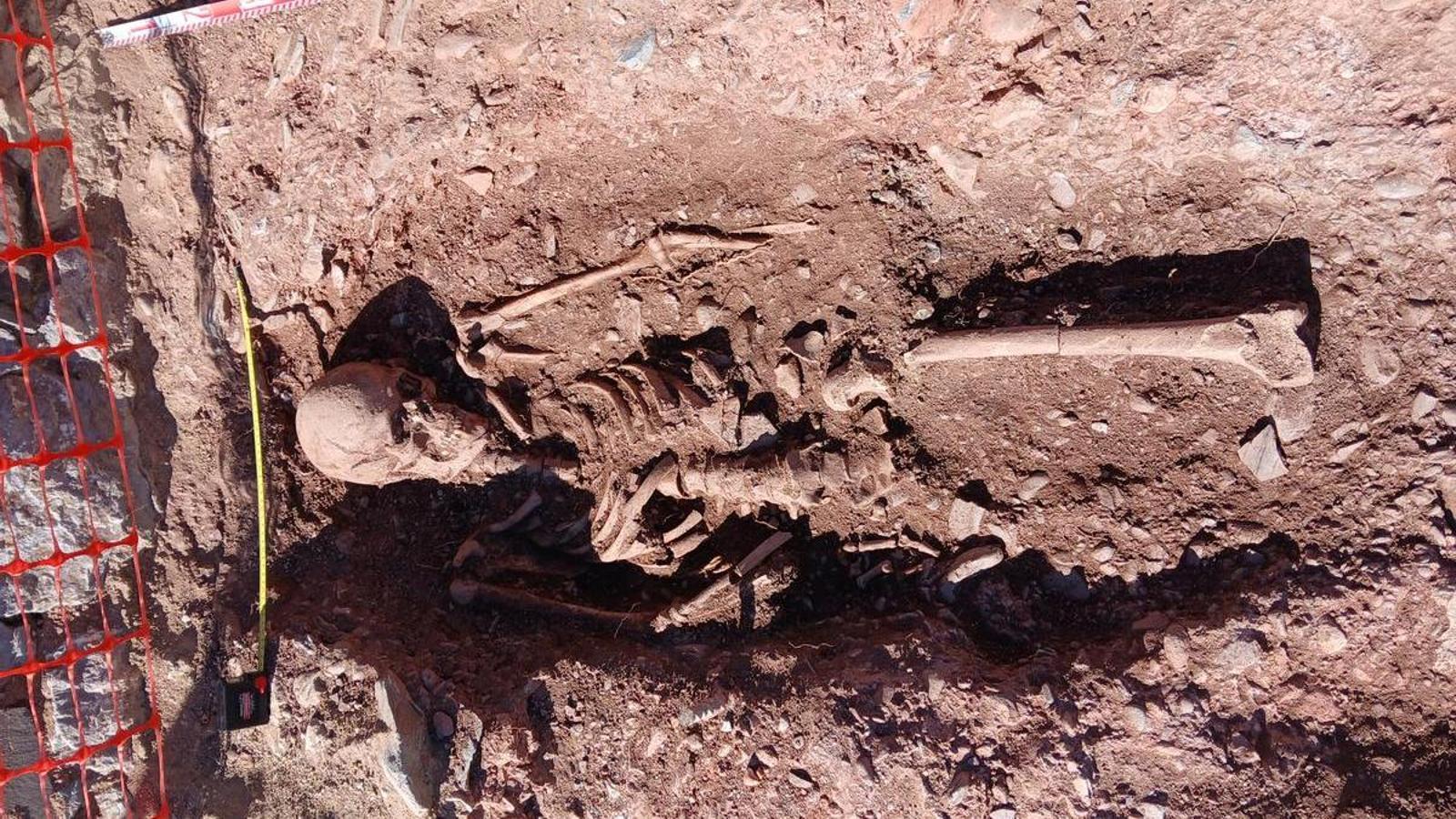
BarcelonaSome works to prevent erosion on the summit of La Mola have uncovered human burial remains around the monastery of Sant Llorenç del Munt, as reported by the ACN. Although the existence of a necropolis in the area was taken for granted, the discovery has been a surprise to archaeologists because the remains have been located in a highly trafficked area, on the access ramp to the monastery's esplanade. Remains of 14 individuals and two anthropomorphic tombs from the early stages of the monastery's occupation, in the 10th century, have been found.
The project's archaeologist, Maica Carmona, has highlighted the magnitude of the discovery: “So far, fourteen individuals have been found, but we believe there will be more,” she said. “Now we will have to continue carrying out the necessary studies to determine if they are men or women, if they have traumas, pathologies, as well as determine their dating,” added Carmona, who explained that “the grave goods accompanying the bodies are very scarce, which makes it difficult to pinpoint their chronology.” “But we have two anthropomorphic tombs that speak to us of the 10th century of the monastery's occupation; it will have to be studied,” she said.
The archaeologist recalls that several excavations have been carried out in the monastery and its surroundings in recent years, but this discovery has been a surprise they did not expect due to the location where it was found: “We suspected that something might be there, but considering it was a passageway, we were surprised to find complete skeletons in places where sand had accumulated.”

Archaeological work in progress
The archaeological works are being systematically developed, with manual techniques and precision tools, photographic recording and mapping. Given that it is a possible funerary area, the intervention also requires multidisciplinary work, with anthropology professionals in charge of the excavation and study of human remains.
The intervention is conditioned by the need to adequately preserve the remains and also by external factors, such as the weather, as the work is carried out outdoors. Once this phase is completed, the data obtained will be recorded in an archaeological report, which will be sent to the Department of Culture of the Generalitat de Catalunya and the Diputació de Barcelona.
The summit of La Mola is the highest point of the Sant Llorenç del Munt i l’Obac Natural Park, with an altitude of 1,103 meters, and is located within the municipal district of Matadepera. The site hosts the Benedictine monastery of Sant Llorenç del Munt, from the 11th century, declared a cultural asset of national interest and acquired by the Diputació de Barcelona in 1983. The monumental complex has a surface area of 946 m2 and is formed by the church, the Galilee and the old hospitality building. It is located in a protected land area, of high archaeological and paleontological interest, and has historically hosted restoration, information, and cultural and environmental outreach services.
