They discover a bronze ritual cart from the Tartessian civilization
The piece, decorated with divinities and griffins, has appeared at the Casas del Turuñuelo site next to the remains of a ritual banquet from the 5th century BC
-
CAT -
CAST
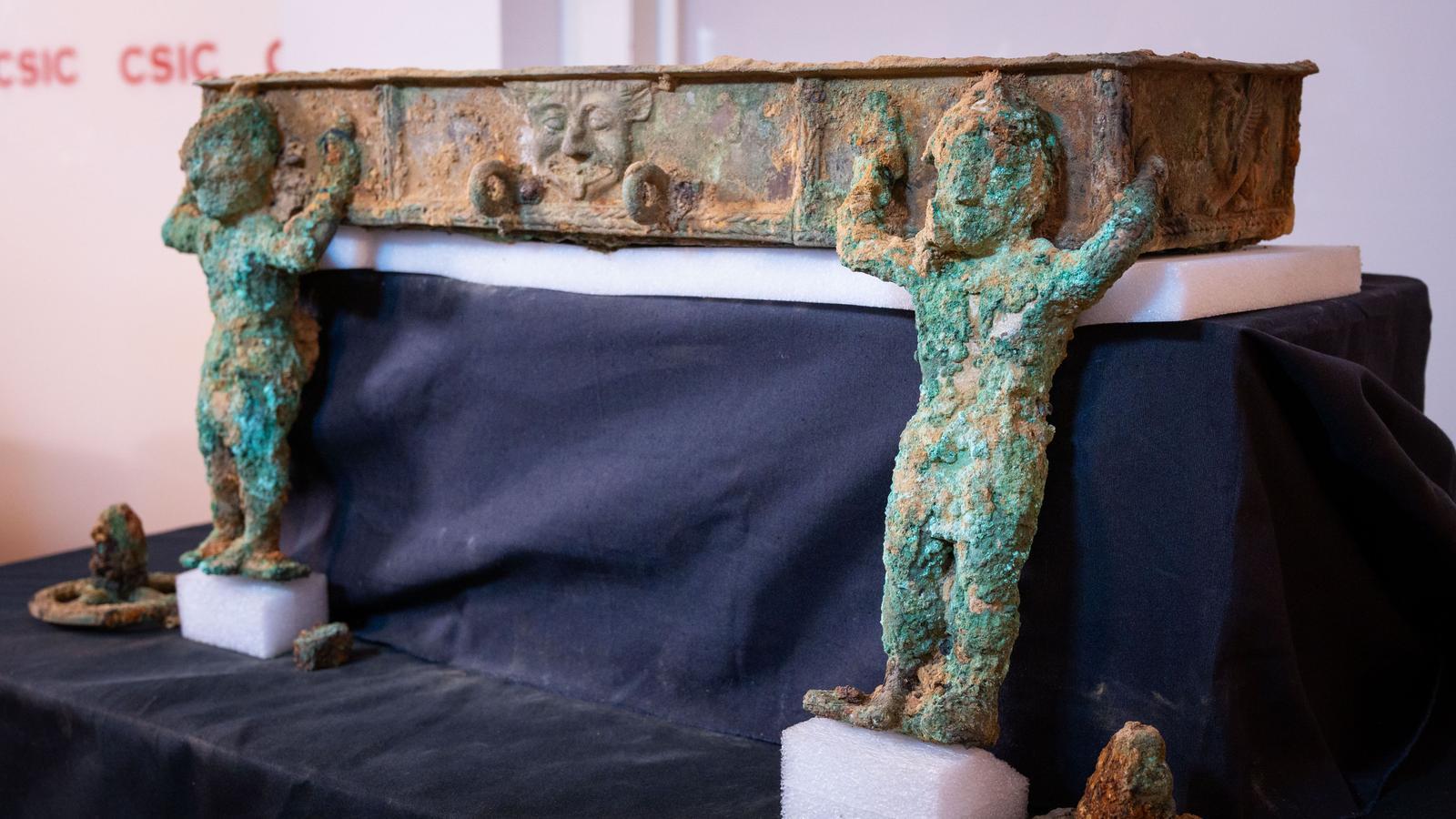
BarcelonaThe last twenty years of archaeological research have completely transformed the traditional view of Tartessos. Excavation work at the Casas del Turuñuelo site, in Guareña (Badajoz), has uncovered a bronze chariot from the 5th century BC with a structure and decoration absolutely unprecedented in the Iberian Peninsula. According to the initial interpretations of the research team, the only parallels for a piece of this kind are found in ancient Etruria, in present-day Italy, from where it could have originally come. The discovery confirms that it was a complex civilization connected with the great powers of the Mediterranean, which inhabited the southwestern peninsula between the 8th and 5th centuries BC.
The piece has been recovered in the southern sector of the main building of the complex. The chariot stands out because it preserves a very rich figurative decoration. On the front is depicted an Akhelōos, a river divinity associated with the underworld, while on the sides appear two griffins, mythological creatures with the head of an eagle and the body of a lion. The entire ensemble rests on two also profusely decorated wheels and is flanked at the ends by two human figures with raised arms supporting the structure.
"This is one of the most relevant discoveries made so far in this Tartessian enclave," highlighted Esther Rodríguez, co-director of the excavations along with Sebastián Celestino. Both lead a project piloted by the Institute of Archaeology of Mérida (IAM), a joint center of the CSIC and the Junta de Extremadura. Beyond its aesthetic spectacularity, the parallel with the Etruscan world—a civilization that experienced its greatest splendor in central Italy between the 8th and 5th centuries BC—reinforces the hypothesis of the great connectivity of the Tartessians with the rest of the Mediterranean. Although the exact function of the chariot is yet to be determined in future research, Celestino points out that "it could be related to ritual activities, fundamentally linked to banquets." In fact, the chariot appeared next to the so-called banquet room, the space where the final meal that the community of Turuñuelo celebrated before sealing and abandoning the building at the end of the 5th century BC was documented.
Greek and Egyptian pottery
This year's excavation has uncovered other imported materials of high historical value. Along with the cart, ceramics from the region of Attica (Greece), an alabaster vessel of Egyptian origin, and ivory fragments decorated with representations of warriors and plant and animal motifs have been recovered. "These materials provide us with extraordinary information to understand the commercial relations between the East and the Iberian Peninsula," explains Rodríguez, who details that the conservation and restoration work on the pieces will be carried out soon at the Autonomous University of Madrid (UAM).
The discovery of this Etruscan chariot concludes a campaign that adds to a history that for ten years has led to a rethinking of the knowledge that was held about the societies that lived in the Iberian Peninsula. The projectConstruyendo Tarteso began in 2017 with the discovery of the remains of a massive sacrifice of more than 50 animals (mainly horses, but also bulls, pigs, and dogs). The skeletons, arranged in the building's courtyard following a very strict ritual order, constitute the first documented evidence of a hecatomb of these dimensions in the entire ancient Mediterranean. Subsequently, in 2023, the first representations of human faces from Tartessos were brought to light. In 2024, a slate plaque with an alphabet was added.
