L'Arannà is one of the groups performing at the 22nd edition of (a)phònica, Banyoles' voice festival, which takes place from June 25th to 28th. The lineup includes groups and artists such as Kiko Veneno, the duo Alosa (Alícia award for emerging talent), Gavina.mp3, Magalí Sare with Cor Bruckner (performing the show for the album Descasada), Lina & Marco Mezquida, Raquel Lúa, Carmen Aciar, Minibús Intergalàctic, Caamaño & Ameixeiras, Lorena Álvarez, El Petit de Cal Eril, Anna Andreu and Quim Carandell (the singer of La Ludwig Band), who will perform on a boat while sailing on the lake.
There is no wild boar that ends the musical wonder of L'Arannà
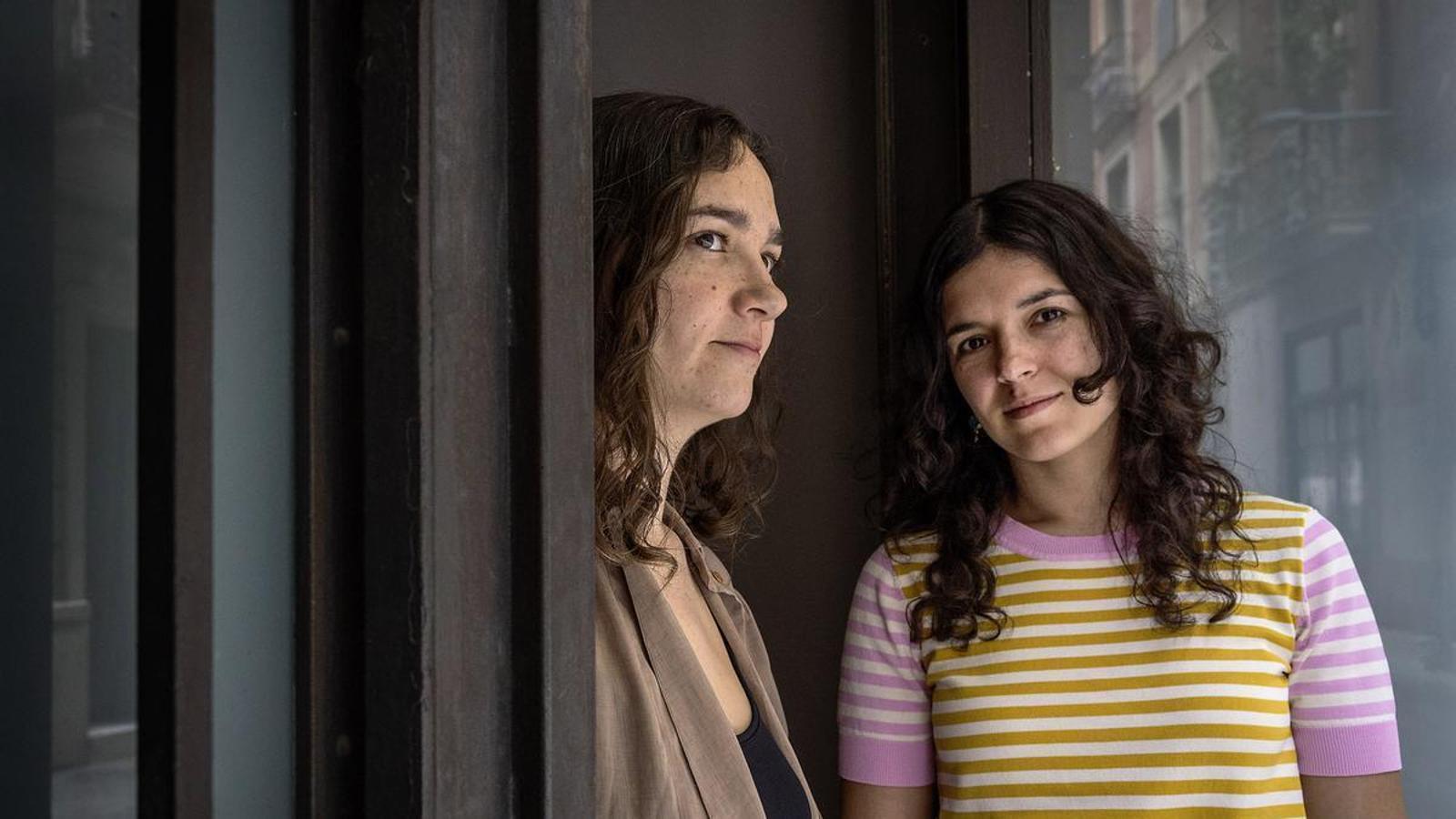
The duo formed by Lara Magrinyà and Anna Sala brings the project 'Turmarí' to the (a)phònica Festival in Banyoles
24/06/2026 - 21:37 h
-
CAT -
CAST
BarcelonaIt was a close call that a wild boar didn't turn a concert review into an epitaph. "Remember this name: L'Arannà". This was the title of ARA about the concert that the Ibizan-Empordà duo had performed at the Fira Mediterrània de Manresa on October 11, 2025. "The day after the concert, we were driving on the A2 and suddenly a wild boar appeared from the right. I swerved a few times, the car started to wobble and hit a concrete barrier. We miraculously didn't flip over," recalls Anna Sala (Sant Feliu de Guíxols, 1996). "The car was destroyed, but we were unharmed. And the instruments too. If we had died, that article would have been an epitaph," adds Lara Magrinyà (Ibiza, 1993). Both had just presented the show Turmarí, which next autumn will become an album, and which in recent months has already made L'Arannà one of the most exciting musical projects in the country thanks to how they delve into the tradition of Ibizan double singing with contemporary tools and mentality. They will demonstrate this once again this Friday, June 26, at the Auditori de l'Ateneu de Banyoles (8 p.m.), as part of the (a)phònica festival program.
They climb the ancestral fig tree and at the same time critically observe the discotheque that has altered the landscape of Ibiza. "On the one hand, we have the root, represented by the double singing, but in some songs we add a harder electronic sound," confirms Magrinyà. And Sala adds the latent conflict between the two cultures: "Often the double singing and the peasant dance have been ridiculed as a sign of low culture, and the idea has been transmitted that those who have come from outside to set up the nightlife businesses have come to bring wealth and save the island." Arannà, a contraction of Lara and Anna, tackle the conflict with judgment and good humor, and above all with an artistic curiosity that has led them to go beyond what they offered in the notable La salamandra (Blau Atzavara, 2024), an album inspired by Mercè Rodoreda.
To top it all off, and as if it were a bad omen, that October of 2025, Anna Sala's father, the writer Toni Sala, had recently published the novel Scenarios, which begins with a traffic accident and whose cover shows a wild boar. "We've already told him to feature the lottery on the cover of the next novel," jokes Magrinyà. Anna Sala, by the way, points to her father as one of L'Arannà's role models: "I've always seen him as a person very dedicated to his craft, which is something we also replicate." The other role models who appear in the conversation are Joana Gomila and Laia Vallès. "We have looked up to them," admits Sala; as Magrinyà says, "they live completely immersed in artistic research."
The song that appeals to the core
Trained at Esmuc and researchers by nature, Sala and Magrinyà were looking for a challenge that "made sense" for them. Sala, from Empordà, was unaware of the 'cant redoblat', that primordial mantra of laryngeal vibrato that is performed with the company of a drum in Ibiza and Formentera. Magrinyà, from Ibiza, knew it but had never heard it live, nor in Christmas carols. "I had not experienced the tradition from within, nor with family. In Ibiza and Formentera there are people who perform 'cant redoblat', not many, and more focused on the traditional sphere. We accessed a digital archive and immediately saw that it was something very different from everything and that it appeals greatly to the core. It seemed to us that it would be very interesting to work with 'cant redoblat' to make modern songs," says Magrinyà. "I was very impressed the first time I heard Lara doing 'redoblant'. She learned it right away," assures Sala. The rigor learned in classical training, the investigative curiosity, the respect for traditional techniques and contexts, and the daring configured the highly recommendable adventure of Turmarí (a name that brings together the two most common surnames in Ibiza).

Just before the accident, they were trying to assimilate the press's praise. "We had been very focused on the "Turmarí project for months, and we arrived in Manresa quite stressed," recalls Sala. "And the day after the concert, reviewing what had been written about it, we realized that what we were doing was solid," explains Magrinyà. In the subsequent presentation at the Càntut Festival and in many concerts, also across Europe, they have obtained the validation, the admiration, in fact, of the public. The buzz and bookings have added stress, welcome stress, to the recording of the album. "For us, live performance is the most important thing, and in concerts you see how the songs mature before recording them," comments Magrinyà. "This way we see how we divide the work on stage and what the most powerful way to interpret this material is. But after Manresa, a lot of work has come our way and we have to juggle gigs with recording the album. It's more complicated than if you make the album first and then the concerts come out," Sala completes.
At the performance at the Càntut Festival in Cassà de la Selva, L'Arannà invited Isidor Marí and Víctor Planells, members of the legendary Ibizan trio Uc, to sing "Jo tenc una enamorada" with them and the audience. "It was the first time a well-known figure from Ibizan music had contact with our songs, and it was very emotional," recalls Magrinyà. Toni Manonelles, an essential disseminator of the popular culture of the Pitiüses, was also there. "Toni was super happy, and that gave us a sense of calm..." says Sala. Thus, various validations converged: from the public, from programmers, from the press, and from the world of roots music. It is exciting that L'Arannà works with the tradition of cant redoblat, but the most important thing is that they move and impact with their songs. No wild boar can end the musical marvel of L'Arannà.
(a)phònica 2026 with Kiko Veneno, Alosa, Minibus Intergalàctic, Magalí Sare.
