The ignored revolution of prehistory: the invention of rope and weaving
Elisabeth Wayland Barber, who had to sign for years with initials to hide that she was a woman, defends the economic importance of women's work
-
CAT -
CAST
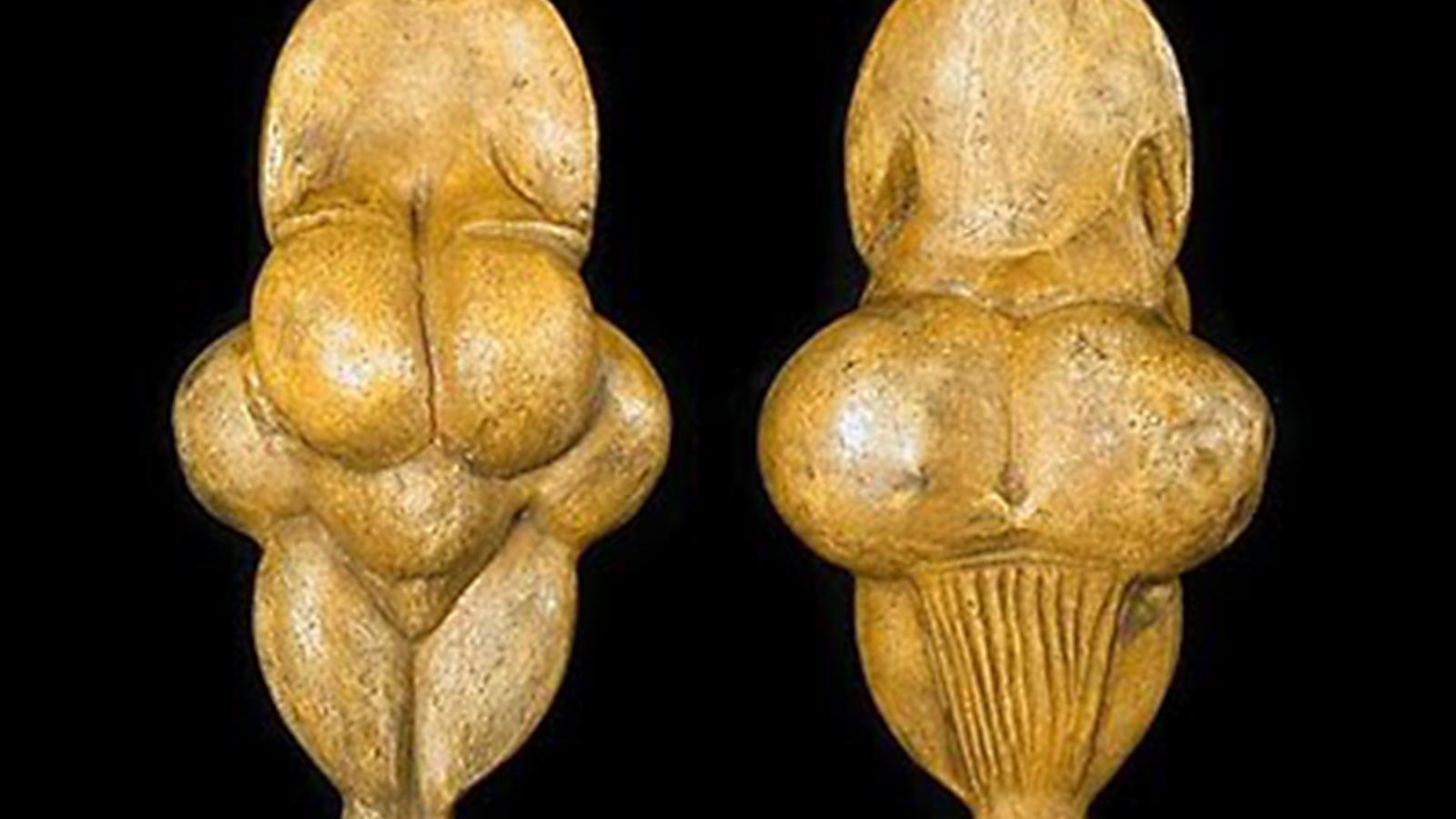
BarcelonaAlongside the invention of the first stone tools, between 20,000 and 30,000 years ago, there was another great silent revolution: the invention of rope and sewing. In the archaeological sites of this period, ornaments made of bone, teeth, and shells with extremely fine perforations have been found, which were sewn onto clothing. The most conclusive evidence of this birth of textiles is a sculpture: the Venus of Lespugue (France), a statuette made of mammoth bone dated around 20,000 BC, which shows a woman dressed in a skirt (sculpted) made of long strips of twine suspended from a belt at the back of her body.
Achieving a long and resistant rope was an absolute paradigm shift. “The discovery of this soft and flexible material, an indispensable requirement for producing fabrics, opened up a huge range of possibilities and radically improved the species' probability of survival. In fact, the technological impact of rope in prehistory had a very similar effect to what the steam engine would have, millennia later, in the Industrial Revolution,” assures the American Elizabeth Wayland Barber (Pasadena, 1940). Professor emerita of archaeology and linguistics, and an expert in textiles and folk dance, Barber defends in the essay Los trabajos de las mujeres (Capitán Swing) the economic importance of women and textile manufacturing in prehistory and the ancient world.
When Prehistoric textiles. The development of cloth in the Neolithic and Bronze Ages was published in 1992, a monumental 500-page work, the world of archaeology assumed that this specialist was a man. The book was signed with the initials E.J.W. Barber. "I had to publish it like that so they wouldn't realize I was a woman. At that time, men didn't consider textiles interesting, and if I had signed it with my name, it wouldn't have had any impact," recalls Barber. In fact, for years academic reviews referred to her as "he." Barber did not arrive at prehistoric textile archaeology solely through books, but also through practice: "I grew up watching my mother sew and weave. I learned to sew when I was four years old, and to weave at eight." This learning gave her a decisive advantage over her colleagues. While academics analyzing ancient frescoes saw simple ornaments, she saw technical spinning solutions. That intuition was the beginning of a titanic research that lasted seventeen years and culminated in Prehistoric textiles.The “blindness” of the academy
According to Barber, the documentary void on textiles is the result of the combination of the material's physical fragility and the academic world's blindness. On the one hand, fibers rot quickly if not kept in extreme conservation conditions. On the other hand, the Industrial Revolution moved textile production out of homes. "When modern archaeological studies began, men no longer saw women spinning and weaving at home. They bought ready-made clothes and lost the notion of how they were made," points out the researcher.
Nineteenth and twentieth-century archaeologists were unable to understand the technological complexity hidden behind the small fragments they found at excavations. To reconstruct this invisible puzzle, Barber had to resort to modern scientific methods: from the chemical analysis of paleolithic rope fragments to the study of the microscopic imprints that threads left on the clay of ceramic objects. She even conducted practical experiments using threads of the same thickness and color as the archaeological scraps to reproduce their exact weaving patterns and understand how those women worked.
Textiles were the main driver of the ancient domestic economy, a job associated with the female gender for strictly logistical reasons, according to the author. "The best theory I've found is compatibility with childcare. Spinning and weaving are not dangerous for children. Moreover, it is an activity that can be easily interrupted and resumed at any time if the child has a crisis or falls," she explains.
Weaving in the dark
This flexibility, however, implied endless working days. As an example, Barber recalls that in Russian folk tales it is naturally explained that women "had to learn to spin in the dark, by touch, so as not to waste candles while the men slept". This research, spanning almost two decades, has also revealed the meaning of mythical pieces like the string skirt, which is documented in figurines like the Venus of Lespugue 20,000 years ago. Far from protecting from the cold, this piece functioned as a genuine social alert: "It indicates that the woman is of fertile age. It could not be worn until puberty and had to be removed with menopause," points out Barber. The string skirt has survived millennia. “The most surprising thing is that it continued to be used in Eastern Europe until the end of the 20th century,” says the author. It is not the only analysis on the utility and codes of dress. Trousers were invented around 1000 BC in response to the pressure to which certain sensitive parts were subjected when riding a horse.
Men did not enter the world of weaving until major structural changes occurred: “It is clearly seen in 18th dynasty Egypt. With the introduction of vertical looms with two uprights, which allowed for much more elaborate garments, men entered specialized workshops to make clothes for the elite. They adopted the new vertical loom to create luxury items. They had more time to think about design and technique because they did not have to combine it with domestic tasks,” details Barber. Meanwhile, women were relegated to continuing to produce the daily consumption clothing for the home on traditional horizontal floor looms.

