Christian Petzold: "The football fields of cities are the new churches"
Filmmaker. Protagonist of the D'A Festival Focus. Premieres 'Mirrors no. 3'
-
CAT -
CAST
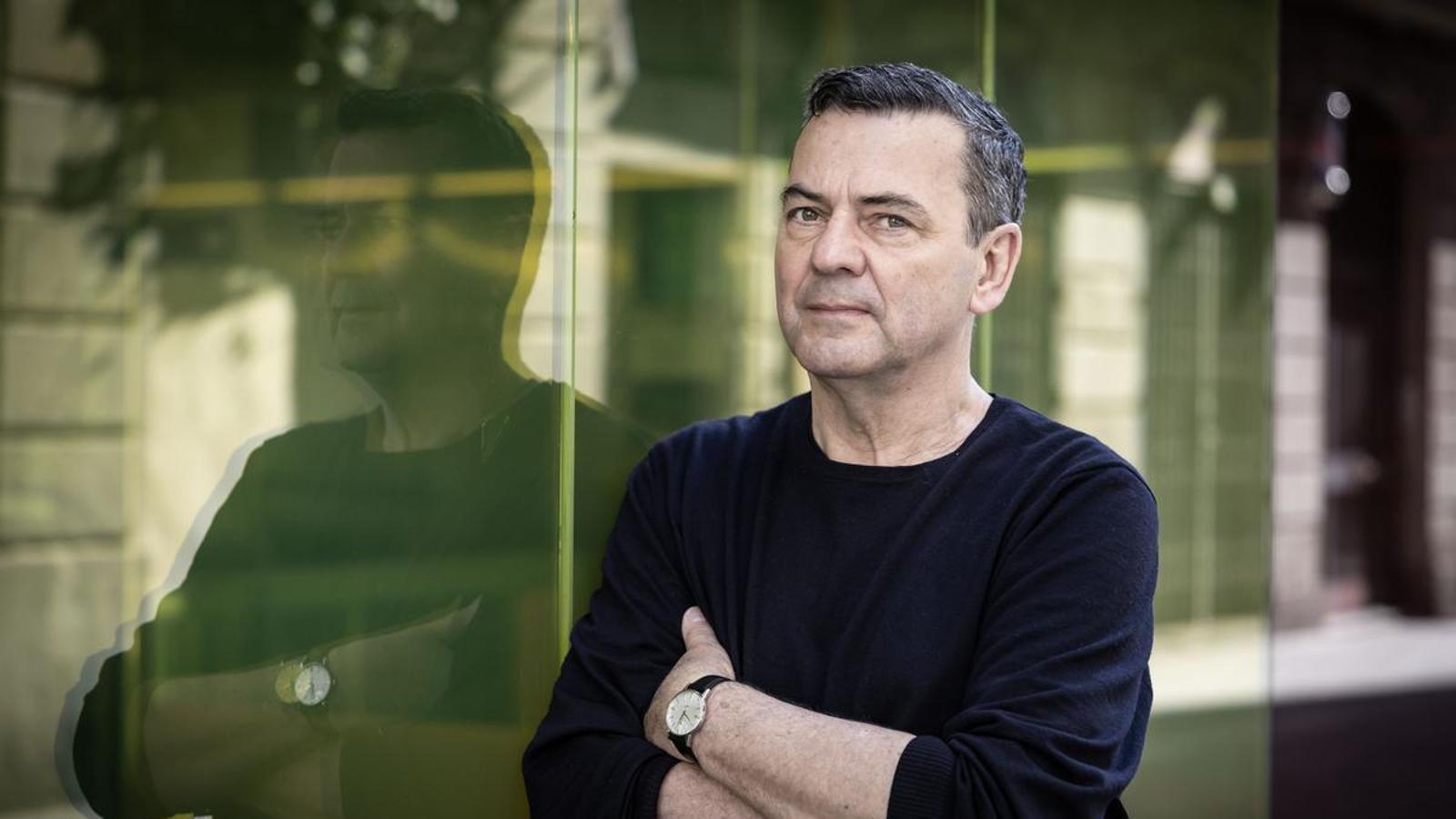
BarcelonaA leading German filmmaker of recent decades, Christian Petzold (Hilden, 1960) has visited Barcelona for the retrospective dedicated to him by the D'A Film Festival, a program that includes his latest film, which will be released in cinemas on April 10. In Espejos n. 3, a depressed piano student and sole survivor of a fatal car accident recovers at the home of a woman she has just met. Tenderness and unexpected connections in a film that functions as a compendium of the virtues and obsessions of one of the most in-form European directors of the moment.
He is one of the few current European filmmakers who practices melodrama and embraces the characters' emotions without remorse. What is it about melodrama that interests him so much?
— I am a child of the sixties and, therefore, of illustration. My teachers were rationalists. But when I went to the cinema I discovered Fassbinder, who was one of the few post-war German directors interested in melodrama. Through Fassbinder I discovered melodrama, just as he had discovered it through Douglas Sirk. For the children of rationalism, melodrama was kitsch, but in reality melodrama is a way of reaching the deepest layers. Cinema has more to do with ballads, kitsch and fairy tales than other disciplines.
You mentioned Fassbinder, but there is another great German filmmaker who is very important in your career and with whom you wrote scripts: Harun Farocki. How did you meet?
— When I was a teenager, I lived in a city where there was no cinema, but I discovered it in the library, reading a magazine called Filmkritik, which awakened my desire for cinema. Farocki was one of its editors and wrote for it. When I was studying literature in Berlin, I learned that Farocki was giving a seminar and I went. The first film he showed us was a B-movie thriller, an apparently simple choice, especially for an intellectual filmmaker like Farocki. Afterwards, we went to the editing room to analyze the first 15 minutes and discuss every editing decision, every camera position and movement. When we finished, we went back to the cinema to watch those 15 minutes again. And although it is always said that if you analyze and interpret a work too much, you end up destroying it, the opposite happened to me: the experience was even richer. We had learned to watch a film.
And so they became friends?
— Not very well. At first, Harun made comments about me in class that bothered me. "What does our literature expert think of this?" he'd say, referring to me. But I went to talk to him after the seminar and told him to stop that shit. Whether he thought literature students were idiots and filmmakers were the only ones worth anything, the only ones who wanted to change things. He noticed that I was carrying a ball and clothes to play football because I had training that afternoon. He really liked football, and when he found out I played, he invited me to his training. And we played football together for thirty years. That's how our friendship began, in the shower, after playing football.
Speaking of football, a few days ago a match was held in New York that pitted a team led by you against a team led by the Georgian director Alexandre Koberidze. Reading the news, it was inevitable to think of the famous match that pitted Pasolini's team against Bertolucci's.
— Oh, it's interesting that you say that. Once, Harun gave me a photo of Pasolini playing football. And a couple of months ago I was talking about it with the film's distributor in the United States. Also about how I had met Koberidze a few months earlier and about the fact that we had been talking for hours about how the football fields in cities are the new churches, the places where people meet. Even though many of these fields are ruined and no one plays anymore, and this reflects the crisis in our current social life. Be that as it may, the distributor had the idea of organizing a match in New York between a team from my film and another from his.
And who won?
— Koberidze, but only because he brought a team of Georgian players. We lost 6 to 5, but we were the moral winners. And the match was a success, more than 200 people came to see us even though it was freezing cold. My distributor was enthusiastic and wants to have a match every year. I couldn't play because my knee is messed up, but next year they will operate on me and I will be able to play. And then I will show that I am a better player than Koberidze. [Laughs]
I think he recommends that film students, if they are invited to festivals, do not go. Why? And why have you come to D'A?
— Because I only recommend it to young filmmakers. When you're a film student and you make two or three shorts, many festivals invite you to present your films. You can travel halfway around the world for two years with a short, and stay in four-star hotels, festival after festival, and sit in bars for hours with students from all over the world, every night in a different bar. It's a lot of fun, and you can fall in love with this lifestyle. But you can't work. It's impossible to work. My advice is: don't go to festivals; first, work. And when you're older, they'll give you retrospectives in Barcelona like they're giving me one.
Is it true that he is working on a script for a film that will reunite him with Nina Hoss and Paula Beer? For Christian Petzold fans, it will be an event to see the two key actresses of his filmography together.
— The truth is that I am working on a script that might become a reality in three or four years. But it's just a story, nothing is confirmed. I mentioned that about Nina and Paula to a journalist and he put it in the headline. The next day I received a million messages. Everyone congratulated me on the great idea. But the only messages I didn't receive were from Paula and Nina. That means it was a big mistake to mention it. When I go back to Berlin, I'll go talk to them and they'll tell me: "What the hell are you explaining to the press?" This is the situation right now.
Nina Hoss was the figure around whom she wrote her first films. Was it complicated to stop working with her to work with Paula Beer?
— No, no way. I made six films with Nina and the next one was going to be En tránsito, but the script required her to be a young actress and it wasn't possible to work with Nina again. She accepted it without any problem. Paula was a complete novelty for me. I had never worked with anyone like her, because it's as if instead of an actress she were a dancer. She doesn't act, she dances. She doesn't come from any acting school, and I saw things in her that made me want to do different things. So we have shot four films together, but now she has become a mother and wants to take a two-year break, she has gone back to studying art and things are going well for her. So I will work with other actors.
A curiosity: in 2018 they asked him to choose 10 films from the last 10 years and on his list appeared Den of thieves [Thieves' Game] in our house], a thriller about heists with Gerard Butler. Some of his more cinephile fans must have rubbed their eyes.
— It's a fantastic movie! We always talk about Michael Mann and Heat, but Den of thieves is like another version of Heat, a version made for the working class. I like it a lot, it's a brilliant movie. I recently saw another movie along these lines that I liked a lot: I'm Your Woman, directed by Julia Hart. It's set in the 70s and it's about a gangster's wife who is being pursued. If you don't know it, watch it.
