The dragon, the enemy that has surpassed Saint George's knight in popularity
The creature with wings and that breathes fire became the quintessential monster with Judeo-Christian tradition
-
CAT -
CAST
BarcelonaThe dragon can be terrifying, as it is an enormous creature capable of dominating all the forces of nature: earth, water, fire, and air. In the Babylonian poem Enuma Elix which was ritually performed during the Babylonian New Year festival, it is explained how the god Marduk defeats the sea goddess Tiamat, represented as a sea serpent and a symbol of chaos. In Greek tradition, figures like Medusa or sea monsters also express this tension between order and chaos. The Judeo-Christian tradition contributed greatly to the dragon's bad reputation: it turned it into the symbol of the enemy par excellence. In contrast, in China, dragons have a benevolent character. There they embody the control of natural elements, are venerated in temples, and, in some dynasties, represented imperial power. In the Scandinavian world, dragons are not solely negative forces either, but are also associated with the sea, essential for the life and survival of the Vikings. They were seen as both a threat and a protection.
“It is a common archetype in all cultures, in which the dragon appears as a being that dominates the forces of nature, beyond moral issues”, explains Jordi Bertran, doctor in humanistic studies and professor at the Universitat Rovira i Virgili. Over time, the dragon has represented various enemies. “It is interesting to see how the same being can be a deity or a monster depending on the cultural context”, summarizes Mireia Freixa, professor of art history at the University of Barcelona.
The dragon and the apocalypse
In the ancient world, the dragon was often depicted as a hybrid and mysterious being, linked to the elements of earth, sea, and air. This ambiguity was progressively reduced with the consolidation of Christianity. A key moment is its incorporation into the Apocalypse of Saint John, in which it adopts a clearly satanic dimension: it has seven heads, ten horns, seven crowns, and a great tail that drags the stars of the sky, and tries to devour the son of a woman who is about to give birth. The dragon is Satan, the ancient serpent of earthly paradise. Also in the epic of the Nibelungs, the hero Sigfrido kills the dragon Fafnir, which represents greed, and obtains a treasure and frees Brunilda. “They are variations of the same archetype: the combat between order and uncontrolled force”, points out Freixa.
The heroes who have faced dragons are many, but in Catalonia, Saint George has triumphed. "Initially, Saint George was above all the patron of chivalry and nobility, with little presence in popular religiosity", assures Bertran. He was the protector of the army in the time of Count Borrell, in the 10th century, and became the patron of the Crown of Aragon when, according to legend, he helped King Peter I in the battle of Alcoraz (1096) against Islamic troops. "The legend of Saint George arrived in Europe in the context of the crusades, when the figure of the holy knight was linked to the fight against the infidel", says Freixa. From the 13th century onwards, it became consolidated with the popularity of saints' lives and later with its dissemination thanks to the invention of the printing press. One of the first representations appeared in Lives of Roussillon Saints, a Catalan adaptation of the Golden Legend by Jacobus de Voragine, carried out at the end of the 13th century. From here, the image of Saint George killing the dragon became dominant in the West.
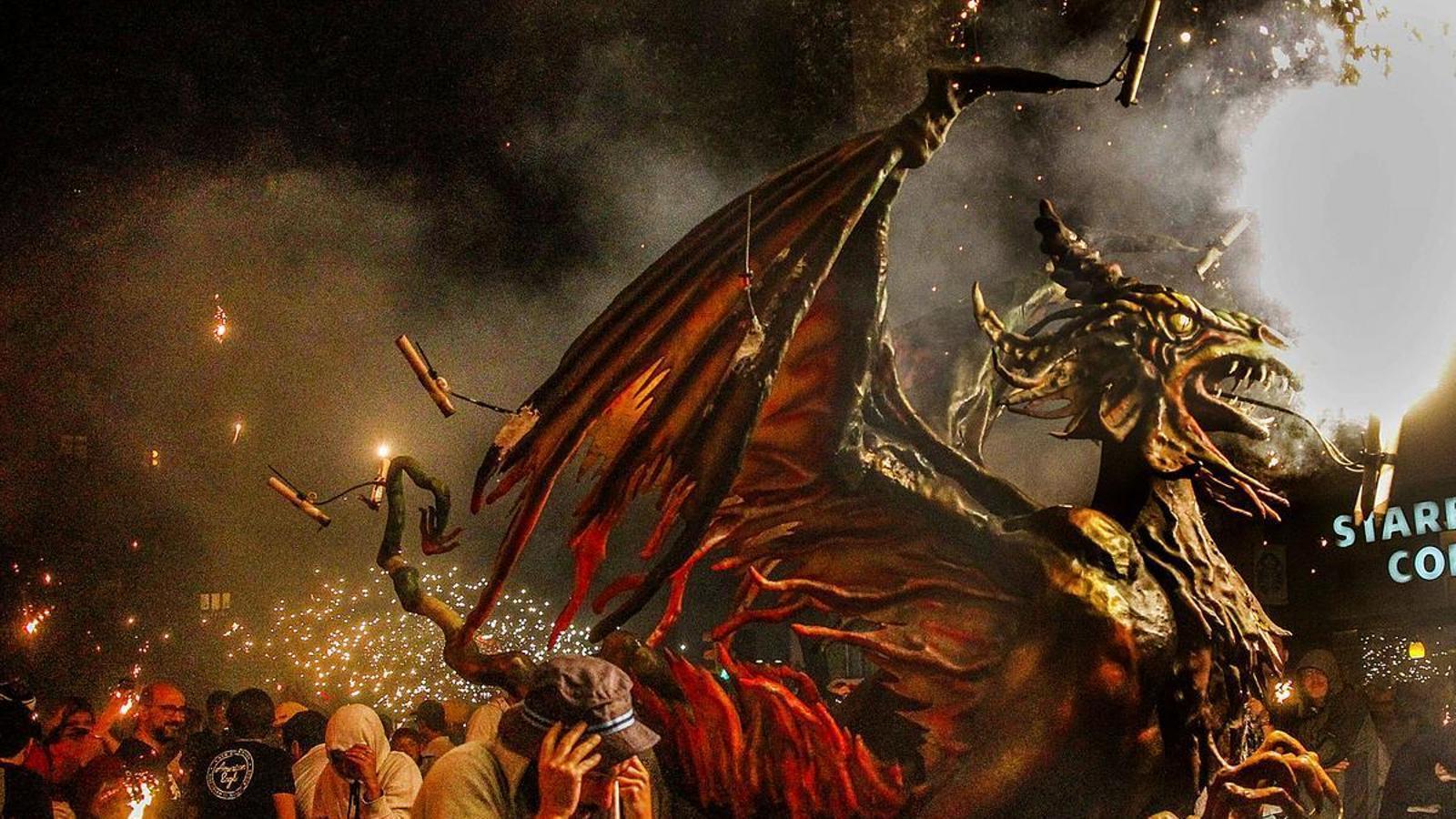
"It was at that moment that the dragon became an enemy," says Bertran. This interpretation was reinforced by the literature of medieval bestiaries, which cataloged real and fantastic animals, with the dragon occupying a central place among dangerous creatures. "The dragon appeared in Romanesque miniatures, in ceramics, and in religious representations," adds the professor from Rovira i Virgili. In the 12th and 13th centuries, similar forms are documented in Aragon, Tarragona, and Valencia, with common morphological characteristics: wings, a spiral tail – with a face-shaped tip that reinforces its malevolent power – enormous eyes, and a forked tongue. "There is a very clear iconographic continuity throughout the centuries," explains Bertran.
From the 14th century onwards, the dragon ceased to be merely an artistic image and entered the public sphere through religious processions and festivals. It appears, for example, in a mid-14th-century painting in Tarragona Cathedral depicting a popular procession, with other beasts, musicians, and dancers. In Barcelona, the Corpus Christi festival of 1424 already documents the presence of Saint George and the dragon (called vibre, and víbria in the case of the female dragon). He was not the only hero who fought the winged and forked-tailed monster: Saint Margaret also did. "At this time the myth became a spectacle – Bertran points out –. The performances included dances, music, and dramatized street scenes, which consolidated a festive tradition that still survives today."
The dragon, political enemy
Its popularity also made it a political symbol at certain times. After the defeat of 1714, the figure also acquired new symbolic readings within Catalan culture. "The dragon symbolized the Spanish oppressor," says Freixa. During Modernism, this symbolic reinterpretation intensified remarkably. One of the most emblematic examples is the Casa de les Punxes, where Saint George appears as a monumental figure with a clearly vindicatory message: “Saint patron of Catalonia, give us back our freedom!”
Freixa highlights that this type of imagery generated controversy at the time. “They were images that had a very evident political reading and that the authorities tried to control, because representations of Saint George were used on stamps, postcards, and even coins,” assures the historian. Thus, in 1900, gold, silver, and bronze coins were minted, designed by the sculptor Juli Vallmitjana. The obverse shows Saint George on horseback killing the dragon with the inscription “Unió Catalanista 1900”. On the reverse, each coin features different symbols: the throne of King Martin (gold), the four bars on a cross (silver), and the four bars with a helmet and crown and the motto Vindicamus hereditatem patrum nostrarum [We claim the inheritance of our fathers].
Saint George has been disappearing from the entourages. "There are some exemptions from ancestral (not contemporary) traditions in Monçao (Portugal) and Mons (Belgium), but in many other localities the figure of Saint George has disappeared from the entourage. The dragon, on the other hand, has not lost popularity. In fact, it is no longer just an enemy; it is a beloved and central figure of the festival,” highlights Bertran. "It's like with the representations of David and Goliath. David has not survived. The giants, on the other hand, who were the bad guys, are enormously popular,” he adds.
