'Ana Catalani, my Barcelona'

-
CAT -
CAST
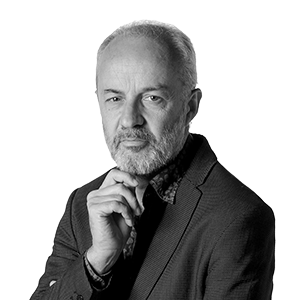
The politician, writer, economist, and urban planning consultant Antoni Vives has lived for six and a half years in Saudi Arabia, at the service of Prince Mohammed Bin Salman (MBS), designing and promoting the construction of the linear city Neom, in the desert at the northern tip of the Arabian Peninsula, on the Red Sea coast; a unique commitment to sustainable modernity, conceived for architects and engineers as well as botanists. Civilization and nature: 170 km long, on paper it is designed to run on renewable energies and intended for 9 million inhabitants who will not need to use cars, with all personal and collective services within 5 minutes. It is the largest open-air construction project in the world. Will they succeed?
To the secret country. A Catalan in the court of the Prince of Saudi Arabia Al país secret. Un català a la cort del príncep de l’Aràbia Saudita (Pòrtic).
". Inside the car, with Antoni around, the imam sings him the sura for ten minutes One day, before leaving Saudi Arabia, he decides to take one last solo inner journey that, among other places, takes him to Medina. In the Seven Mosques neighborhood, he strikes up a conversation in the street with a group of young people led by a young imam. He wins them over from the start by introducing himself in their language: "Ana Catalani, min Barxiluna, wa ana ismí Antoni". In the car, with Antoni around, the imam sings him the surah An-Najm for ten minutes, the first that the prophet Muhammad recited. "The undulating melody, like life itself, elevates me," he recalls in the style of Montaigne.
"I ask you to have patience"
His Arab life has taken many turns. Just three months after settling there, he faced the shock of the brutal assassination in Istanbul of the dissident Yamal Khashoggi, a journalist for the Washington Post: bound, suffocated, and dismembered at the Saudi consulate. Antoni was warned by the Minister of Economy who had hired him: "Before accepting the job we are offering you, I want you to think carefully, because now comes the second part of what I wanted to tell you: you will see many things that you will not like, things that will make you say: 'How am I here, among these people?'. Well, I ask you to be patient, to endure." The first part had been this: "I want for my country what you have: good services, good sidewalks, and a special joy of living and working. We want material progress and social progress. Only then will our generation, and the prince's generation, leave the legacy they hope to leave".
Saudi Arabia was founded in 1932 by the grandfather of MBS, the head of the Saud tribe, who subjugated or integrated – depending on how you look at it – the other tribes to create a modern state. A nation. The fact of guarding the holy cities of Mecca and Medina gives it special legitimacy within the Muslim world. It is Sunni majority, but the oil region is Shiite. The first well began to extract black gold in 1968. It is estimated that the reserves will last 100 years, time for a modernization that will emancipate the country from oil dependence.
How? With the MBS Vision 2030 program, of which Neom is a propaganda spearhead, a program at the pace of aperturist decisions: suppress the religious police, end gender segregation, open the doors to cinema and music, break with the clientelist structure, think more about improving GDP than ROI (return on investment) via the sovereign wealth fund PIF (Public Investment Fund). In a country with 75% of the population under 35 years old, the prince knows he has the youth on his side, to whom he offers a well-being of material hedonism (consumption and entertainment) and a new cosmopolitanism (many have studied in the West), but not democracy, and without abandoning the tribal and religious soul (Sharia is included in the Constitution and the Wahhabi clergy offers resistance to changes).
Is the synthesis of this revolution from above possible? In any case, it is his alternative to the Iran of the ayatollahs, today besieged by the US. MBS: a governor with an iron fist, with absolute power, who plays Chopin on the piano and plays on the Play, who drives the country with one foot on the accelerator and the other on tribal tradition. Who imposes the richness of culture and the culture of richness.
Vives' book is a song against "a weakness that makes us very vulnerable": Western prejudices when looking at the Middle East, today once again shaken. If anyone ventures to visit Neom, and to see how progress is advancing there at a bizarre speed, at the maritime station they will be greeted by a sculpture with the four bars designed by Ricardo Bofill. If anyone goes to Riyadh, they will admire it planted with trees: a million in two years. At the end of his Saudi tour, Vives takes stock. He clings to "the deeply kind soul of the Arab people and the desert peoples" to conclude that MBS's dictatorship "is one of the most welcoming countries I have found".
