The Cemetery of Forgotten Books reopens its doors
Planeta commemorates the 25th anniversary of the publication of 'The Shadow of the Wind', by Carlos Ruiz Zafón, with a party at the Sant Pau Art Nouveau Site

-
CAT -
CAST
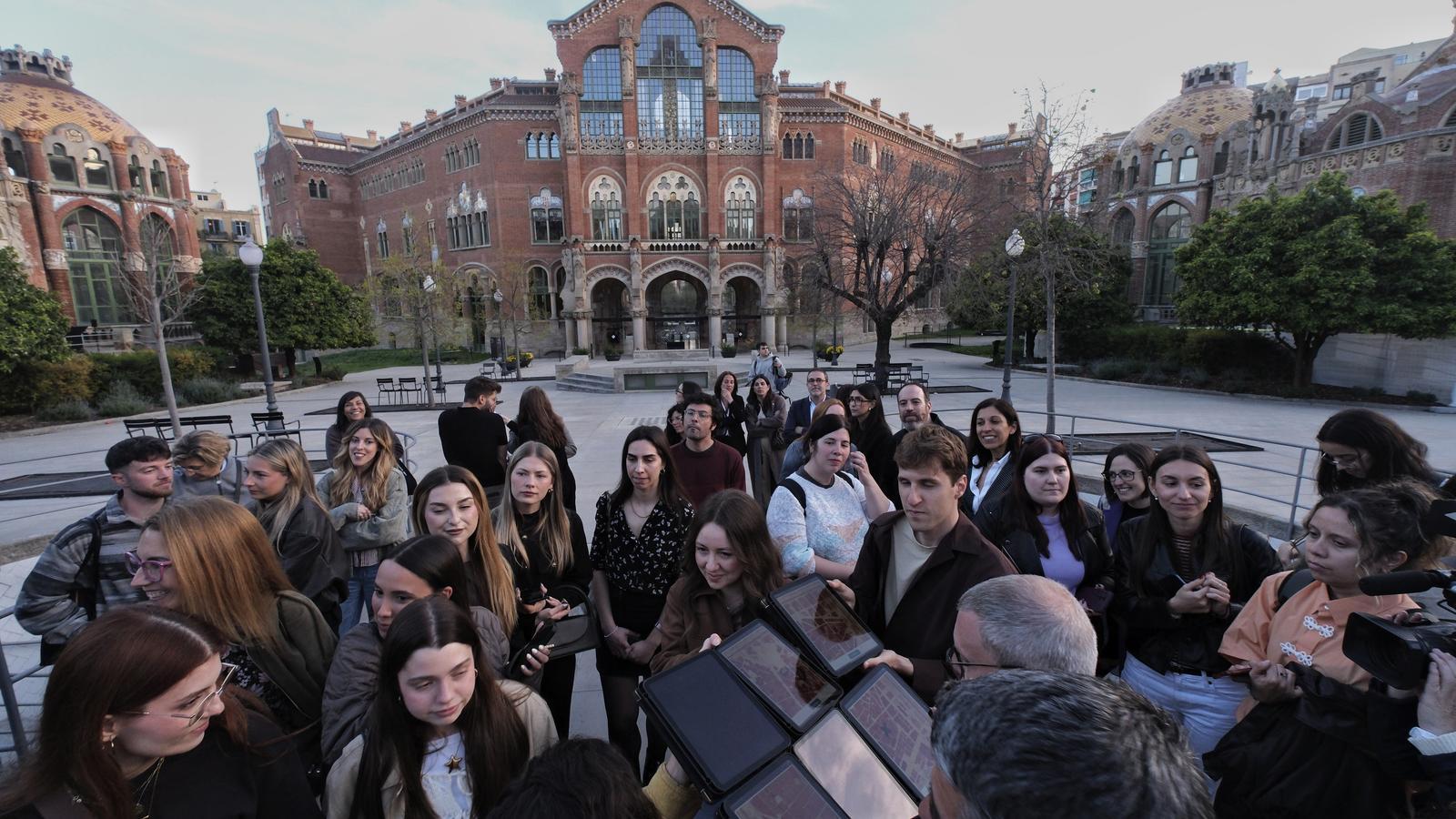
Barcelona"Stories have memory, and if no one takes care of them, they die", proclaimed, at the entrance of the Sant Pau Modernist Site, the guide who would accompany the sixty or so chosen ones – readers, influencers and journalists – to the Cemetery of Forgotten Books, one of the most emblematic settings of The Shadow of the Wind, the novel with which Carlos Ruiz Zafón (1964-2020) conquered the world 25 years ago.
Dressed in a suit and tie and with an elaborate syntax, the master of ceremonies recalled some of the premises of the story that changed its author's life in 2001. It all began when young Daniel Sampere accompanied his father to a mysterious place in the heart of Ciutat Vella, "where he found a cursed book that would drag him into the labyrinth of intrigues that the city hid". "It was The Shadow of the Wind, by Julián Carax", murmured one of the attendees, about to follow with commendable devotion the trail of clues that the Planeta publishing house had set up through half a dozen iPads.
An unusual publishing phenomenon
It has been a quarter of a century since word-of-mouth turned that novel set in 1945 Barcelona into one of the decade's most unusual publishing phenomena. The Shadow of the Wind became a bestseller in Spain, Italy, China, Germany, Australia, and the United States. It won the readers' prize in the Netherlands and the booksellers' prize in Canada, was considered the best foreign novel in France in 2004, and was the Booksense Book of the Year – a book to remember – from the prestigious New York Public Library. In 2014, Penguin Classics also chose The Shadow of the Wind as the last of 26 works selected to represent the history of universal literature. The Barcelonian accompanied Jane Austen, Marcel Proust, and Charles Dickens, among others.

Along the path of the catacombs
This Tuesday evening, at the Sant Pau Modernist Site, the guide was preparing the readers to access the catacombs where, in addition to the Cemetery of Forgotten Books, a standing dinner and a freshly baked copy of the novel's lavish commemorative edition awaited them, which Columna publishes in Catalan and recovers the translation by Josep Pelfort. "Do you remember the forbidden love story between the rich Penélope and Julián Carax, son of a humble hat maker?", he asked. "In which neighborhood is the heart of this story located?", he asked a little later. Inspired by a warehouse in Los Angeles and by the second-hand bookstores of Ciutat Vella, Carlos Ruiz Zafón managed, thanks to the mysterious Cemetery of Forgotten Books, to capture a large number of readers around the world: it has been translated into more than 40 languages and has sold more than 16 million copies. One of the most illustrious readers was Stephen King, who described it as a "wonderful" work and an "authentic gothic novel". "To appreciate it fully, you have to be a true romantic," he added.
The sixty or so Ruiz Zafón enthusiasts were leaving the party ready to continue spreading the passion for reading a novel that has changed their lives as readers, as they agreed to acknowledge, in a brief round table before dinner, the Planeta finalist, Ángela Banzas; the bookseller from Madrid's Pérgamo, Pablo Cerezo, and theinfluencer and novelist Fernando Bonete.
