The Barcelona City Council unblocks the Can Batlló project with an investment of 98 million
The old factory will house all the city's archives and will free up 17,000 square meters for social housing
-
CAT -
CAST
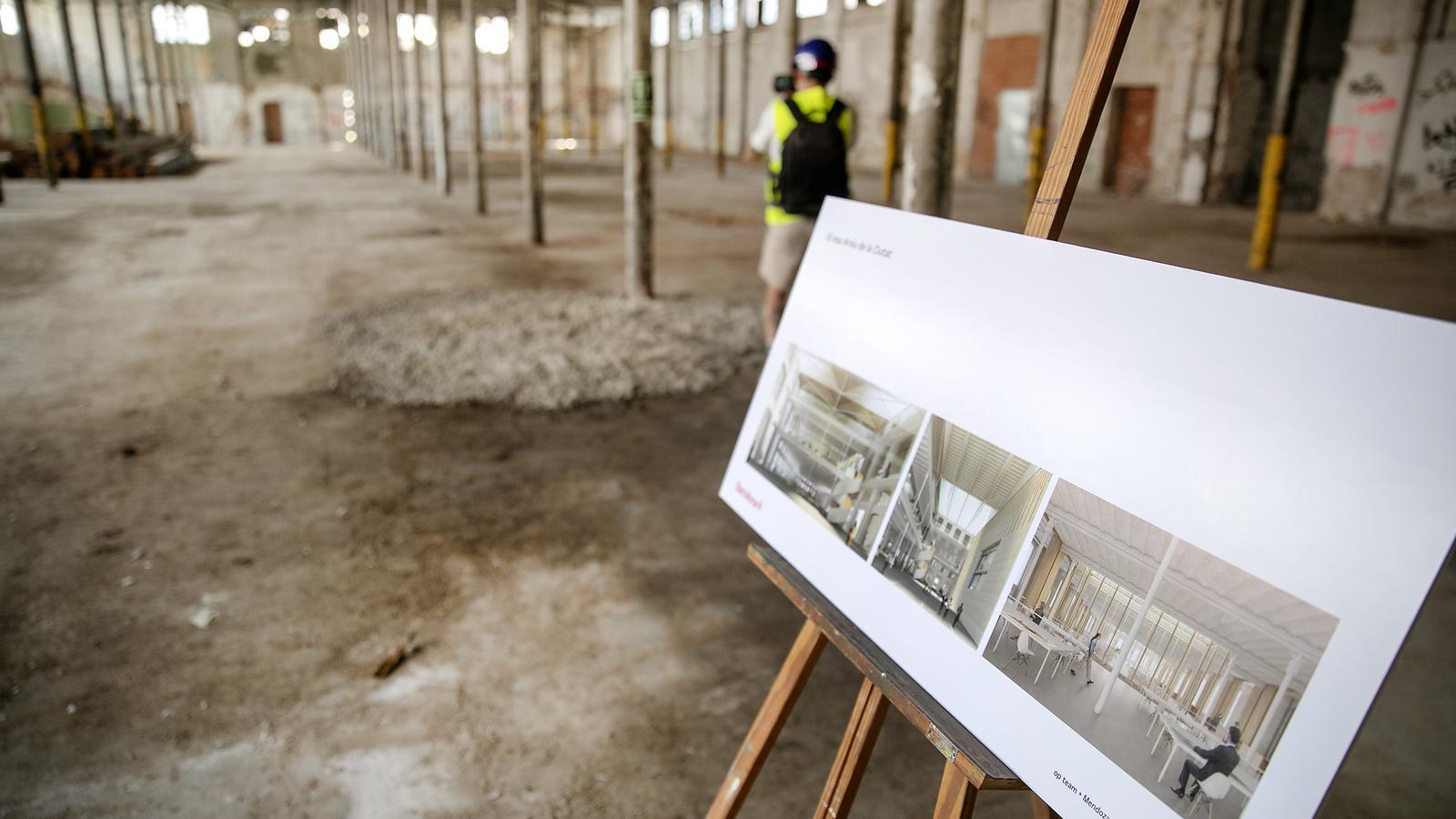
BarcelonaAlmost a decade after the ambitious project to convert the central nave of the Can Batlló industrial complex into a large agora open to neighbors and the sole headquarters of all Barcelona's archives was presented, the municipal government has taken a step forward to unblock a long-claimed infrastructure. "With this announcement, what we have had to wait for so many years, we make it happen. Work begins in the first quarter of next year," highlighted the mayor of Barcelona, Jaume Collboni.
The original project, from 2018, with a budget of 47 million euros, had been completely stalled, according to Collboni, by the covid-19 pandemic, political changes, and the lack of real financial allocation. Now, the transformation of Block 8, in the Bordeta neighborhood's factory site, is gaining new momentum with a financial injection: the budget practically doubles, reaching 98 million euros: “The increase is due to the update of market prices and an expansion of the usable space, which grows by 5,000 m2 compared to the last tender,” Collboni informed. “It will have 30,000 m2, an area larger than that of the Disseny Hub and will be one of the largest cultural facilities in the city,” he added. The works will last until 2034, but, according to the mayor, spaces will be opened gradually.
Obsolete archives at saturation point
The historical archives of Barcelona have always prided themselves on preserving the city's memory: there are documents spanning twelve centuries of history, from the 9th to the 21st. Inside each folder are millions of stories: power struggles, urban revolutions, records of bombings, municipal regulations on prostitution, assassinations, or neighborhood demands. Not to mention all the documentation generated daily. But they have become obsolete. "The current situation presents deficiencies in access difficulty, obsolescence, and a space limit that has already reached 95%," warns the chief archivist of Barcelona, Ana María Pazos. At Can Batlló, all the documentation currently dispersed across 23 archive centers and municipal departments will be moved. In total, there will be 70 kilometers of physical memory.
When the visitor enters the central nave of Can Batlló, currently a large empty industrial skeleton, they will find an immense lobby. According to the team of architects in charge of the project —the UTE comprising OP Tema Arquitectura, Mendoza Partida, and Ramon Valls—, which won the public competition ten years ago, it will be "a great agora". Its 1,900 m2 will serve as a transit area, a large exhibition hall, temporary exhibition rooms, educational classrooms, a shop, a cafeteria, and an auditorium with a capacity for 1,200 people. All these spaces will be accessible from the street, allowing them to be autonomous and have their own opening hours. It will be the area that retains the most original parts of the building, recovering the roofs, the facade, and the interior space. The second floor will house a large consultation room that is more accessible and much better equipped than those currently in the city's various archives. On the third floor, there will be offices. The other half of the building will have up to six floors, where the documentary collection will be housed.
Space freed up for housing
With the unification of the documentary funds, the City Council will manage to free up about twenty different locations that add up to nearly 17,000 m2 of facilities. "Enough space will be freed up for endowment housing in saturated critical points such as the Ciutat Vella district, in areas like Bisbe Caçador street, or in Poblenou," said Collboni.
Built in the 19th century as a textile manufacturing industry, Can Batlló, with a surface area comparable to that of Camp Nou, was one of the most important factory strongholds of the time. After its activity ceased, in June 2011, the residents of La Bordeta, organized in the Can Batlló Platform, managed to get Block 11 ceded, which is currently a self-managed space. Since then, neighborhood struggles have been ongoing to reclaim different spaces of the old factory.
