Nausicaa Bonnín faces patriarchy
Anna Serrano directs at Teatre Lliure 'The Author', a text by Ella Hickson that wants to deconstruct the theatrical world from fiction

-
CAT -
CAST
BarcelonaTo write The Author, Ella Hickson locked herself away for five weeks in a cabin, in the woods, without seeing anyone. The British playwright wanted to get rid of the patriarchal mechanisms that surround the world of theatre, and for that reason she threw herself into a process of automatic writing that resulted in an experimental text full of questions. The director Anna Serrano brings it to the stage at the Teatre Lliure de Gràcia, where it can be seen from May 7th to June 7th. Nausicaa Bonnín is the protagonist and on stage she is accompanied by Javier Beltrán, David Selvas and Ravina Raventós.
"Hickson has an inevitably political discourse, with a very clear gender perspective. Through art and theatre, she tries to create a work that is free, that has no imposed rules or structures, but she does so within a capitalist and patriarchal system. She seeks to escape the sexualizing and male gaze on the female body," explains Anna Serrano, who for more than a decade was part of the Colectivo VVAA and who currently also works as artistic and programming coordinator for Sala Beckett. For this production, the director has worked with a translation by Carlota Subirós which is published in the Llum de guàrdia collection by the publisher Comanegra.
Writing from instinct
The author does not have a common thread, but is constructed from the scenes that Hickson imagines, in a metatheatrical game that takes place from the beginning. On stage, Nausicaa Bonnín plays the same playwright, while Beltrán and Raventós are two actors with the challenge of staging the play that the protagonist is writing. David Selvas, for his part, is the director. "We tried to rationalize the play, but then we realized that it is a performance that cannot be understood solely from the head. Hickson wrote it from instinct. The text explains itself according to this and invites you to let yourself go," emphasizes Bonnín.
Beyond attacking patriarchal structures, the show also offers a deep reflection on creation from its depths. "It speaks of the perversion of art. At what point has it become a profession? If the goal is to sell tickets, where does the art of an author who faces the blank page go?" asks Beltrán, and Serrano adds: "At the same time, the play is a tribute to theater, to this device in the scenic box that allows us to make magic every time we start something new."
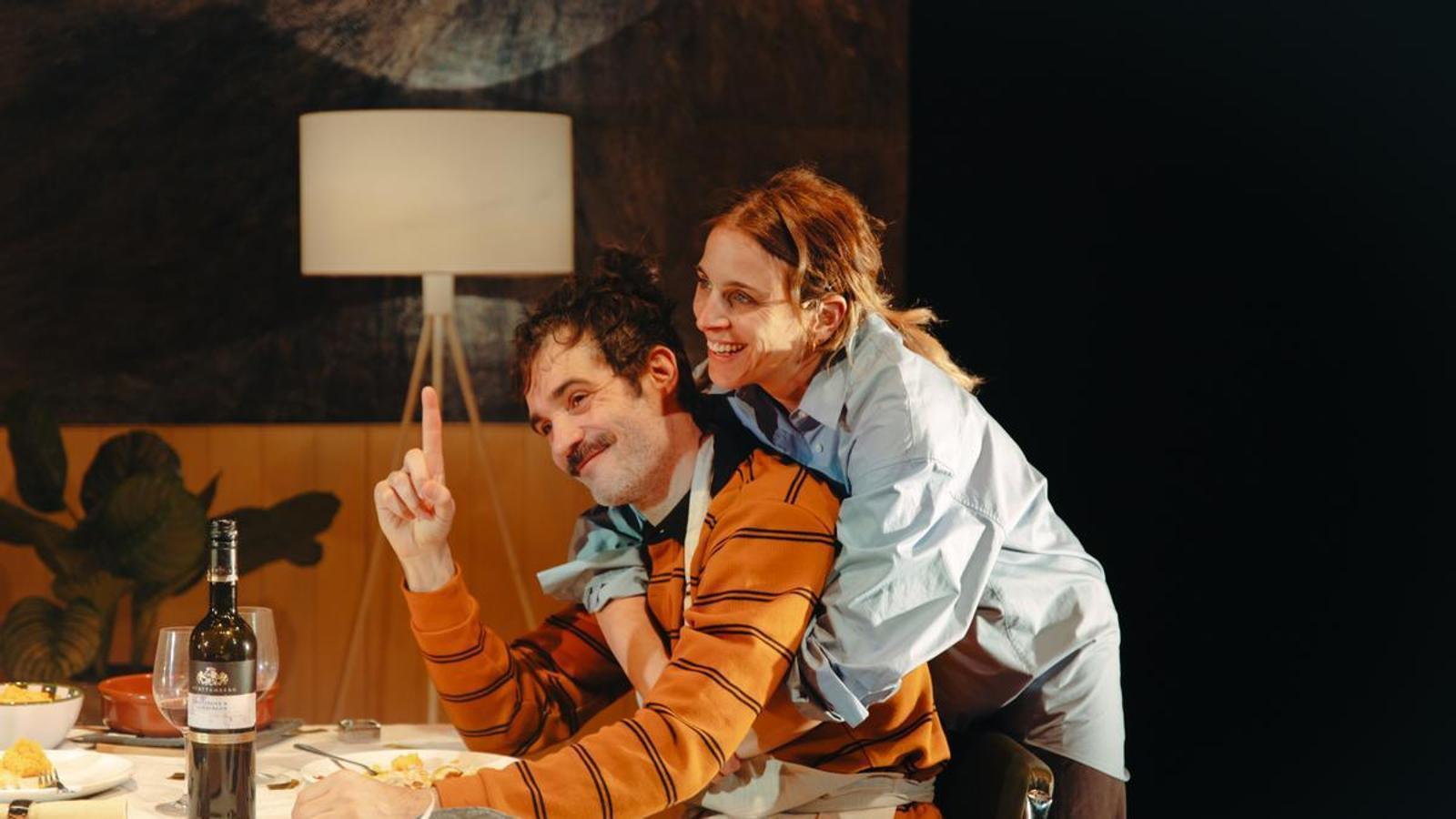
Despite the high abstract content of the piece, the company has tried to ground it through scenes that refer to the most intimate and everyday situations. "There are moments like an encounter between two characters going to the theater or a couple's dinner. Hickson takes the scenes to the limit to show us the impact of the other's gaze on things and how each person's baggage transforms what we see," says Serrano.
In this regard, the scenic space in charge of Judit Colomer has been "quite a challenge," because it has had to house "the different plays that Hickson proposes in the same space," says the director. The scenographer has worked to create a stage for each chapter of the show and, at the same time, build a universe that encompasses them all. "There is a certain magic in the scenic space, and we have played with it until the end," emphasizes Colomer.
