A helicopter will "bombard" Barcelona with 100,000 Catalan and Chilean poems
Freedom is the concept of the action of the Chilean collective Casagrande in cities that were punished by bombings
-
CAT -
CAST
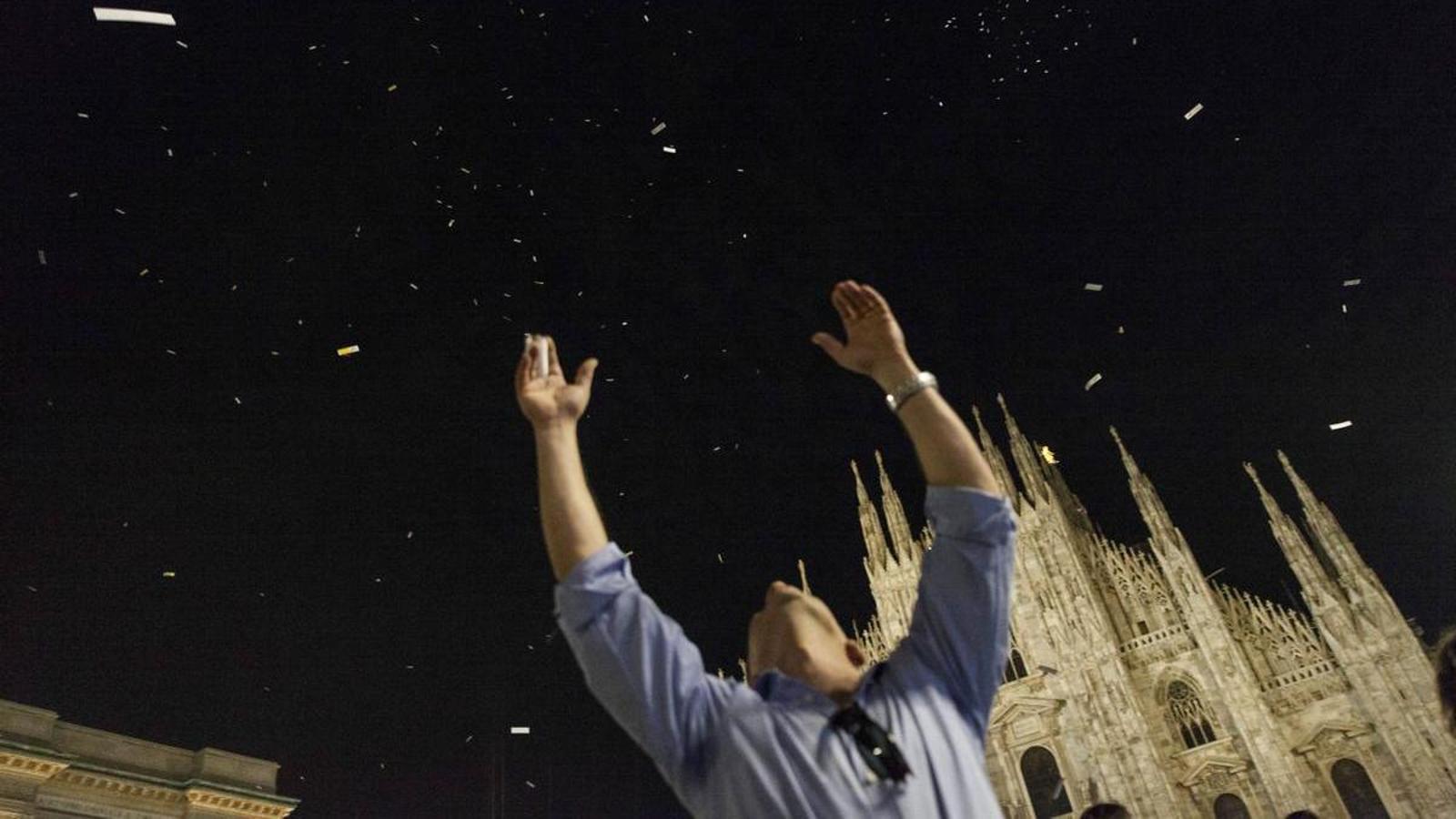
Barcelona88 years ago, the citizens of Barcelona and other Catalan towns looked at the sky with terror. "The terrible hecatomb that punishes Barcelona continues. A couple of thousand victims and more than a hundred buildings destroyed in two days. Panic and horror. Let's all go to Vallirana. The scenes of exodus and sheltering witnessed at the metro stations and platforms are unforgettable," wrote Josep M. López-Picó on March 18, 1938. On Saturday, June 20, however, one will be able to look at the sky with optimism: 100,000 poems will fall. On the occasion of the 50th anniversary of Franco's death, a helicopter will fly over Plaça Nova and the surroundings of Barcelona Cathedral to drop verses, in Catalan and Spanish, especially from emerging poets.
"It's half a ton of poetry. We have gathered a hundred authors, fifty Chilean and fifty Catalan, who speak of freedom in any of its forms," assure Joaquín Prieto, Cristóbal Bianchi, and Julio Carrasco, from the Chilean collective Casagrande. Barcelona will be the tenth city "bombed" with poems by this group of artists who started by filling train cars with poetry. They have been preceded by other cities bombed by aviation at different historical moments such as Santiago de Chile, Guernica, Berlin, Warsaw, London, Dubrovnik, and Rotterdam.
Prieto, Bianchi, and Carrasco were born in 1973, the year the Moneda Palace, the seat of the Chilean government, was bombed, with President Salvador Allende and his collaborators inside. After the coup d'état, Pinochet established the dictatorship and destroyed the legacy of the democratically elected president, who died that same day. In 2001, 28 years later, Casagrande decided to bomb the same Moneda building with poetry dropped from a helicopter, as well as reading poems from the balconies. There was no prior rehearsal, obviously, but it was a success: the public raised their hands to catch the poems in flight. "Not a single poem was left on the ground," assure the three artists. "We choose emerging poets. The limit is our own generation, authors mostly born from the 70s onwards. We are not looking for historic figures like Pablo Neruda; we are interested in dialoguing with the present and looking towards the future," explain Casagrande. Among the Catalan poets are also some young voices chosen by the Barcelona City Council.
Emerging voices
Poems will fall from the sky printed on a rigid rectangular paper format; a design studied so that the papers "spin in the sky" as they descend, so that people can catch them in the air. "In other cities there has been an explosion of joy; adults turn into children running to catch the poems. When we did it in Guernica it was very special because we met survivors who were children when the bombs fell there," remember the Chilean artists.
"Throughout these past months of curatorship, our central objective has been to answer a key question: how can we address democratic memory through art and culture? Given the violence and the global war climate we are experiencing, it seems important to oppose it through words, emotion, and empathy," assures Carmina Gustrán, commissioner for the celebration of the 50 years of Spain in Freedom organized by the Spanish government, which is financing the poetic action. "Many citizens do not know that spaces like the Cathedral avenue were created as a result of the bombings of the Civil War, or the tragedy that struck Sant Felip Neri square, where forty people died, twenty of whom were children," adds Gustrán, who highlights that the focus has been placed on emerging voices because it is this young audience they want to reach. "Sometimes we run the risk of falling into an excessively serious rigor that distances us from society. If we want to reach audiences who are not convinced a priori or who do not approach memory on their own initiative, we have to look for new forms of connection," she reiterates. The action will begin at dusk and end at night, because the intention is to experience this change of light: to transition from the traumatic event towards a different future outlook.
Among the participating Catalan poets are Vicenç Altaió, Eva Baltasar, Carla Fajardo, Àngels Gregori, Xavier Mas Craviotto, Biel Mesquida, Marta Pessarrodona, Fàtima Saheb, Víctor Sunyol, and Antònia Vicens. Among the Chilean poets, authors such as David Bustos, Elicura Chihuailaf, and Valentina Marchant stand out ("the full list and the poems that will fall from the sky can be consulted on the website). The event will be recorded for the creation of a video, and all the material and images from the day will be available on the collective's website from June 24th.

