Emma Zafón: "I have met many men with a discomfort they don't know how to express"
Writer, publishes 'The Mother'
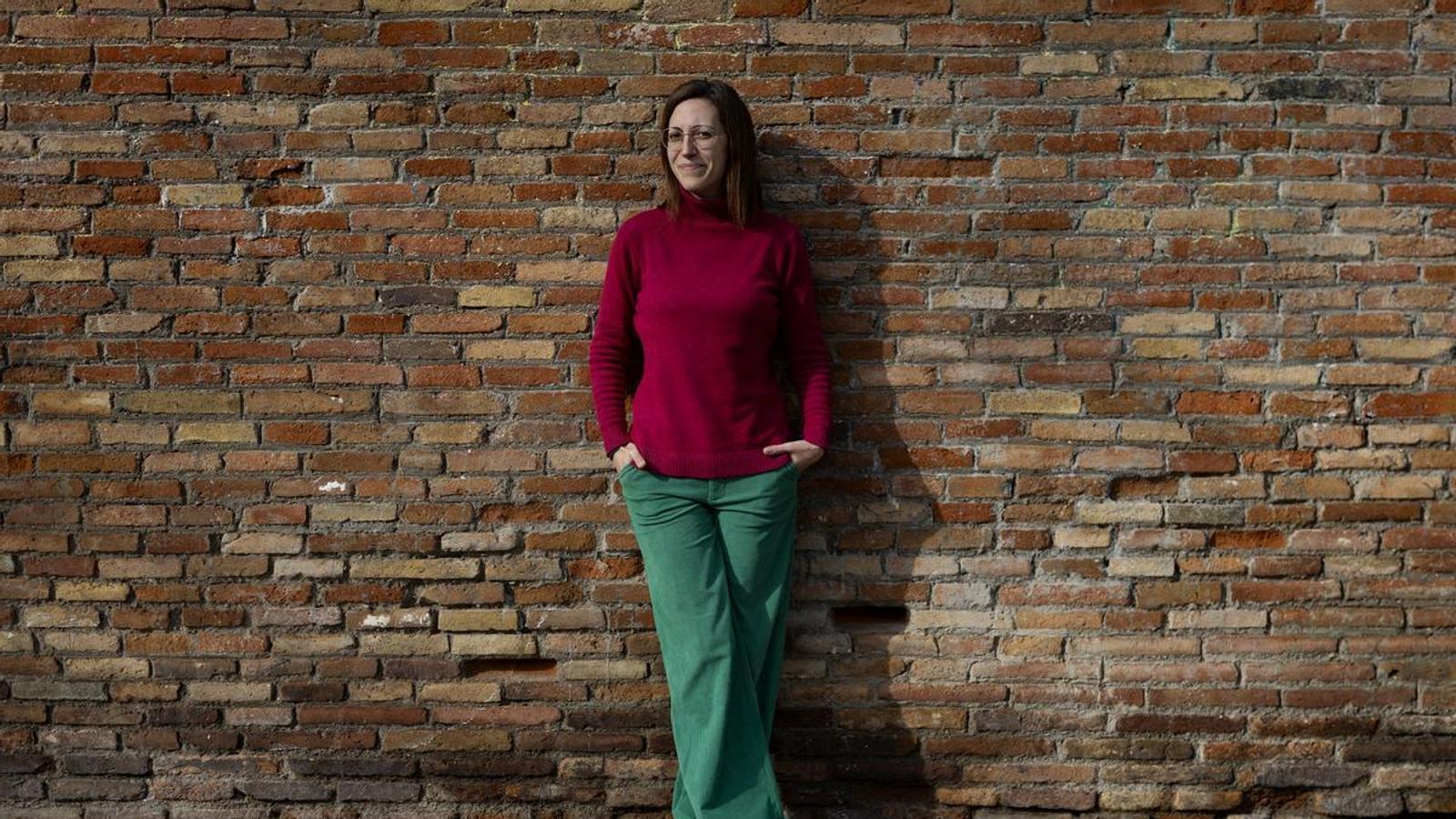
BarcelonaThe novel Casada y callada (Empúries) discovered three years ago the powerful voice of Emma Zafón (Llucena, 1987), a writer with narrative muscle and her own perspective. After that novel, nominated for the Òmnium prize, Zafón has returned to bookstores with a new story that acts as a mirror to the wounds of patriarchy. In La madre (Empúries), Zafón imagines three adult siblings –Roberto, Lorena, and Álex– from a family in Borriol who see their day-to-day life change when their mother, on whom all domestic care falls, breaks her arms and someone has to take care of her.
How have you approached this novel?
— I wanted it to have more characters and for them to hold their own minimally, not to focus solely on the voice of one protagonist. The fact that Casada i callada was liked for the elements that I valued highly, the generational story and the speech of the Valencian Country, has pushed me to keep writing.
Would you say it's a family novel?
— Yes, and it is because it was needed. I wanted to explain how practically all families in Catalonia, in the Spanish State, in many places, are functioning. Women who are now between 50 and 70 years old work, have concerns, and no longer understand that they necessarily have to assume the care of the elderly. My grandmother took care of her parents and her in-laws, that's what was done. Now, fortunately, it doesn't necessarily have to be like that, and suddenly the care of the elderly is shaken. What do we do?
In the protagonist family it is assumed that Lorena is the one who must take charge, and she does so at first.
— In many families it is always assumed that women have to do much more. For the novel, it has served me to offer different perspectives: that of the daughter but also those of the male siblings. On the one hand, there is how she deals with it, the discomfort it causes her, and on the other hand, how they are not aware of all the work that has to be done when the mother has an accident. They are out of sorts, they don't understand why their sister gets so angry. It is a reality that continues to happen.
¿How was the writing process from the perspective of the two brothers, two men strongly marked by patriarchy?
— I don't want to ridicule them, but to explain their reality from two different stories. One of the brothers is very young, it's the accident that happens when the mother thinks she's going through menopause. He always sees himself as the baby of the family, who will always be looked after. The older one has had the role of the man of the house, with the women at his service. Nothing that happens to them is pleasant, but they also never take the initiative to help their sister. They always go along for the ride. It's what they've seen at home, what has been instilled in them, and what predominates in the social structure.
Despite having more or less functional lives, both experience an emotional blockage that prevents them from being happy. The writer Anna Punsoda would say that they are stuck men.
— Anna Punsoda's concept seemed very accurate to me. I've met many men with a discomfort they don't know how to express, who perhaps think it's not their place to express it, and all of this ends up affecting the people around them. It's a way of being in the world, a kick forward, and the days go by. This is experienced like this, above all, by the older brother. With the younger one, there are moments when they connect, both have the concern of wanting to say something to each other, but in the end, they always end up talking about superficial topics.
Roberto is a prisoner of a relationship that does not satisfy him. Is this situation a critique of the idea that a lifelong partner will make you happy?
— With this, I wanted to portray this traditional way of life that is still much more hegemonic in villages than in cities. They are couples in which many times they do not feel well, but they stay together because of the idea that this is what is expected. Maite and Roberto have a relationship of inertia, with a lack of passion after many years of living together. They haven't known how to take care of what they had, and he feels out of place, he doesn't know whether to continue or break it off. And perhaps they are happier together than apart, because they don't know anything else, and a breakup generates more pain and displacement.
The novel unfolds a powerful class perspective through the jobs of the three protagonists. Roberto is a banker and has a comfortable life, Lorena works her skin off at the bar, and Àlex ends up inheriting his father's trade, who is a stonemason.
— For the people of Castellón who lived off construction and supplier industries, 2008 was our Vietnam. I wanted to illustrate this hecatomb and it suited me well to link it with the character of the older brother, the only one who has made a career, who is a classic of working-class families. He becomes the town's trusted banker until the crisis of preferred shares. That was a drama. In Àlex's case, he is a young man fueled by partying, who puts aside his studies and goes to make quick and easy money. My generation was one of school failure linked to the boom in unskilled jobs. Many men followed this path, and now they find themselves at 40 years old with a very hard life. They live a generational scam: they were promised that life would be comfortable, and now they find themselves broken. If you compare them to someone who does office work, they look ten years older. And then there's the fact that they went through the crisis, and the job market they were promised has never returned. This, in certain areas, explains many things about voting behavior. They are people who feel very abandoned by the system, a breeding ground for the far right.
Language is vital in your stories. When working on it, does it flow naturally or do you do a lot of rewriting?
— I have to rewrite, above all, because sometimes I get too colloquial and then when I read it I see that I can't skip the rules so much. With the first impulse I go all out with speech, and then with the second reading I reel it in. In this case I had more difficulties, because Borriol is not my town, although I know it quite well because I have friends and I used to go a lot when I was young. The localisms are different from those of my dialect. I worked with a compilation of words that Eugenia del Campo published in a local magazine. I am very grateful to her.
