The AADIPA day in Olot began with a visit to three essential works by RCR studio, formed by Rafael Aranda, Carme Pigem, and Ramon Vilalta, winners of the Pritzker Prize —the architects' Nobel Prize— in 2017: their own studio, the result of the rehabilitation of the old Can Barberí foundry; the Tossols Basil athletics stadium, and the Parc de Pedra Tosca. “When Ramon first entered Can Barberí, he said the building was already a landscape,” recalled Laura Llimona, coordinator of the RCR summer workshop and collaborator of the RCR Bunka foundation. While in Can Barberí the intervention was minimal and strategic to maintain the atmosphere of the place, in the stadium the integration into the landscape is key. “The track turns around the boulders and the grandstand follows the topographic line. The interventions, even the paving, are totally related to a slope that goes down to allow nature to grow,” explained Llimona.Regarding the Parc de Pedra Tosca, Carme Pigem explained that their aim was to “awaken” the place, that is, to awaken the stone from the site itself, which they considered a “dormant” material, and to use this stone instead of “discovering” other materials. “A narrow, broken line of steel allows crossing the space, and at sporadic intervals, the steel holds the protruding mounds in position. The zigzag of the steel lines contrasts with the rounded masses of rock and establishes new clearings,” explained Pigem.
Gardens, squares, and housing: revitalizing an old neighborhood with people in mind
The study Un Parell d'Arquitectes and architect Itziar González lead the transformation of the old town of Olot

-
CAT -
CAST
OlotThe architectural transformation of Olot's old town is unstoppable. "There had been so many plans that the residents were tired and wanted action," says architect Eduard Callís, the founder with Guillem Moliner of the studio Un Parell d'Arquitectes. This studio is responsible for a major recent project, the Pla de places i placetes of Olot. This Saturday, Callís guided the public through these works during a visit organized by the Group of Architects for the Defense and Intervention in Architectural Heritage (AADIPA) of the College of Architects of Catalonia. The most recent of these works are the Jardins de la Muralla, the result of injecting life into "a kind of empty space" that emerged from the demolition of a residential building about twenty years ago. "There were only two rows of plane trees and a esplanade, and the residents were very interested in transforming the place into a garden, and in this garden connecting the city with the river," says the architect. The inauguration is scheduled for May 8.

A Pair of Architects are accustomed to making a virtue of necessity, and Callís explains the innovations they have introduced with materials taken from the construction site itself or from the municipal brigade's storage, among which is a path made with concrete slabs that used to form a sidewalk, some benches and some play equipment that have been moved. Furthermore, their vision of architecture is profoundly social: "We wanted to create the possibility of fostering connections between neighbors, many of whom are of foreign origin. They know each other by groups, but not personally, so we collaborated with the Olot choreographer based in Paris, Tomeu Vergès, and Elena Masanas, who is a facilitator of community processes and organizational change." Thus, the neighbors brought an object evoking their relationship with the place, of which a brass version was made and applied by the builders at different points along the route, in an act that was also a tribute to the builders. "It was very special, it ended with seven minutes of applause, and the neighbors and builders were jumping while hugging each other," adds Callís.

One of the premises of the Plan of squares and small squares is to recognize the idiosyncrasy of each square. "It is about understanding that public space also includes ground floors, homes, what happens behind the facades, and valuing heritage, even if it is not always considered heritage," says Callís. "The teams have always been very transversal and multidisciplinary –explains Guillem Moliner–. In all the squares we have also worked with Quim Domene, who is an artist, and in each project other technicians have been incorporated into the team".

Before the Wall Gardens, A Couple of Architects finished the renovation of the main square, which is once again showing all its colors. "It is a renovation that goes further, it is integral –warns Callís–. The balconies have been restored, air conditioning units have been removed, and blinds have been unified". Painting accounted for 30% of the budget, and the rest was dedicated to combating structural pathologies of the exteriors. "We received the commission to change the pavement, but we came to the conclusion that at the price the project was going to cost, with the same amount in subsidies, the square could be transformed much more and its character could be valued much more than by intervening in the ground, where we changed the slabs and removed the planters –explains Callís–. This was also greatly encouraged by the neighbors, because, although they are public space projects, we actually worked more on the margins, because we were very aware that this was the plot we could work on. But the Old Quarter needs deeper interventions than just changing pavement or putting in a bench or a lamppost".
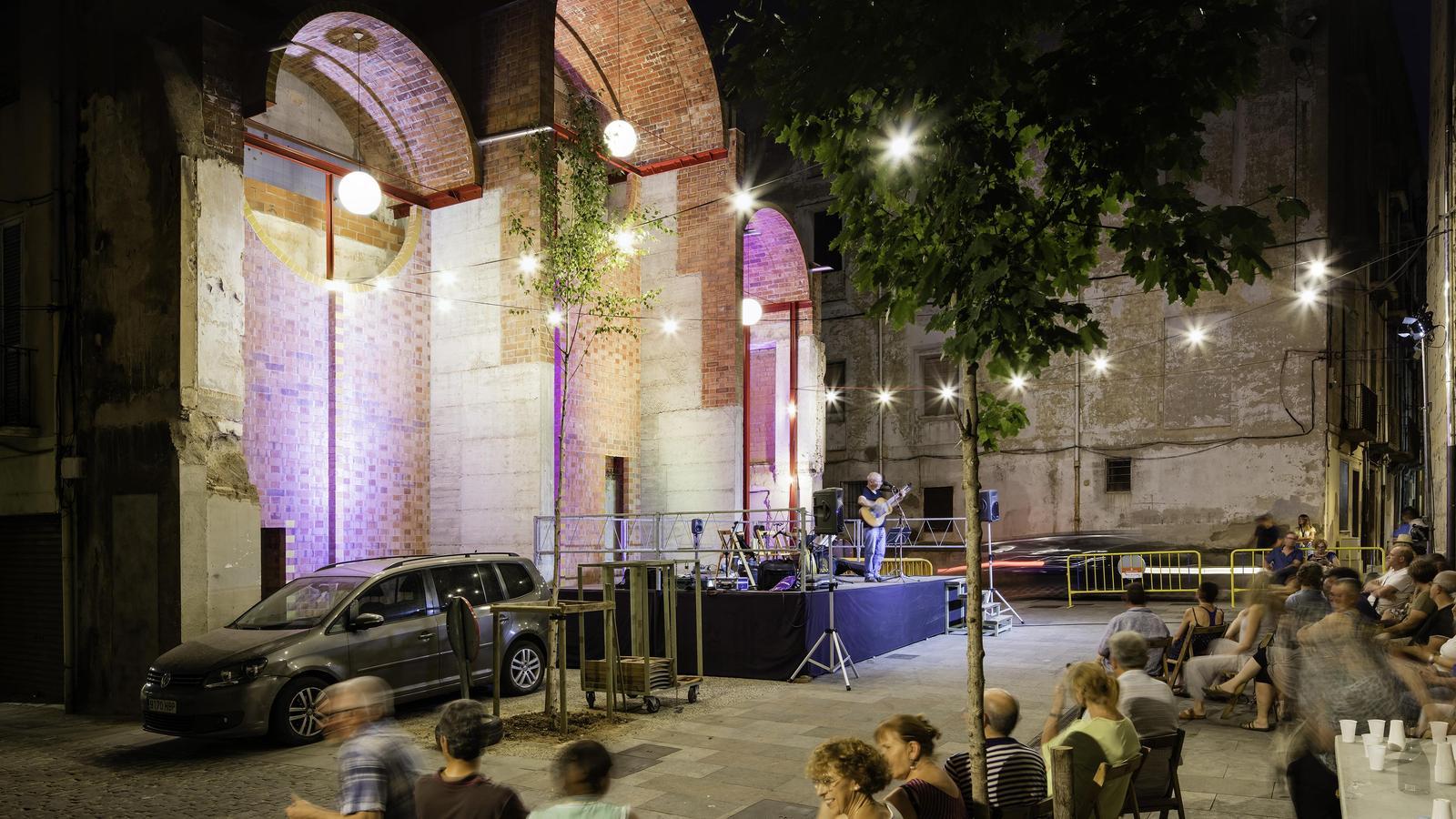
And another of their most emblematic works is Can Sau, an "emergency scenography" with which they dignified a party wall. "It was about transforming a plot into a square, a party wall into a facade, and with this facade we recovered the memory of the artisans who had worked in this neighborhood", says Callís. And Bon dia, Carme!, the interventions with which they revitalized the ground floors and the surroundings of the Carme square. "Having a perspective of general transformation –says Callís–. We have not had a large budget, and we have focused where we believed the problems were most urgent. We have taken advantage of every place, but at the same time it was like a way of thinking about the city from the point of view of the meantime. Instead of planning the city with large urban projects with large budget allocations, we have dignified the spaces with what we have, thinking about resources and turning what we have around", says Moliner.
Recovering about 300 empty homes in the old town
In addition to the work of Un Parell d'Arquitectes, architect Itziar González leads the Old Town Regeneration Project. "We realized that the Olot Squares and Small Squares Plan was not enough, because the old town, in addition to being old, was losing population, due to the type of apartments and the type of streets," states Josep Quintana, commissioner of the Old Town Regeneration Project. "It is a small late medieval expansion, where the layout and distribution of the apartments hardly allows for their rehabilitation on their own," says Quintana. Therefore, the action, which has a budget of about 25 million euros over the next five years, is planned by "blocks" to make it possible to dignify housing with actions such as the installation of elevators and the opening of light wells. "The main problem with housing in the center of Olot is not speculation, but rather that there are people who could not make the minimum investment or that the building did not allow it," says Quintana. In the center of Olot there are more than 500 empty apartments. "There is demand from people who want to come to the center, many elderly people who live on the outskirts of Olot, which is a very large city, and who would like to return to live in the center, for mobility reasons." Fifteen of the twenty-five million of the budget are provided by the Generalitat, because the Old Town Regeneration Project received the highest score out of the eighty projects presented to the call for the Neighborhoods and Towns Plan 2025-2029 by the Generalitat. To carry out the project and understand the city in depth, Itziar González moved to Olot about two years ago. "We are committed to doing it from within, with the people and the technicians and scientists of Olot, we have done it very km 0," states the architect.
More specifically, the award for the regeneration of the first islands is expected to be made this year, with around 300 homes. Itziar González's project includes eight islands or areas for building regeneration (ARE). It is in this area where the oldest buildings are located and the housing stock has deficits, with problems of "habitability, substandard housing, structural deficiencies, accessibility, and energy efficiency". The City Council, through the Neighborhood Plan, will finance the necessary studies and will assist the owners in creating community property and, afterwards, they will have to make the investment to carry out the works. Owners who do not wish to make the investment may sell the property, but the council reserves the right of pre-emption and redemption. "Itziar González's action is not only about rehabilitation but also about transformation," emphasizes Jordi Moret, the delegate of the College of Architects of Catalonia in Olot-La Garrotxa. Precisely, Itziar González has set up her cooperative workspace at the COAC headquarters in Olot. "The aim is for the homes to be more attractive and for there to be facilities such as a nursery, as there are none in the old town, actions to promote families with children to move to the old town," explains Moret.

