Han Kang: "Cooking and eating together is a way of showing love towards others"
Writer. Publishes the novel 'Ink and blood'

-
CAT -
CAST
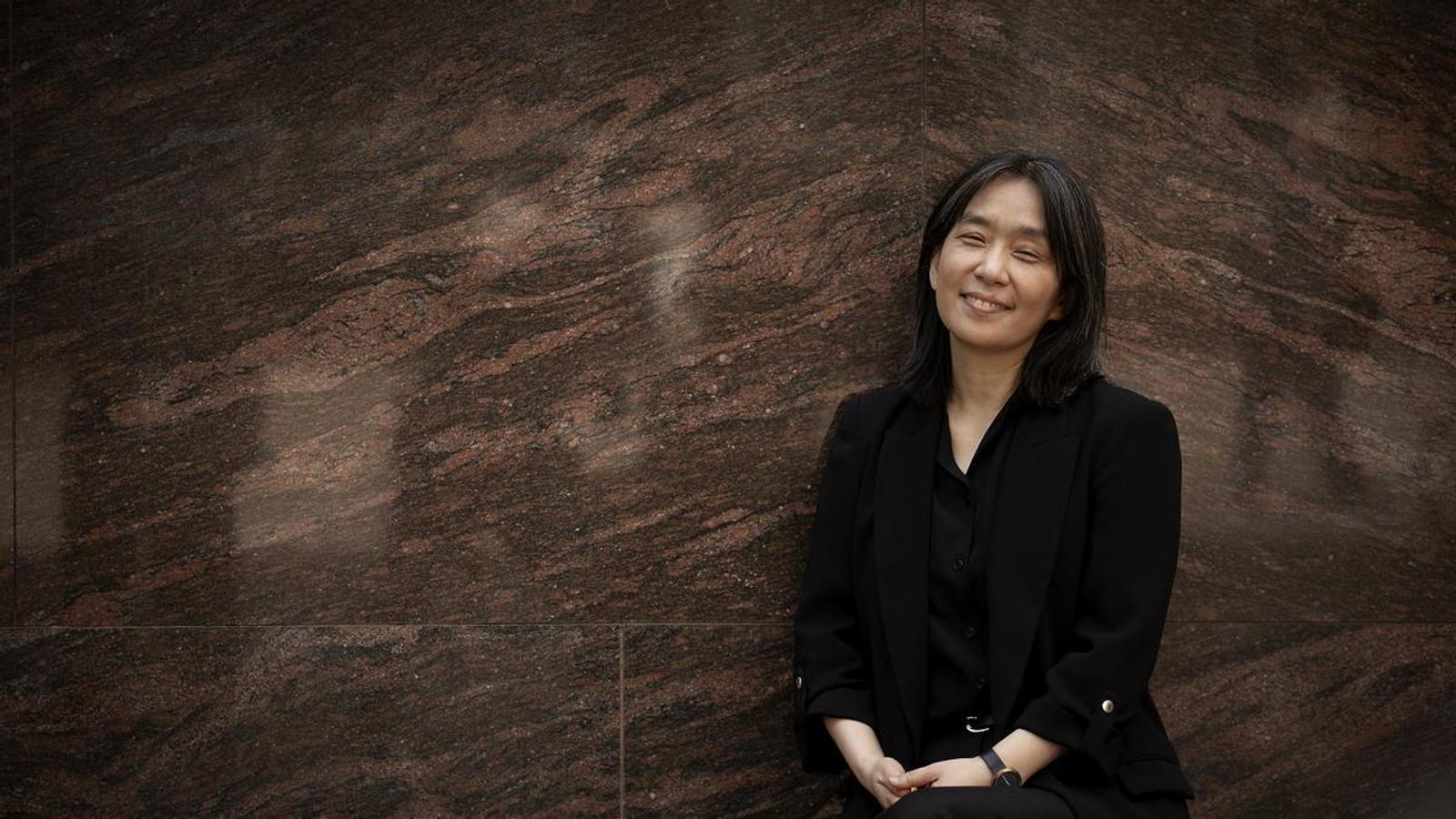
BarcelonaThe writer Han Kang (Gwangju, South Korea, 1970) has extremely high expectations for Sant Jordi. "I've been told that all these streets I've been walking through will be transformed. I'm really looking forward to seeing it," explains the author of books like The Vegetarian (2007; La Magrana, 2024) and Human Acts (2014; Rata, 2019) and Nobel Prize in Literature 2024. Shy and humble, Kang is surprised every time she encounters the crowds of readers who await her as if she were a rock star. On Tuesday, she gathered many people at the Centre de Cultura Contemporània de Barcelona (CCCB) and, after attending to more than a hundred, had to stop signing books due to a wrist injury. This Sant Jordi, the writer will be at the La Central del Raval bookstore and has already limited signatures to only 100 copies.
Kang is in Barcelona to present Ink and Blood (La Magrana / Random House), a novel published in Korean in 2010 and now arriving in Catalan with a translation by Hèctor Bofill and Hye Young Yu. With the poetic breath that makes her literature shine, Ink and Blood imbues the story of Lee Jeonghui with mystery, a playwright who wants to prove that her best friend, a successful painter, has not committed suicide. Through the protagonist's investigation, the writer delves into the psychological recesses of a group of characters struggling against suffering and in favor of survival.
Ink and Blood appeared shortly after one of her most recognized titles, The Vegetarian. How does one novel connect to the other?
— Rather than having a single reason to write, I usually work with a sum of reasons. In the final scene of The Vegetarian, Young-hye is very close to her death. Her older sister looks out the window, waiting for an answer, and sees the trees passing by. I wanted that scene to remain forever, for the characters to be able to breathe and live in that moment, but at the same time I knew that Young-hye was approaching death. In that novel, she was trying to save herself, rejecting human violence and, in one way or another, also the human being. But all that salvation led her to her own end. That's why I wanted the next novel to be about insistence, about intention, and about people's stubbornness in wanting to survive.
Lee Jeonghui's research is structured around a series of thoughts and reflections on astrophysics and art. Why do you link these seemingly disparate disciplines?
— At that time I read a lot about astrophysics, and I realized that it had many similarities with literature. Writers deal with the natural aspects of human beings, about what this world is and what it means to live. Astrophysics also talks about that. How did the universe begin? What are its characteristics? One day, on the street, I came across a poster and the image of a black universe with the explosion of a star. It sparked a lot of curiosity in me. I went to the gallery and was observing all those paintings. Afterward, I wrote to the painter by email to ask if I could meet him. We met and, little by little, we built a friendship. That experience helped me to imagine the novel.
The novel is a great defense of life, but through the moments when we are closest to death.
— Before writing Ink and Blood I met a doctor who told me about critically ill patients who travel by ambulance. He told me that, in some cases, they arrive at the hospital more seriously ill because during the journey they have been connected to a respirator, but they also start breathing. Then a clash occurs between artificial respiration and natural respiration. That collision allowed me to think about the clash between life and death, which in the novel I represent through the characters and also through different typographies, with fragments in regular font and others in italics.
Another of the great contrasts in history is the love and at the same time the suffering experienced by many of its characters. “When someone says they love me, the first thing I feel is fear”, says Inju.
— Since it is a mystery novel, there is a strong collision between truth and lies, and also of the characters with even physical violence. At the same time, however, it is a book that contains a lot of love. In fact, when it was to be re-published in Spain, I reread it after 10 years and was surprised by all the love with which I had written it. It is a novel in which love and suffering collide head-on. I realized that I had written many scenes where someone cooked for someone else, that someone bought food for someone else, where the characters ate together and took care of each other in this way.
This habitual appearance of food in history is a consequence of The Vegetarian, where the act of not eating was a way of destroying oneself?
— In The Vegetarian, the protagonist makes an ethical and moral choice. She refuses to belong to the human species, she refuses to eat because she wants to become a plant. Here I wanted to differentiate myself from that story. In this book, the act of cooking and eating together is a way to show love for others. Through these scenes, I wanted to convey the message that you have to survive. Towards the end, the protagonist really strives to live. I started the novel by asking myself: in the face of so much pain and suffering, is it worth living? The answer is yes. When I was writing, I squeezed the pencil tightly to convey the feeling that one must survive.
Suicide appears in the novel, sometimes as an unknown and other times as a way for characters to escape pain. Why do you turn it into literary material?
— I haven't asked them directly, but I suppose many readers of this novel have gone through difficult times. I just hope that, as they read it, they experience the emotional and psychological journey of the story towards survival. We read when we are happy, but also when we are down. Literature allows us to reflect on what happened to us, what is happening to us, or what, perhaps, will happen to us. For all those moments of suffering and affliction, literature offers us solace. I know it may sound like a cliché, but at the same time, I know that sometimes, this solace is what we need. The novel is so full of love because it wants to spread the desire to move forward. I hope, with all my heart, that readers find this solace.
Why did you opt for a thriller structure?
— The starting point of the novel is Lee Jeonghui's will to prove that her best friend did not commit suicide. To write about it, she needed the mystery genre. But at the same time, perhaps readers will be surprised, because the novel does not follow the codes of traditional detective books. In many parts, I wanted to fill the story with a poetic aspect, and this perhaps makes it a different or stranger novel within the genre.
The entire story takes place during a freezing winter, which the reader can practically feel on their own skin through the narrative voice. How does this atmospheric cold condition the story?
— Winter speaks of the most fundamental and natural state of human beings. Our body has a quite high temperature, which contrasts with that of winter. In this season we can feel more vividly when we shake hands, when we hug each other. In the book, winter invites characters to be more in contact, to maintain this temperature and, at the same time, they must experience the cold alone. They must fight for love.
Throughout the story, the protagonist wonders about what her friend hid from her and links it to the enigma of the dark side of the Moon. Just a few weeks ago a spacecraft photographed this part of the satellite. Are you sad that this mystery is being revealed?
— When I was little, I took a picture of the waning moon. It was one of the images I liked the most, it aroused many expectations in me. Perhaps an astrophysicist won't like what I'm about to say, but is it really the most appropriate time to research the moon? We should worry more about making our planet live than about the Moon. Faced with the great mystery of the universe, we should feel small and strive to think about how to make the Earth sustainable for longer. It is a great event and a scientific advancement, but the news doesn't impress me that much. These types of discoveries may perhaps spark more interest in people towards the universe, but it also makes me think that the world powers just want to show their strength and their ability to expand. I have contradictions about this matter.
In the last interview we did with you at ARA you had not yet won the Nobel Prize for Literature. How has your life changed by achieving this recognition?
— Internally, the Nobel Prize has not changed anything for me. I continue with the same concerns about what the next book will be like, how I can write it, how I can finish it soon. But in Korea, above all, when I go down the street people recognize me and greet me with joy. Sometimes they want to hug me, it feels strange to me. I often feel confused, they are strangers to me. That's why I now walk down the street with a mask.
