What will we do with his collection when grandfather is no longer here?
The Granollers Natural Sciences Museum has been growing without ceasing to be didactic.

"In the sixties, when I was a child, I lived in a house located in the lower part of Mataró, very close to the sea. I really liked going to the beach after storms. There was everything: logs, small rounded pieces of colored glass... and shells and small snails. I used to collect shells and snails," explains Alfons Palau. "When I spent a few days in Galicia, I took the opportunity to go to the beaches and collect sand brought by the waves, which contained many small snails. Since it took time to find them, I decided to take that sand from the Atlantic home, to the Mediterranean, and thus observe it calmly and sort out snails and shells. I could spend months observing a bag of sand. I did it with a binocular magnifying glass, and the result was very effective." The collection is composed of approximately 93,000 items. They are saltwater snails and shells, freshwater (from rivers, lakes, and ponds), land snails, and fossil snails and shells. "When we had covid-19, I took advantage of the confinement to review and inventory the entire collection," she recalls.Alfons decided to donate the collection to a museum, as no one in the family intended to continue it. He didn't want it to be lost. "I looked for natural science museums nearby and found the one in Granollers. They came to see the collection and confirmed that they would keep it. They took it away recently." It is now at the Granollers Museum of Natural Sciences, well documented: for each piece, its name, the family it belongs to, the place where it was found, and the date are written.

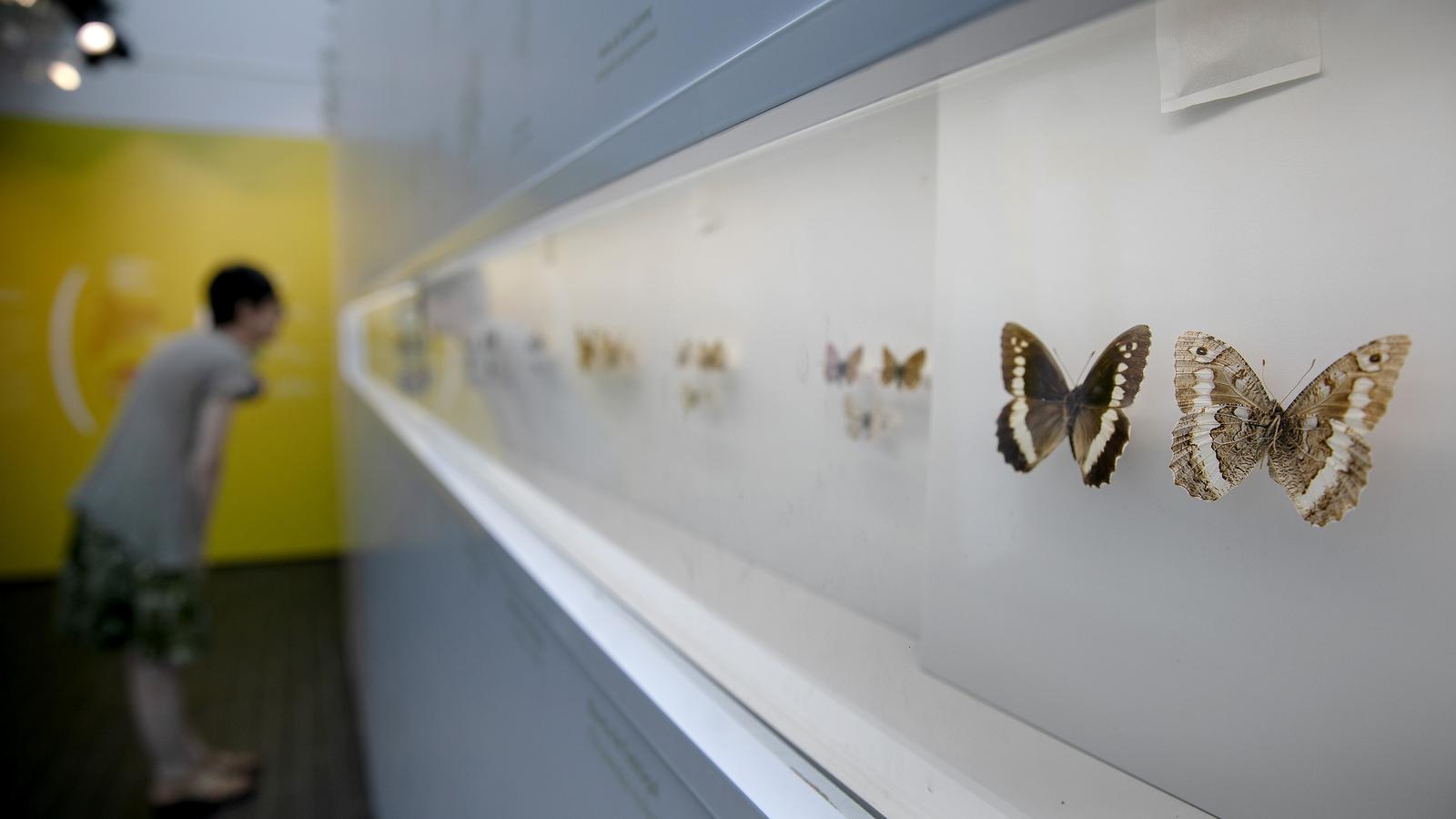
"We are increasingly selective when accepting collections, not only because many are not well documented, but also due to a lack of resources and space," explains Belén Fernández-Villacañas, a biologist and museologist. She is responsible for the documentation and management of this museum's collections.""The museum was promoted in the eighties by Antoni Jonch from Granollers, who had previously been director of the Barcelona Zoo. During his tenure at the Zoo, cages with bars and concrete floors were replaced by spaces similar to the natural ecosystem where the animals live. In addition, the Great African Fauna was created, a space with elephants, giraffes, rhinoceroses... and the dolphinarium. Jonch was also key in the creation of the Ikunde biological station in Guinea, where Snowflake was found, which for years was one of the main attractions of the Barcelona Zoo," explains Belén Fernández-Villacañas. We are in a warehouse full of compacts. This is where the collection reserves are kept. Belén takes care that they are at the right temperature and humidity and that the anti-moth tablets in the arthropod boxes are changed. Without these tablets, the moths would eat everything. "Look: almost all European butterflies and beetles are small, and the tropical ones are large," says Belén.
Next, we enter a room crowded with jars, where there are snakes, amphibians, and marine invertebrates preserved in 96-degree alcohol. Previously with formalin, but it is carcinogenic and has been discontinued.Walking through the different spaces of the museum, we pass by two capitosaurus. They are life-size replicas, made of synthetic resin, of these amphibians that lived during the Triassic in the Calma plain, in Montseny.Research in natural sciences and the way of explaining them has changed a lot in recent decades. Many things about this museum have also changed. "I have moved the entire library and documentation center five times," says Belén. Initially, the museum was entirely housed in a modernist tower, built in 1912. It was the home of the owners of the textile factory located where the new museum building is now. The factory had been dedicated to making parachute fabrics for the army. In the early days of the museum, in the old garden there were cages with wild boars, foxes, genets... The cages disappeared, of course. These were different times.We are finishing the visit. "When the entire building housed the museum (offices, laboratory, permanent exhibition, temporary exhibition and conference room) the collections did not fit", comments Belén as we enter a room with a splendid collection of fossils. This collection is presented as its creator, Joan Maria Viader, had it in his home.I notice a poster of very well-made drawings of mammals: brown bear, tapir, rhinoceros and pangolin. It's from the era before the internet, and perhaps from the beginnings of television, when there were hardly any images of animals from other territories.There is a local animal that Belén, head of the Montseny Documentation Centre, pays special attention to. It is the Montseny newt. Although it was initially observed by chance in the Montseny massif in 1979, for decades it was mistakenly classified as an isolated population of the Pyrenean newt. The Montseny newt has atrophied lungs; it does not breathe oxygen from the air with its lungs, but rather oxygen from the water through its skin and mouth. It is critically endangered. The natural sciences area that became independent from the Granollers MuseumThe scientific area of the Granollers Museum took flight. This is the origin of the Granollers Museum of Natural Sciences, which has paleontology, geology, botany, meteorology, and especially zoology as its thematic areas. It is a very didactic center, which organizes numerous workshops.

