Alvar Aalto, the victory of the human factor
-
CAT -
CAST
HelsinkiWe have landed in Finland. During these days, we have visited with the family some of the works of Alvar Aalto (Kuortane, 1898 - Helsinki, 1976) which have just been declared World Heritage by Unesco. Thirteen buildings and complexes designed by Alvar, Aino and Elissa Aalto that explain a large part of the evolution of modern Finnish architecture. But after seeing them, entering them, and inhabiting them for a few hours, the feeling that remains has little to do with monumentality. Aalto's great victory is the victory of the human factor.
In front of his work, what impresses is not the grandiloquent gesture. It is a railing, a vase, a chair, a window, the light that enters a room, the touch of a material. Aalto understood that modern architecture could not be just a perfect machine. It had to be, above all, a place to live.
Perhaps that is why his architectures seem to have movement. His lines dance like the trees in the forests of Finland. They adapt, turn, open up. Faced with the wind, they do not seem to want to resist it, but rather to soften its waves like reeds on the edge of the Baltic.
Building is not necessarily imposing oneself. Sometimes it is knowing how to listen. Listening to nature. The rustling of leaves, the gentle waves of the sea and lakes, the jackdaws that fill the fields, the silence of the forests. In Finland, one better understands to what extent Aalto was not drawing against all this, but from all this. Nature is not the backdrop of his architecture, it is part of it. And it is here where the Finnish landscape intertwines with another of his great references, Japanese architecture, in this subtle way of blurring the boundaries between interior and exterior and allowing the landscape to enter the inhabited space.
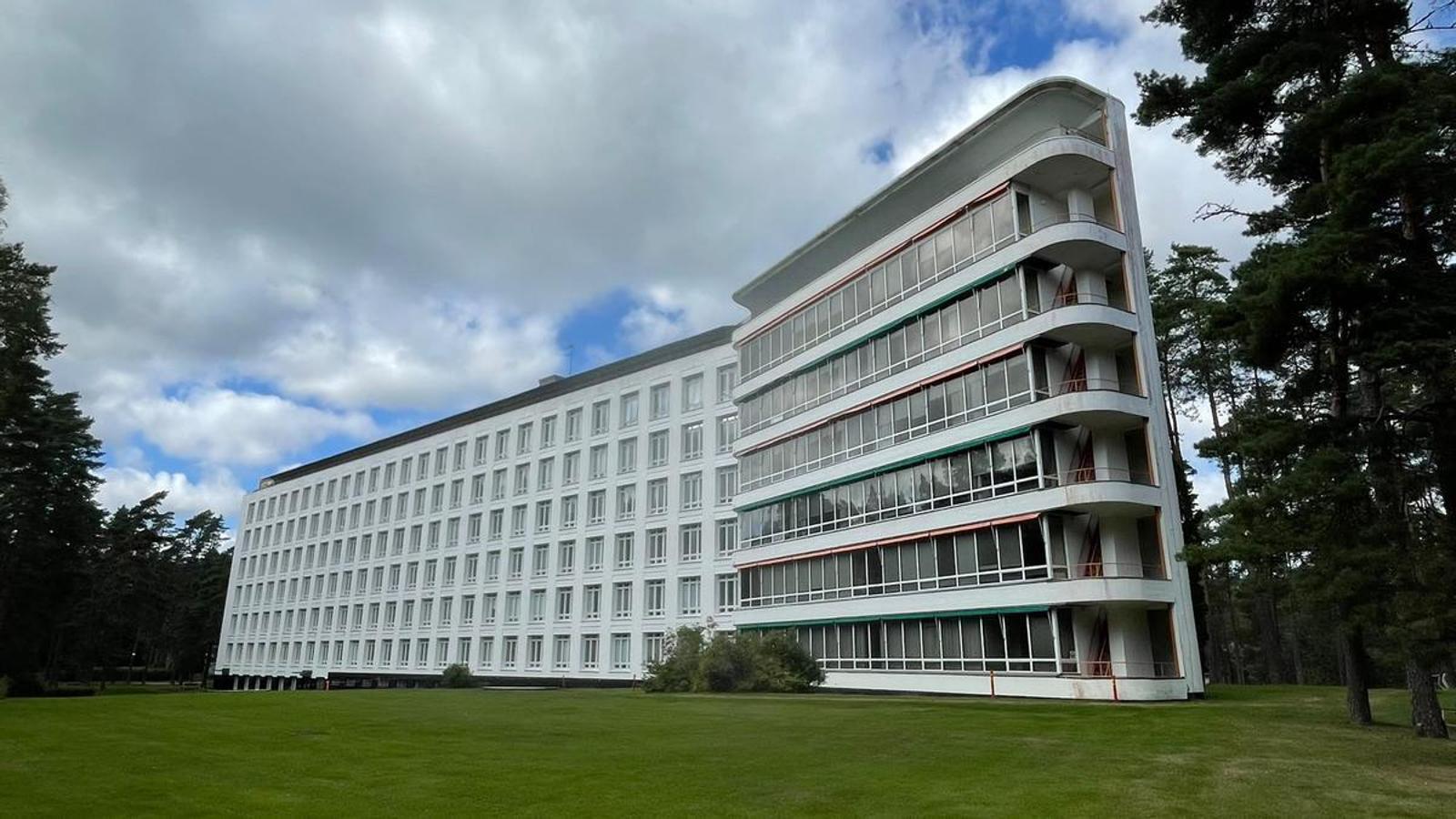
In the Paimio sanatorium, this gaze is directed towards the person. Aalto tries to design from the patient's bed. The light, the colors, the orientation, the furniture, and even the sinks respond to their needs. Architecture stops asking itself how it wants to be seen and begins to ask itself how it will be lived.

But, curiously, the works that have impressed me the most have been two of the most personal, humble, and lived-in: Aalto's house in Helsinki and the experimental house in Muuratsalo. And it seems extraordinary to me that both are today World Heritage Sites.
In Helsinki, you enter knowing the importance of the building, but after a few minutes you imagine life there: the table, the books, an armchair, the garden. The house remains a house. Muuratsalo is a summer house and a laboratory at the same time. The bricks, the patio, the fire, the forest, the lake. Aalto tries, experiments, makes mistakes. It is experimental without ceasing to be domestic, exceptional without wanting to be monumental. That such intimate and lived-in architectures are World Heritage Sites forces us to review what we understand by heritage. The victory of the human factor is also the victory of the everyday.
And there is another Finnish lesson. These architectures are taught as they are. The house, as a house. The university, as a university, full of students. Life has not been expelled in order to teach heritage.

An inventory of life
Great 3D reconstructions or virtual recreations are not always necessary. Technology is extraordinary when it allows us to understand what we can no longer see, but it should not replace the experience of the place. When the architecture is still there, the primary heritage is the architecture itself.
People must be brought closer. Help them to look, to understand, to live in that space for a while. Perhaps interpreting heritage consists, first and foremost, in creating the conditions for the place to explain itself.
The thirteen recognized works are almost an inventory of life: houses, homes, a sanatorium, a university, a town hall, a church, cultural facilities. And they also explain the construction of the Finnish welfare state: the conviction that the places where people's lives unfold deserve good architecture.
During the trip, I was able to speak with Tommi Lindh, director of the Alvar Aalto Foundation. He explained to me that they had been fighting for almost twenty years to achieve this recognition. Aalto has also had to wait. And this says a lot about the difficulty we still have in recognizing contemporary heritage. Too often we continue to confuse heritage and antiquity, when heritage does not begin when an architecture gets old, but when a society is capable of recognizing what it cannot afford to lose.
And I inevitably think of Barcelona. Of its extraordinary 20th-century architecture. Some is protected. Other continues to wait.
The Finnish lesson is not to wait. Not to wait until it is threatened to discover its value. Not to wait until it is lost to claim it. And to understand that protecting also does not mean freezing: that a house continues to be a house, a university continues to be full of students, and that people can continue to live architecture.
Aalto has had to wait. We should not. We hope that these gentle waves that cradle the Baltic, and which Aalto knew how to turn into architecture, will soon reach our shores as well.

