The financier who created an empire of steel, trains and cookies
William Henry Moore, who also bred horses, was so successful in business that he closed his law office
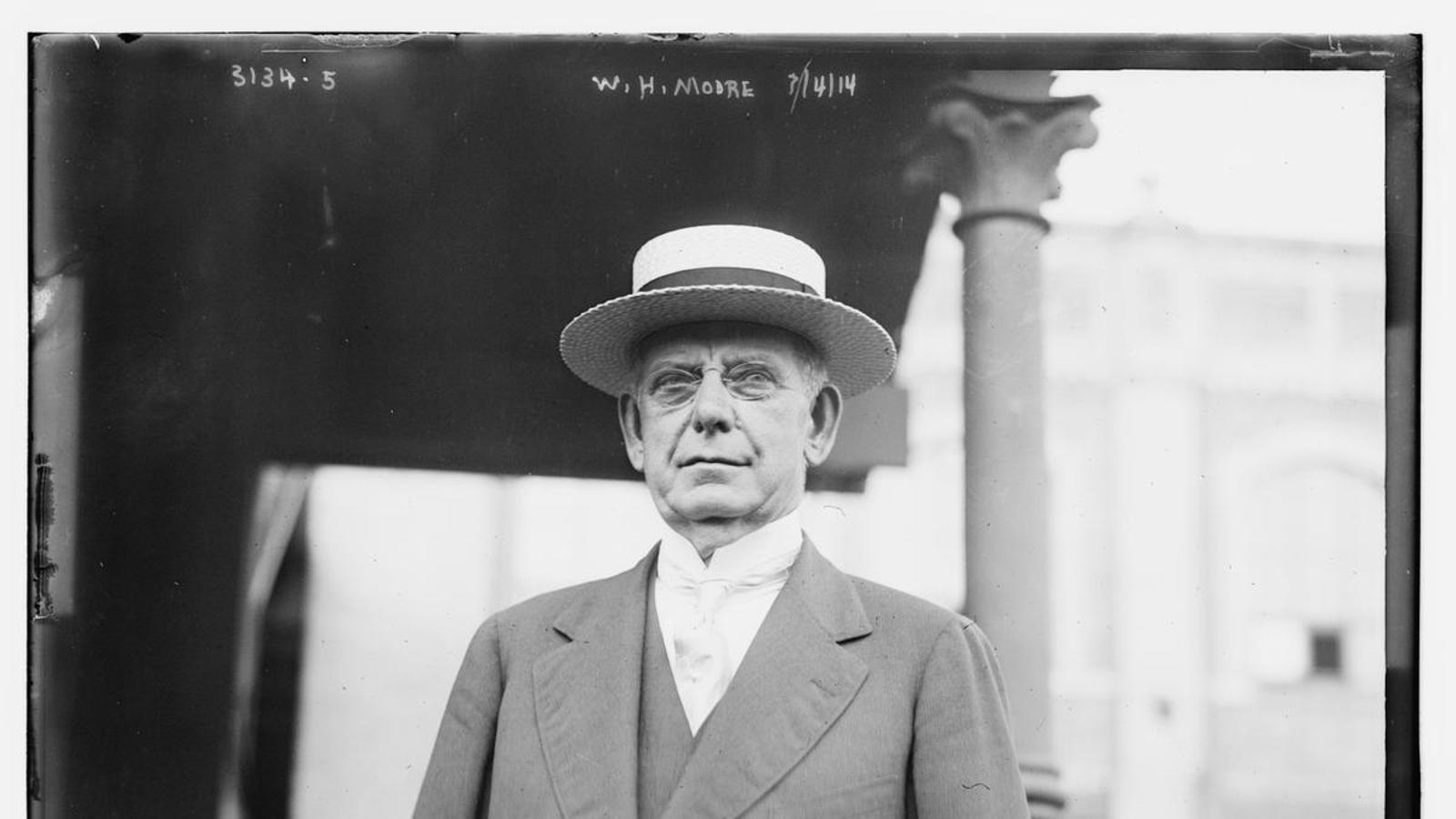
In January 2024, we explained the life and miracles of Andrew Carnegie, the steel magnate who built a great fortune when he integrated his company, Carnegie Steel Company, into a large consortium devised by John Pierpont Morgan called US Steel. Behind the formation of this great company, in 1901, was the Connecticut banker, but also a less known financial artist than Morgan named William Henry Moore.
- 1848-1923
The lawyer and financier Moore was born into a well-known New England family, whose ancestors could be traced back to the times of colonization. As befitted someone of his social class, he received a very high-quality education and during some summers he combined it with surveying work for a railway company. He graduated in law, and then practiced as a lawyer on the west coast. Later he went to Chicago, where he began working in the law firm of Edward Alonzo Small, also from an important local family. After Small's death, Moore married his daughter. The wife was a member of the ninth generation of a Maine family and a descendant of Isaac Allerton, one of the passengers on the Mayflower. Under Moore's direction, the firm became one of the city's leading ones.Together with his brother, James Hobart Moore, he applied his knowledge of commercial law and financial engineering to carry out very lucrative corporate operations. Thus he created National Steel, which was the result of the union of several companies in the steel sector. He also grew the Diamond Match Company, a match firm that doubled its size in a short time. The voracity for grouping companies continued into the food sector, as he acquired several local manufacturers of savory crackers to then merge them and create, in 1898, the National Biscuit Company, a firm that more or less everyone will know, as it is the current Nabisco.The great operation arrived in 1901, with the merger of four large steel factories to form US Steel. It is the operation with which we began this writing and which made Carnegie very rich, but also Moore, who contributed his National Steel. The resulting company became the largest in the world, but not only that, but it was also responsible for producing two-thirds of the steel in the United States. With such dominance, it is not surprising that the company had frequent problems with the authorities due to the antitrust legislation in force at that time.The same year that the world steel giant was founded, Moore and his partners took control of the Chicago-Rock Island-Pacific railway company, whose value they multiplied eightfold in just over five years thanks to the acquisition of several companies in the area. This new sector, that of trains, proved interesting enough for him to close his law firm and dedicate himself to it exclusively in the following years. The number of railway lines he directed to both the west coast and Chicago approached ten, positions he held concurrently with the direction of US Steel. He was also part of the governing bodies of the Continental Fire Insurance Company, the Western Union Telegraph Company, and the American Cotton Oil Company. He held so many positions that he clashed with United States legislation, which is why he had to step down from the management of some businesses. Where he did remain was at the National Biscuit Company and the First National Bank of New York.Outside of business, his racehorses were also famous. He was internationally known as a breeder of purebred horses, and he himself participated in horse-drawn sulky races, where he usually won.The one that was also an almost endless list was that of societies and clubs to which he belonged: the New York Chamber of Commerce, the Bankers Club of America, the National Golf Links Club of America and the Racquet and Tennis Club, among many others. He was also a member of the Sleepy Hollow Country Club, in the town that became world-famous thanks to a short story by Washington Irving.In the fall of 1922, he suffered some heart problems, but the doctors assured him that he would recover. This was not the case, and a few days after the start of the following year, he died suddenly at his Manhattan home.
