A laboratory that works like a bakery: Juanola lozenges celebrate 120 years
The renowned brand, based in Sant Quirze del Vallès, claims its origins while reinventing itself to face the future

-
CAT -
CAST
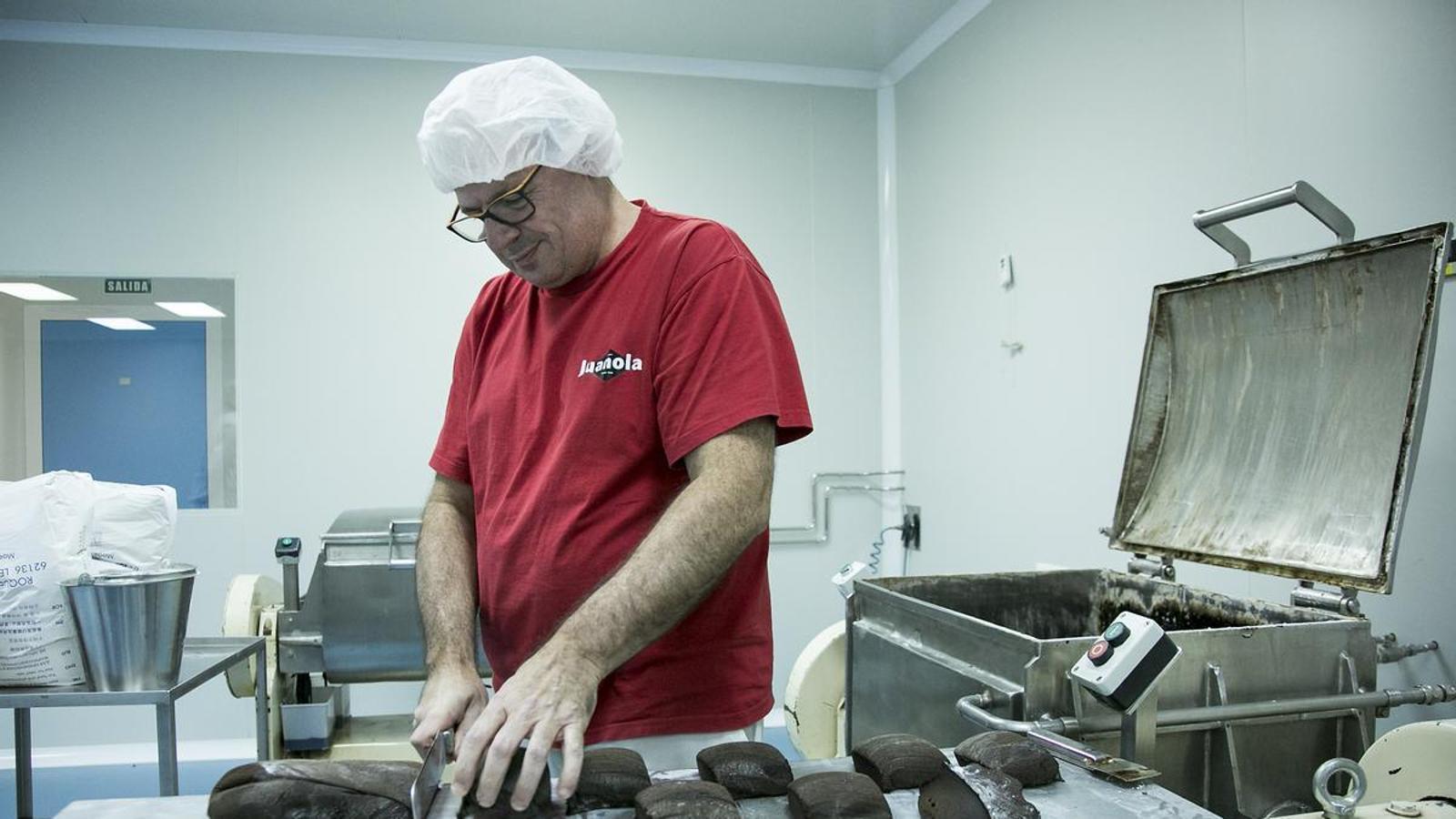
BarcelonaSurrounded by a strong smell of liquorice and equipped with gloves and hairnets, operators knead blocks of a tar-black color with an elasticity similar to bread dough. They place them on various trays to let them dry while, in another room, the pastes that have already completed their resting process are rolled and cut into small portions to then be packaged. The image, straddling the scenes of a bakery and those of a pharmaceutical laboratory, is the day-to-day life inside the Juanola lozenge factory, located in Sant Quirze del Vallès (Vallès Occidental). The legendary cough drop brand is celebrating 120 years and is doing so by preserving the essence of its product, while at the same time opening up to new business lines to reinvent itself for the future.
"In the end, it's as if we were working with cakes and breads," indicates the head of the Juanola plant, Isidoro Martínez, during an institutional visit to commemorate the milestone. From inside the facilities, this executive who has been linked to the company for thirty years explains how the manufacturing process does not vary much from its origins, which date back to a small pharmacy on Carrer del Montseny in Barcelona, in the heart of the Gràcia neighborhood. Back then, the product, which was obtained from the liquorice root, was also handled by hand, with the only difference being that the cutting was completed with more rudimentary machines. "That is why there are no two lozenges alike," asserts Martínez. He, along with six other workers –the same number as ten years ago–, are the main ones responsible for producing the more than three million boxes of Juanola that are sold every year throughout Spain.
The origin of the lozenges dates back to 1906, when the pharmacist Manuel Juanola i Reixach wanted to experiment with a product with an unmistakable taste to combat coughs and clear the throat. Success was immediate, with more than 100,000 six-gram boxes sold in 1907, and up to 236,000 by 1913, shortly after Juanola consolidated itself within the pharmacy channel after being recognized as a pharmaceutical specialty. The popularity of the product went growing until, during the 1930s, it expanded to the rest of the country and gradually expanded its product portfolio.
In its recent history, the company points to two dates as key moments that ended up catapulting the brand's success. On one hand, the acquisition in 1996 of Juanola by the Italian laboratories Angelini. The transalpine group decided to maintain its roots in the Catalan territory, but it allowed for the opening of new business possibilities, expanding sales to establishments such as gas stations or shops. The second turning point arrived in 2005, when the production of Juanola moved from the historic headquarters in Barcelona to the current facilities in Sant Quirze del Vallès, thus adapting production to new industrial processes. Over the last few years, Angelini has invested more than 500,000 euros in machinery at the plant.
New business lines
Juanola's star product continues to be its signature lozenges, capable of achieving something that other pharmaceutical products have not been able to. "It is a brand that, over time, has also become part of popular culture as a consumer product," comments Martínez. The result of this success is an annual turnover of about 15 million euros, a figure that has remained stable over the last few years, as stated by the company.

However, taste preferences change, especially among younger audiences. That is why the brand, with the support of its parent company, has launched alternatives on the market to diversify its portfolio, currently made up of about forty references. Propolis has emerged as the other emblem of the house, a product that moves away from the characteristic taste of licorice and opts for soft lozenges with flavors such as honey and lemon to soothe throat discomfort.
Angelini has also placed its trust in the Catalan brand, which has begun to incorporate new lines at the Vallesana plant to manufacture other products for its parent company, with a much wider range of solutions within the health sector. Among them are Soñodina, a range of food supplements to contribute to sleep onset; Termacare, patches that provide relief from muscle and joint pain, or Leotron multivitamin supplements.
What is clear is that licorice lozenges will continue to be one of the pillars of Juanola and that its facilities will be linked to Catalonia for a long time to come. This commitment was expressed by the General Director of Angelini in Spain, Daniel Gheorghe, at the same anniversary commemoration event. "It has been 120 years of travel, history, and tradition, and Juanola is more than a product; it is part of our lives. [...] We want to continue innovating while maintaining what has defined us, which is trust and origin," the executive summarized.
