"I am an architect without a degree and an illustrator without training, but I do both"
Anouk Hoffmann-Morin studied Architecture and Philosophy degrees in Montreal, where she grew up

-
CAT -
CAST
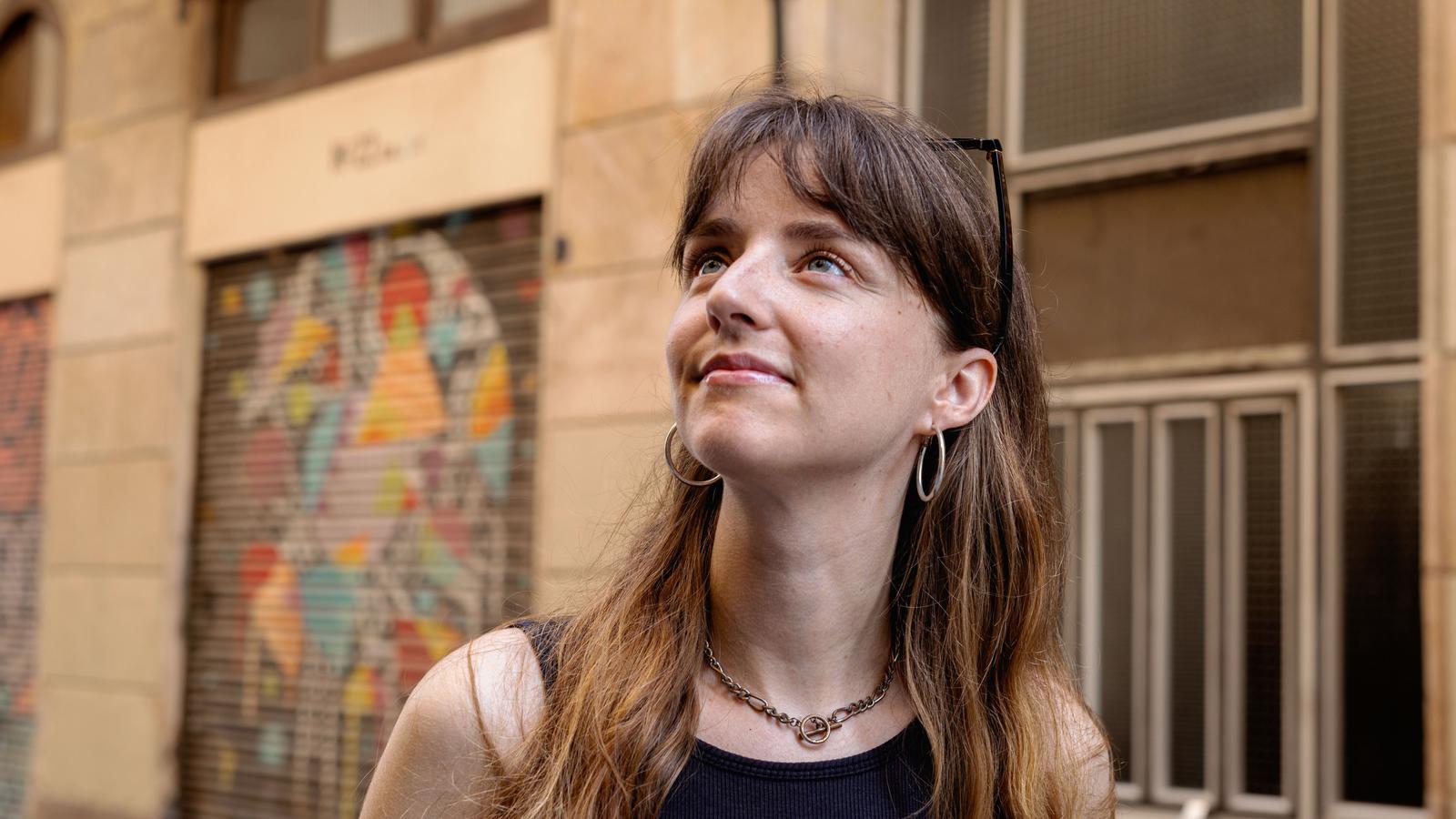
Anouk Hoffmann-Morin (Berlin, 1996) describes herself like this, laughing. “I’m an architect without a degree and an illustrator without training, but I do both things,” she explains. Hoffmann-Morin has completed a degree in Architecture at the University of Montreal and Philosophy at the University of Quebec. And, even though she doesn’t have the qualifying architect’s degree or formal training in the art world, this hasn’t stopped her from creating a comic book about architecture.
Originally from Berlin, Hoffmann-Morin moved to Montreal at the age of four. Recently, however, she has landed in Catalonia after an investigation that has taken her to Berlin, Leipzig, Amsterdam, Zaragoza, Cal Rosal (Berguedà), and Barcelona, where she has documented heritage buildings transformed into self-managed initiatives through drawing.
In Catalonia, for example, Hoffmann-Morin has portrayed the interior of the old 19th-century convent of nuns converted into an artistic center, El Konvent de Cal Rosal (Berguedà); the complex of self-built houses in Les Casetes in El Carmel, Barcelona, which are today occupied by residents and activists of the Platform of Affected Housing of the Three Hills; the old Civil Guard barracks located near Park Güell and currently a symbol of the squatter movement, La Kasa de la Muntanya; and the buildings of Ca L'Espina and L'Antiga Massana, also in Barcelona. After fieldwork that began in the summer of 2024, he has filled 6 sketchbooks with drawings and notes from these projects, as well as hundreds of pages with interviews from those who have brought them to life. The idea behind it all is simple: to understand how they have used creativity and imagination to transform them.
Although initially the research was to be translated into a paper academic, Hoffmann-Morin has opted for a more accessible format: the comic strip. The first sketch of The palaces are ours! (The palaces are ours!, in Catalan) follows the journey of a character who discovers eight such projects across Europe to find new ways of living and understanding space beyond traditional frameworks. "I was interested in getting to know places where there is a lot of freedom of construction and where there can be a certain spontaneity in intervening collectively," explains Hoffmann-Morin. "In contexts like rental housing – where most of us end up – doing this is more difficult than in a space that has been reappropriated and where its future is decided collectively," she insists.
Hoffmann-Morin's research is part of a Canadian government scholarship she obtained at the end of her architecture studies, which aims to address the problems in her country with the use and restoration of heritage buildings. "Unlike Catalonia, in North America there has been a terrible destruction of built heritage and its memory: most have either been demolished or ended up in museums, without any historical continuity," she exemplifies. "The idea of the scholarship was to investigate other ways of inhabiting these spaces to understand how heritage is managed, and to transfer this knowledge to the Canadian context to find new ways of reusing them without losing their soul," she points out.
Beyond conducting research for an academic entity, Hoffmann-Morin also aspires to reach new audiences that allow her to bring closer a reality often undervalued or marginalized. "Besides being more accessible, it perhaps also offers a change of perspective: are there really other ways of living beyond what we have been taught?" she concludes.
